Which of the following is/are example(s) of animal-microbe mutualism?
Show Hint
- Human - {Mycobacterium tuberculosis}
- Dog - Rabies lyssavirus
- Human - {Lactobacillus plantarum}
- Cow - {Ruminococcus albus}

The Correct Option is C, D
Solution and Explanation
Let's review each example of animal-microbe mutualism:
- Option (A): Mycobacterium tuberculosis causes tuberculosis, a disease harmful to humans, not a mutualistic relationship. Therefore, Option (A) is incorrect.
- Option (B): Rabies lyssavirus is a pathogenic virus that causes disease in dogs, not a mutualistic relationship. Therefore, Option (B) is incorrect.
- Option (C): Lactobacillus plantarum is a beneficial bacterium that resides in the human gut and aids in digestion. This is a mutualistic relationship, where both the human and the bacterium benefit. Therefore, Option (C) is correct.
- Option (D): Ruminococcus albus is a bacterium found in the cow’s digestive system, where it helps break down cellulose in the cow’s diet. This is another example of mutualism, benefiting both the cow and the bacterium. Therefore, Option (D) is correct.
Thus, the correct answer is (C), (D).
Top GATE XL Life Science Questions
- Which one of the following molecules captures \(CO_2\) in the \(CO_4\) cycle?
- Which one of the following methods separates biomolecules based on their hydrodynamic volumes?
- Which one of the following restriction endonucleases is a blunt cutter?
- Which one of the following ion channels opens to repolarize the neuronal membrane when an action potential is generated?
- Which one of the following is the most sensitive immunoassay?
Top GATE XL Microbiology Questions
- India is aiming to be free of tuberculosis by 2025. One of the key approaches for this program is DOTS. Which one of the following options is the full form of DOTS?
- Robert Koch used a meat-infused nutrient medium for which one of the following purposes?
- A bacterium obtains energy from a chemical source by the oxidation of reduced \({NO}_2^{-}\), with \({CO}_2\) as the principal carbon source. Which one of the following nutritional groups does this bacterium belong to?
The origin of the Escherichia coli chromosome on the genetic map is shown below.
Bidirectional replication is a feature of this system and both replication forks move at the same rate. Which one of the following sequences of replication of the genes is correct?
Which of the following sites is/are the location(s) of ATP generation through oxidative phosphorylation in Escherichia coli?
Top GATE XL Questions
- The CORRECT order of electronegativity is
- Which one of the following is the CORRECT representation of the variation of the Gibbs free energy (G) of a substance with temperature (T) at constant pressure?
- Among the following, the structure representing histidine is
- The CORRECT order of acidity of the following compounds is
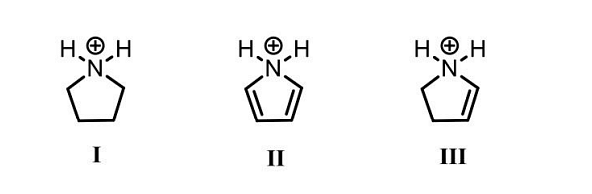
- The molecules A and B are a pair of___