Question:
What is NOT true about congenital PUJ (pelviureteric junction) obstruction?
What is NOT true about congenital PUJ (pelviureteric junction) obstruction?
Show Hint
Congenital PUJ obstruction is mostly intrinsic, not from vessel compression.
Updated On: Jul 8, 2026
- It is due to compression by an aberrant vessel rather than due to intrinsic causes
- Retrograde pyelography is useful to find the site of obstruction
- Whitaker's formula is useful for classification and treatment assessment
- Antenatal diagnosis is possible
Show Solution

Verified By Collegedunia
The Correct Option is A
Solution and Explanation
Step 1: Understanding the Question:
The question asks which statement about congenital pelviureteric junction (PUJ) obstruction is FALSE. PUJ obstruction blocks urine flow from the renal pelvis into the ureter, and it can come from a defect in the ureter wall itself (intrinsic) or from pressure by an outside structure (extrinsic), such as a lower pole crossing vessel.
Step 2: Key Formula or Approach:
In children, most cases of congenital PUJ obstruction come from an intrinsic problem, a segment of ureter with poor muscle development (an adynamic segment) that fails to carry urine forward normally. An aberrant crossing vessel compressing the PUJ is a real cause too, but it is seen less often than the intrinsic type, and it is more typical in older children and adults.
Step 3: Detailed Explanation:
Check each statement against this fact.
"Due to compression by an aberrant vessel rather than due to intrinsic causes": this reverses the real pattern. Intrinsic causes are more common in congenital PUJ obstruction, not vascular compression. This statement is false.
"Retrograde pyelography is useful to find the site of obstruction": true. Dye passed up the ureter outlines the pelvis and ureter from below and marks exactly where the narrowing starts.
"Whitaker's formula is useful for classification and treatment assessment": true. The Whitaker test measures pressure and flow across the PUJ and helps decide if the obstruction is bad enough to need surgery.
"Antenatal diagnosis is possible": true. PUJ obstruction is one of the most common causes of antenatal hydronephrosis picked up on routine fetal ultrasound.
Step 4: Final Answer:
Three of the four statements are correct facts about congenital PUJ obstruction. Only the claim that vascular compression outweighs intrinsic causes is wrong, since intrinsic narrowing is the more common cause in children. \[ \boxed{\text{Due to compression by an aberrant vessel rather than due to intrinsic causes}} \]
The question asks which statement about congenital pelviureteric junction (PUJ) obstruction is FALSE. PUJ obstruction blocks urine flow from the renal pelvis into the ureter, and it can come from a defect in the ureter wall itself (intrinsic) or from pressure by an outside structure (extrinsic), such as a lower pole crossing vessel.
Step 2: Key Formula or Approach:
In children, most cases of congenital PUJ obstruction come from an intrinsic problem, a segment of ureter with poor muscle development (an adynamic segment) that fails to carry urine forward normally. An aberrant crossing vessel compressing the PUJ is a real cause too, but it is seen less often than the intrinsic type, and it is more typical in older children and adults.
Step 3: Detailed Explanation:
Check each statement against this fact.
"Due to compression by an aberrant vessel rather than due to intrinsic causes": this reverses the real pattern. Intrinsic causes are more common in congenital PUJ obstruction, not vascular compression. This statement is false.
"Retrograde pyelography is useful to find the site of obstruction": true. Dye passed up the ureter outlines the pelvis and ureter from below and marks exactly where the narrowing starts.
"Whitaker's formula is useful for classification and treatment assessment": true. The Whitaker test measures pressure and flow across the PUJ and helps decide if the obstruction is bad enough to need surgery.
"Antenatal diagnosis is possible": true. PUJ obstruction is one of the most common causes of antenatal hydronephrosis picked up on routine fetal ultrasound.
Step 4: Final Answer:
Three of the four statements are correct facts about congenital PUJ obstruction. Only the claim that vascular compression outweighs intrinsic causes is wrong, since intrinsic narrowing is the more common cause in children. \[ \boxed{\text{Due to compression by an aberrant vessel rather than due to intrinsic causes}} \]
Was this answer helpful?
0
0
Top NEET PG Surgery Questions
- A 55-year-old male presented with verrucous carcinoma around the glans of the penis. Examination reveals that the inguinal lymph nodes are not enlarged. What is the appropriate management for this patient?
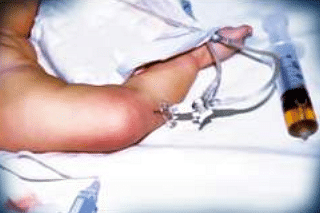
- Identify the procedure being performed in the image given below.
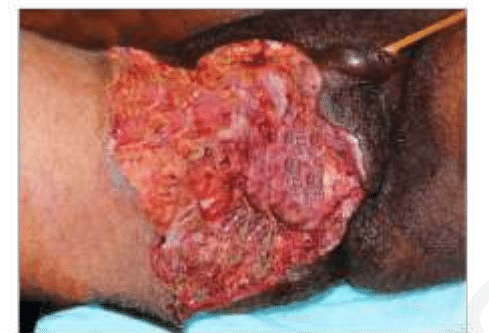
- A diabetic patient presents with sudden-onset perineal pain. On examination, foul-smelling discharge, and necrotic tissue as seen in the image is noted. Which of the following is true about the given condition?
- Which of the following is the most common complication following ligation of the first vessel during abdominoperineal resection for rectal carcinoma?(APR Abdominoperineal resection)
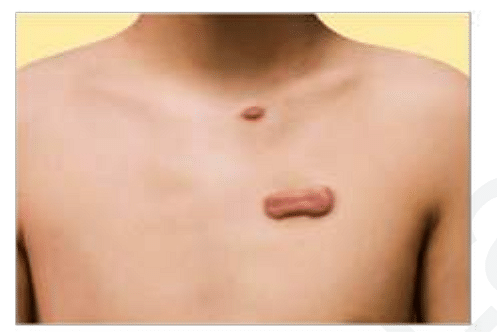
- A patient presents to the clinic with the lesion given in the image. He had a traumatic injury to the chest one year ago. What is the most likely diagnosis?
View More Questions
Top NEET PG Pelviureteric Junction (PUJ) Obstruction Questions
Top NEET PG Questions
- A patient hailing from Delhi presents with fever, arthralgia, and extensive petechial rash for 3 days. Lab investigations revealed a hemoglobin of 9 g/ dL, a white blood cell count of 9000 cells/mm3, a platelet count of 20000 cells/mm3, and a prolonged bleeding time. The clotting time was normal. What is the most likely diagnosis?
- Which of the following statements is true about Trichomonas vaginalis?
- A lady from West Rajasthan presented with an ulcer surrounded by erythema on the right leg. Microscopy of the biopsy from the edge of the ulcer showed organisms with dark staining nuclei and kinetoplast. What is the most likely causative agent?
- A child presents with a fever and a rash. Urine examination showed cells with owl's eye appearance. What is the most likely diagnosis?
- Infection with Clonorchis sinensis is associated with an increased risk of__?
View More Questions