Question:
Pelviureteric obstruction on the left side in a 33 year old male who presents with fever and infection. All the following are correct EXCEPT
Pelviureteric obstruction on the left side in a 33 year old male who presents with fever and infection. All the following are correct EXCEPT
Show Hint
Recall whether an intrinsic narrow segment or an outside vessel is the more common cause of PUJ obstruction.
Updated On: Jul 8, 2026
- Dismembered pyeloplasty is the treatment of choice
- Endoscopic pyeloplasty is contraindicated
- Most common cause is an aberrant vessel
- Tuberculosis can be a cause
Show Solution

Verified By Collegedunia
The Correct Option is C
Solution and Explanation
Step 1: Understand pelviureteric junction (PUJ) obstruction.
PUJ obstruction is a block at the point where the renal pelvis narrows into the ureter, so urine cannot drain freely from the kidney. It can be congenital, present from birth, or acquired later from stones, tumors, or infection.
Step 2: Analyze option (A), dismembered pyeloplasty.
The Anderson-Hynes dismembered pyeloplasty is the gold standard operation for PUJ obstruction. The narrow segment is cut out, the pelvis is trimmed, and a fresh wide anastomosis is made to the ureter. This statement is true.
Step 3: Analyze option (B), endoscopic pyeloplasty being contraindicated.
Endoscopic treatment (endopyelotomy) cuts the narrow segment from inside, without removing it or repositioning nearby vessels. It needs a clean, uninfected urinary tract to heal safely, since cutting through infected, inflamed tissue raises the risk of bleeding and urosepsis.
This patient has an obstructed kidney with active fever and infection, so the endoscopic approach is not safe as a first step here, and calling it contraindicated in this setting is a true statement.
Step 4: Analyze option (C), aberrant vessel as the most common cause.
The most common cause of PUJ obstruction is actually an intrinsic problem, an abnormal, poorly contractile (aperistaltic) segment of muscle at the PUJ that fails to push urine forward, present from birth in most congenital cases.
A crossing or aberrant lower pole vessel pressing on the PUJ from outside is a well recognized cause, and it matters because it changes how the pyeloplasty is done, but it is not the single most common cause overall.
So the claim that an aberrant vessel is the most common cause is false, and this is the statement that does not fit with the rest.
Step 5: Analyze option (D), tuberculosis as a cause.
Genitourinary tuberculosis can scar and narrow the ureter at the PUJ as it heals, causing a secondary, acquired PUJ obstruction. This statement is true.
Step 6: Final answer.
Note on the source key: the original answer key for this question was left blank or unclear in the source paper. Working through each statement on current medical grounds, the one that is NOT correct is that an aberrant vessel is the most common cause of PUJ obstruction, since an intrinsic aperistaltic segment is actually the more common cause.
\[ \boxed{\text{Most common cause is an aberrant vessel - INCORRECT statement}} \]
PUJ obstruction is a block at the point where the renal pelvis narrows into the ureter, so urine cannot drain freely from the kidney. It can be congenital, present from birth, or acquired later from stones, tumors, or infection.
Step 2: Analyze option (A), dismembered pyeloplasty.
The Anderson-Hynes dismembered pyeloplasty is the gold standard operation for PUJ obstruction. The narrow segment is cut out, the pelvis is trimmed, and a fresh wide anastomosis is made to the ureter. This statement is true.
Step 3: Analyze option (B), endoscopic pyeloplasty being contraindicated.
Endoscopic treatment (endopyelotomy) cuts the narrow segment from inside, without removing it or repositioning nearby vessels. It needs a clean, uninfected urinary tract to heal safely, since cutting through infected, inflamed tissue raises the risk of bleeding and urosepsis.
This patient has an obstructed kidney with active fever and infection, so the endoscopic approach is not safe as a first step here, and calling it contraindicated in this setting is a true statement.
Step 4: Analyze option (C), aberrant vessel as the most common cause.
The most common cause of PUJ obstruction is actually an intrinsic problem, an abnormal, poorly contractile (aperistaltic) segment of muscle at the PUJ that fails to push urine forward, present from birth in most congenital cases.
A crossing or aberrant lower pole vessel pressing on the PUJ from outside is a well recognized cause, and it matters because it changes how the pyeloplasty is done, but it is not the single most common cause overall.
So the claim that an aberrant vessel is the most common cause is false, and this is the statement that does not fit with the rest.
Step 5: Analyze option (D), tuberculosis as a cause.
Genitourinary tuberculosis can scar and narrow the ureter at the PUJ as it heals, causing a secondary, acquired PUJ obstruction. This statement is true.
Step 6: Final answer.
Note on the source key: the original answer key for this question was left blank or unclear in the source paper. Working through each statement on current medical grounds, the one that is NOT correct is that an aberrant vessel is the most common cause of PUJ obstruction, since an intrinsic aperistaltic segment is actually the more common cause.
\[ \boxed{\text{Most common cause is an aberrant vessel - INCORRECT statement}} \]
Was this answer helpful?
0
0
Top NEET PG Surgery Questions
- A 55-year-old male presented with verrucous carcinoma around the glans of the penis. Examination reveals that the inguinal lymph nodes are not enlarged. What is the appropriate management for this patient?
- Identify the procedure being performed in the image given below.
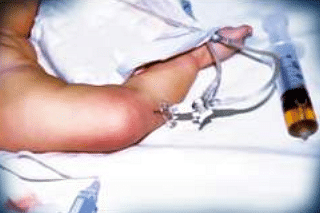
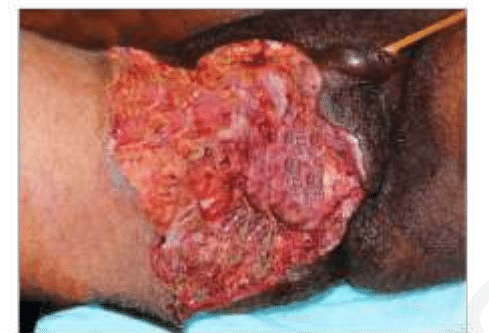
- A diabetic patient presents with sudden-onset perineal pain. On examination, foul-smelling discharge, and necrotic tissue as seen in the image is noted. Which of the following is true about the given condition?
- Which of the following is the most common complication following ligation of the first vessel during abdominoperineal resection for rectal carcinoma?(APR Abdominoperineal resection)
- A patient presents to the clinic with the lesion given in the image. He had a traumatic injury to the chest one year ago. What is the most likely diagnosis?
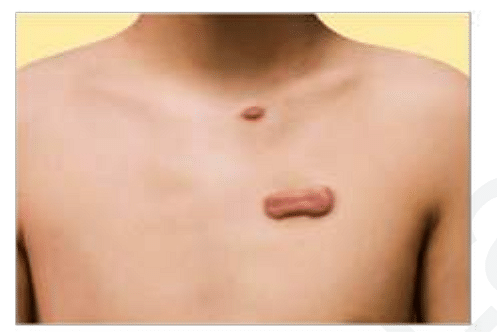
View More Questions
Top NEET PG Pelviureteric Junction (PUJ) Obstruction Questions
Top NEET PG Questions
- A patient hailing from Delhi presents with fever, arthralgia, and extensive petechial rash for 3 days. Lab investigations revealed a hemoglobin of 9 g/ dL, a white blood cell count of 9000 cells/mm3, a platelet count of 20000 cells/mm3, and a prolonged bleeding time. The clotting time was normal. What is the most likely diagnosis?
- Which of the following statements is true about Trichomonas vaginalis?
- A lady from West Rajasthan presented with an ulcer surrounded by erythema on the right leg. Microscopy of the biopsy from the edge of the ulcer showed organisms with dark staining nuclei and kinetoplast. What is the most likely causative agent?
- A child presents with a fever and a rash. Urine examination showed cells with owl's eye appearance. What is the most likely diagnosis?
- Infection with Clonorchis sinensis is associated with an increased risk of__?
View More Questions