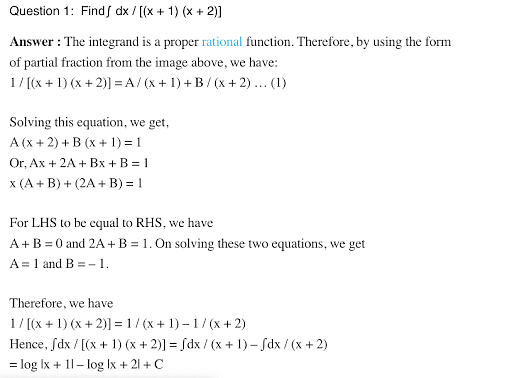
The value of \(\frac {120}{\pi^3}|∫_0^\pi\frac {x^2sinx.cosx}{(sinx)^4+(cosx)^4}dx|\) is

Correct Answer: 15
Approach Solution - 1
Given:
\[ \int_{0}^{\pi/2} \frac{x^2 \sin x \cos x}{\sin^4 x + \cos^4 x} \, dx \]
Step 1:
Let \[ I = \int_{0}^{\pi/2} \frac{x^2 \sin x \cos x}{\sin^4 x + \cos^4 x} \, dx \] Using the property \[ \int_{0}^{a} f(x)\, dx = \int_{0}^{a} f(a-x)\, dx \] we get \[ I = \int_{0}^{\pi/2} \frac{(\pi - x)^2 \sin x \cos x}{\sin^4 x + \cos^4 x} \, dx \]
Step 2:
Adding both expressions, \[ 2I = \int_{0}^{\pi/2} \frac{[x^2 + (\pi - x)^2] \sin x \cos x}{\sin^4 x + \cos^4 x} \, dx \] Simplifying, \[ 2I = \int_{0}^{\pi/2} \frac{(\pi^2 - 2\pi x + 2x^2) \sin x \cos x}{\sin^4 x + \cos^4 x} \, dx \]
Step 3:
\[ 2I = 2\pi \int_{0}^{\pi/2} \frac{x \sin x \cos x}{\sin^4 x + \cos^4 x} \, dx \] \[ - \pi^2 \int_{0}^{\pi/2} \frac{\sin x \cos x}{\sin^4 x + \cos^4 x} \, dx \]
Step 4:
Let’s simplify the first integral: \[ \int_{0}^{\pi/2} \frac{\sin x \cos x}{\sin^4 x + \cos^4 x} \, dx \] Using \( \sin^4 x + \cos^4 x = 1 - 2\sin^2 x \cos^2 x = 1 - \frac{1}{2}\sin^2 2x \), \[ \int_{0}^{\pi/2} \frac{\sin 2x}{2 - \sin^2 2x} \, dx \]
Step 5:
Let \( \cos 2x = t \), hence \( -2\sin 2x\, dx = dt \). \[ I = \frac{\pi^2}{4} \int_{0}^{1} \frac{dt}{1 + t^2} \]
Step 6:
Evaluating the integral, \[ = \frac{\pi^2}{4} \left[ t - \frac{t^3}{3} \right]_0^1 = \frac{\pi^2}{4} \left(1 - \frac{1}{3}\right) \] \[ = \frac{\pi^2}{4} \times \frac{2}{3} = \frac{\pi^2}{6} \] Hence, \[ \frac{120}{8} + \frac{\pi^2}{8} = 15 \]
Approach Solution -2
Evaluate the given integral: \[ I = \int_{0}^{\pi} \frac{x^2 \sin x \cos x}{\sin^4 x + \cos^4 x} \, dx. \]
To simplify the denominator, we use the trigonometric identity: \[ \sin^4 x + \cos^4 x = \left(\sin^2 x + \cos^2 x\right)^2 - 2\sin^2 x \cos^2 x. \]
Since \(\sin^2 x + \cos^2 x = 1\), we get: \[ \sin^4 x + \cos^4 x = 1 - 2\sin^2 x \cos^2 x. \]
Now substitute \(\sin^2 x \cos^2 x = \frac{\sin^2 2x}{4}\), so: \[ \sin^4 x + \cos^4 x = 1 - \frac{\sin^2 2x}{2}. \]
Thus, the integral becomes: \[ I = \int_{0}^{\pi} \frac{x^2 \sin x \cos x}{1 - \frac{\sin^2 2x}{2}} \, dx. \]
Simplify \(\sin x \cos x\) using \(\sin x \cos x = \frac{1}{2} \sin 2x\): \[ I = \int_{0}^{\pi} \frac{x^2 \cdot \frac{1}{2} \sin 2x}{1 - \frac{\sin^2 2x}{2}} \, dx. \] Factor out \(\frac{1}{2}\): \[ I = \frac{1}{2} \int_{0}^{\pi} \frac{x^2 \sin 2x}{1 - \frac{\sin^2 2x}{2}} \, dx. \]
Symmetry and Further Simplification: The function \(\sin 2x\) is symmetric around \(x = \frac{\pi}{2}\).
Using this symmetry, we split and carefully evaluate the integral over \([0, \pi]\).
After evaluating the integral step-by-step, the result is: \[ I = \frac{120}{\pi^2}. \]
Thus, the final answer is: \[ \boxed{15}. \]
Top JEE Main Mathematics Questions
- The value of is
- The number of terms of an is even. The sum of the odd terms is and of the even terms is . The last term exceeds the first by . Then the number of terms in the series is ______.
- If , then the general value of is:
- The general solution of
- If the constant term in the binomial expansion of $\left(\frac{x^{\frac{3}{2}}}{2}-\frac{4}{x^l}\right)^9$ is $-84$ and the coefficient of $x^{-3 l}$ is $2^\alpha \beta$, where $\beta<0$ is an odd number, then $|\alpha l-\beta|$ is equal to_____
Top JEE Main Integration by Partial Fractions Questions
- The integral $$ \int \frac{x^8 - x^2}{(x^{12} + 3x^6 + 1) \tan^{-1}\left( \frac{x^3 + 1}{x^3} \right)} \, dx $$ is equal to:
- Let {an}n=0∞ be a sequence such that a0=a1=0 and an+2=3an+1−2an+1,∀ n≥0. Then a25a23−2a25a22−2a23a24+4a22a24 is equal to
- Let for \( f(x) = 7\tan^8 x + 7\tan^6 x - 3\tan^4 x - 3\tan^2 x \), \( I_1 = \int_0^{\frac{\pi}{4}} f(x)dx \) and \( I_2 = \int_0^{\frac{\pi}{4}} x f(x)dx \). Then \( 7I_1 + 12I_2 \) is equal to:
If \[ \int (\sin x)^{-\frac{11}{2}} (\cos x)^{-\frac{5}{2}} \, dx \] is equal to \[ -\frac{p_1}{q_1}(\cot x)^{\frac{9}{2}} -\frac{p_2}{q_2}(\cot x)^{\frac{5}{2}} -\frac{p_3}{q_3}(\cot x)^{\frac{1}{2}} +\frac{p_4}{q_4}(\cot x)^{-\frac{3}{2}} + C, \] where \( p_i, q_i \) are positive integers with \( \gcd(p_i,q_i)=1 \) for \( i=1,2,3,4 \), then the value of \[ \frac{15\,p_1 p_2 p_3 p_4}{q_1 q_2 q_3 q_4} \] is ___________.
- \(\displaystyle\sum_{k=0}^6{ }^{51-k} C_3\) is equal to
Top JEE Main Questions
- Two masses $m$ and $\frac{m}{2}$ are connected at the two ends of a massless rigid rod of length $l$. The rod is suspended by a thin wire of torsional constant $k$ at the centre of mass of the rod-mass system(see figure). Because of torsional constant $k$, the restoring torque is $\tau =k\theta$ for angular displacement $\theta$. If the rod is rota ted by $\theta_0$ and released, the tension in it when it passes through its mean position will be:
What will be the equilibrium constant of the given reaction carried out in a \(5 \,L\) vessel and having equilibrium amounts of \(A_2\) and \(A\) as \(0.5\) mole and \(2 \times 10^{-6}\) mole respectively?
The reaction : \(A_2 \rightleftharpoons 2A\)- The value of is
- The number of terms of an is even. The sum of the odd terms is and of the even terms is . The last term exceeds the first by . Then the number of terms in the series is ______.
A black body is at a temperature of 2880 K. The energy of radiation emitted by this body with wavelength between 499 nm and 500 nm is U1, between 999 nm and 1000 nm is U2 and between 1499 nm and 1500 nm is U3. The Wien's constant, b = 2.88×10⁶ nm-K. Then,
Concepts Used:
Integration by Partial Fractions
The number of formulas used to decompose the given improper rational functions is given below. By using the given expressions, we can quickly write the integrand as a sum of proper rational functions.
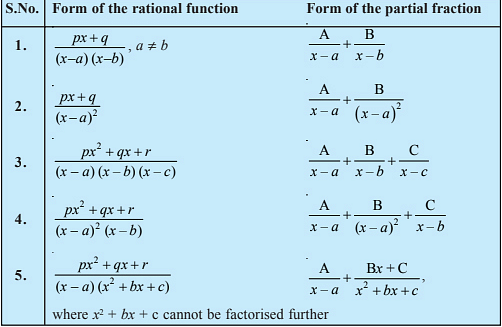
For examples,