The vacant space in bcc lattice unit cell is:
The vacant space in bcc lattice unit cell is:
Show Hint
BCC unit cell includes eight atoms at the corner of the cube and one atom at the center of the unit cell. We can find % vacant space by following the equation.
% Vacant space = 100 - % Volume occupied by atoms in a unit cell
- 0.23
- 0.32
- 0.26
- 0.48

The Correct Option is B
Solution and Explanation
In a body-centered cubic (bcc) lattice, the arrangement of atoms results in some space within the unit cell that is not occupied by atoms. This unoccupied space is referred to as the "vacant space" or "void space." The calculation of vacant space in a bcc lattice can be determined through the geometry of the lattice.
- The bcc unit cell contains 1 atom at the center and 8 atoms at the corners, each contributing 1/8th of an atom to the unit cell, making a net total of 2 atoms per unit cell.
- The relationship between the lattice parameter \(a\) (edge length) and the atomic radius \(r\) in a bcc lattice is given by: \(a = \frac{4r}{\sqrt{3}}\). This is because the atoms touch along the body diagonal.
- The volume of the unit cell is computed as \(a^3\).
- The volume occupied by the atoms in the bcc unit cell can be calculated using the volume of a sphere: \(V_{\text{atom}} = 2 \times \frac{4}{3}\pi r^3\).
- The packing efficiency (fraction of volume occupied by atoms in the unit cell) of a bcc structure is known to be approximately 68%. Therefore, the vacant space, in percentage, is: \(100\% - 68\% = 32\%\).
Thus, the vacant space in a bcc lattice unit cell is \(0.32\), making
0.32
the correct answer.
Top NEET Chemistry Questions
- A $100.0\, mL$ dilute solution of $Ag ^{+}$is electrolysed for $15.0$ minutes with a current of $1.25 \,mA$ and the silver is removed completely. What was the initial $\left[ Ag ^{+}\right]$?
- Under isothermal condition, a gas at 300 K expands from 0.1 L to 0.25 L against a constant externalpressureof2bar Theworkdonebythe gas i s : [Given that 1Lbar= 100J)
- Unit of entropy is : -
- For a reaction, activation energy E$_a$=0 and the rate constant at 200K is 1.6×10$^6$s$^{-1}$. The rate constant at 400K will be- [Given that gas constant] R= 8.314 J K$^{-1}$ mol$^{-1}$
- Half-life period of a first order reaction is $1386\, s.$ The specific rate constant of the reaction is
Top NEET The solid state Questions
- Cation and anion combines in a crystal to form following type of compound
- Formula of nickel oxide with metal deficiency defect in its crystal is $A_{0.8}O$. The crystal contains $A^{2+}$ and $A^{3+}$ ions. The fraction of nickel existing as $A^{2+}$ ions in the crystal is
- The second order Bragg diffraction of X-rays with $\lambda = 1.0 \mathring{A}$ from a set of parallel planes in a metal occurs at an angle $60^\circ$. The distance between the scattering planes in the crystals is
Number of atom per unit cell in B.C.C.
- What fraction of one edge centred octahedral void lies in one unit cell of fcc?
Top NEET Questions
- A $100.0\, mL$ dilute solution of $Ag ^{+}$is electrolysed for $15.0$ minutes with a current of $1.25 \,mA$ and the silver is removed completely. What was the initial $\left[ Ag ^{+}\right]$?
- The time constant of C-R circuit is
- The chronological order of human evolution from early to the recent is
- The correct Boolean operation represented by the circuit diagram drawn is :
- The driver of a car travelling with speed $30\, m/sec$ towards a hill sounds a horn of frequency $600\, Hz.$ If the velocity of sound in air is $330\, m/s,$ the frequency of reflected sound as heard by driver is
Concepts Used:
Solid State
Solids are substances that are featured by a definite shape, volume, and high density. In the solid-state, the composed particles are arranged in several manners. Solid-state, in simple terms, means "no moving parts." Thus solid-state electronic devices are the ones inclusive of solid components that don’t change their position. Solid is a state of matter where the composed particles are arranged close to each other. The composed particles can be either atoms, molecules, or ions.
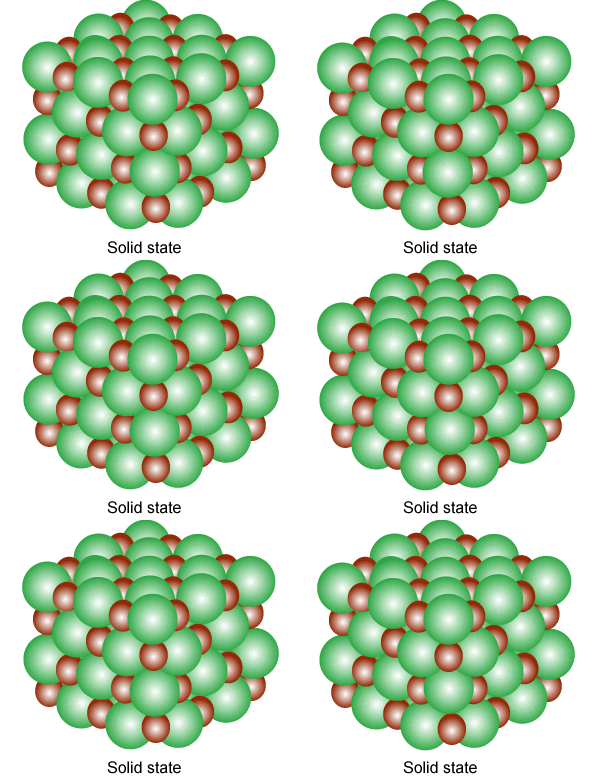
Types of Solids:
Based on the nature of the order that is present in the arrangement of their constituent particles solids can be divided into two types;
- Amorphous solids behave the same as super cool liquids due to the arrangement of constituent particles in short-range order. They are isotropic and have a broad melting point (range is about greater than 5°C).
- Crystalline solids have a fixed shape and the constituent particles are arranged in a long-range order.