The orthocenter of the triangle whose sides are given by x + y + 10 = 0, x - y - 2 = 0 and 2x + y - 7 = 0 is
The orthocenter of the triangle whose sides are given by x + y + 10 = 0, x - y - 2 = 0 and 2x + y - 7 = 0 is
(-4, -3)
(-4, -6)
(4,6)
(3,6)

The Correct Option is B
Solution and Explanation
To find the vertex of the triangle formed by the lines \(x + y + 10 = 0\), \(x - y - 2 = 0\), and \(2x + y - 7 = 0\)
1. Finding the First Vertex:
Solve for the intersection of \(x + y + 10 = 0\) and \(x - y - 2 = 0\):
\( x + y = -10 \quad (1) \)
\( x - y = 2 \quad (2) \)
Add the equations:
\( (x + y) + (x - y) = -10 + 2 \)
\( 2x = -8 \implies x = -4 \)
Substitute \(x = -4\) into (2):
\( -4 - y = 2 \implies y = -6 \)
Thus, the intersection is \((-4, -6)\).
2. Verifying Other Vertices:
Solve for the intersection of \(x - y - 2 = 0\) and \(2x + y - 7 = 0\):
\( x - y = 2 \quad (1) \)
\( 2x + y = 7 \quad (2) \)
Add the equations:
\( (x - y) + (2x + y) = 2 + 7 \)
\( 3x = 9 \implies x = 3 \)
Substitute \(x = 3\) into (1):
\( 3 - y = 2 \implies y = 1 \)
So, the intersection is \((3, 1)\).
3. Third Vertex:
Solve for the intersection of \(x + y + 10 = 0\) and \(2x + y - 7 = 0\):
\( x + y = -10 \quad (1) \)
\( 2x + y = 7 \quad (2) \)
Subtract (1) from (2):
\( (2x + y) - (x + y) = 7 - (-10) \)
\( x = 17 \)
Substitute \(x = 17\) into (1):
\( 17 + y = -10 \implies y = -27 \)
So, the intersection is \((17, -27)\).
\( 2(-4) - 3(-6) + k = -8 + 18 + k = 10 + k = 0 \implies k = -10 \)
However, using \(2x - 3y - 10 = 0\) makes all three lines concurrent at \((-4, -6)\), which does not form a triangle.
Thus, the original line \(2x + y - 7 = 0\) is likely correct, as it yields \((-4, -6)\) as a vertex.
Final Answer:
The vertex is \((-4, -6)\).
Top TS EAMCET Mathematics Questions
- A bag contains $5$ red balls, $3$ black balls and $4$ white balls are drawn at random. The probability that they are not of same colour is
- If $cosec\, \theta - \cot \theta = 2017$, then quadrant in which $\theta $ lies is
- If $a$ is a unit vector, then $| a \times \hat{ i }|^{2}+| a \times \hat{ j }|^{2}+| a \times \hat{ k }|^{2}=$
- $A$ straight line makes an intercept on the $Y$-axis twice as long as that on $X$-axis and is at a unit distance from the origin. Then the line is represented by the equations
- Let $S$ and $S'$ be the foci of an ellipse and B be one end of its minor axis. If $SBS'$ is an isosceles right angled triangle then the eccentricity of the ellipse is
Top TS EAMCET Three Dimensional Geometry Questions
The number of diagonals of a polygon is 35. If A, B are two distinct vertices of this polygon, then the number of all those triangles formed by joining three vertices of the polygon having AB as one of its sides is:
In △ABC, if a : b : c = 4 : 5 : 6, then the ratio of the circumference to its in radius is
The perimeter of a △ABC is 6 times the arithmetic mean of the values of the sine of its angles. If the side BC is of the unit length, then ∠A =
For l ∈ R, the equation (2l - 3) x2 + 2lxy - y2 = 0 represents a pair of distinct lines
In a triangle BC, if the mid points of sides AB, BC, CA are (3,0,0), (0,4,0),(0,0,5) respectively, then AB2 + BC2 + CA2 =
Top TS EAMCET Questions
- A bag contains $5$ red balls, $3$ black balls and $4$ white balls are drawn at random. The probability that they are not of same colour is
- If $cosec\, \theta - \cot \theta = 2017$, then quadrant in which $\theta $ lies is
- If $a$ is a unit vector, then $| a \times \hat{ i }|^{2}+| a \times \hat{ j }|^{2}+| a \times \hat{ k }|^{2}=$
- $A$ straight line makes an intercept on the $Y$-axis twice as long as that on $X$-axis and is at a unit distance from the origin. Then the line is represented by the equations
- Let $S$ and $S'$ be the foci of an ellipse and B be one end of its minor axis. If $SBS'$ is an isosceles right angled triangle then the eccentricity of the ellipse is
Concepts Used:
Three Dimensional Geometry
Mathematically, Geometry is one of the most important topics. The concepts of Geometry are derived w.r.t. the planes. So, Geometry is divided into three major categories based on its dimensions which are one-dimensional geometry, two-dimensional geometry, and three-dimensional geometry.
Direction Cosines and Direction Ratios of Line:
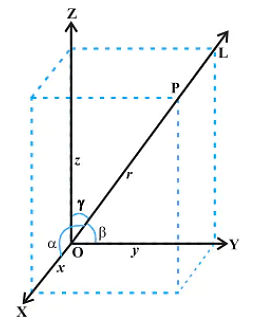
Consider a line L that is passing through the three-dimensional plane. Now, x,y and z are the axes of the plane and α,β, and γ are the three angles the line makes with these axes. These are commonly known as the direction angles of the plane. So, appropriately, we can say that cosα, cosβ, and cosγ are the direction cosines of the given line L.