Question:
The movement of ions against the concentration gradient will be:
The movement of ions against the concentration gradient will be:
Updated On: May 1, 2026
- Active transport
- Osmosis
- Diffusion
- All
Show Solution

Verified By Collegedunia
The Correct Option is A
Solution and Explanation
The movement of ions against the concentration gradient is typically accomplished through Active transport. Active transport processes use energy (usually ATP) to pump ions or molecules across a cell membrane against their concentration gradient, from areas of lower concentration to areas of higher concentration. This process is essential for maintaining ion gradients and performing various physiological functions.
So, the correct option is (A): Active transport
Was this answer helpful?
0
0
Top NEET Biology Questions
- The chronological order of human evolution from early to the recent is
- Upper part of sea/aquatic ecosystem contains
- Where is respiratory electron transport system (ETS) located in plants ?
- Which among the following are the smallest living cells, known without a definite cell wall, pathogenic to plants as well as animals and can survive without oxygen ?
- Three of the following pairs of the human skeletal parts are correctly matched with their respective inclusive skeletal category and one pair is not matched. Identify the non-matching pair. .
Pair of skeletal parts Category (a)$\,\,$ Sternum and ribs$\,\,$ Axial skeleton (b)$\,\,$ Clavicle and glenoid cavity$\,\,$ Pelvic girdle (c)$\,\,$ Flumerus and ulna$\,\,$ Appendicular skeleton (d)$\,\,$ Malleus and stapes$\,\,$ Ear ossicles
View More Questions
Top NEET Cell: the unit of life Questions
- Match the columns and identity the correct option
Column I Column II A. Thylakoids (i) Disc-shaped sacs in Golgi apparatus B Cristate (ii) Condensed structure of DNA C Cisternae (iii) Flat membranous sacs in stroma D Chomatin (iv) Infolding in mitochondria - Identify the components labelled A, B, C and D in the diagram below from the list (i) to (viii) given along with Components: (i) Cristae of mitochondria (ii) Inner membrane of mitochondria (iii) Cytoplasm (iv) Smooth endoplasmic reticulum (v) Rough endoplasmic reticulum (vi) Mitochondrial matrix (vii) Cell vacuole (viii) Nucleus The correct components are:
A B C D (1) (v) (iv) (viii) (iii) (2) (i) (iv) (viii) (vi) (3) (vi) (v) (iv) (vii) (4) (v) (i) (iii) (ii) - Difference in gram ⊕ and gram bacteria is due to
- In plants inulin and pectin are
- Element necessary for the middle lamella
View More Questions
Top NEET Questions
- A $100.0\, mL$ dilute solution of $Ag ^{+}$is electrolysed for $15.0$ minutes with a current of $1.25 \,mA$ and the silver is removed completely. What was the initial $\left[ Ag ^{+}\right]$?
- The time constant of C-R circuit is
- The chronological order of human evolution from early to the recent is
- The correct Boolean operation represented by the circuit diagram drawn is :
- The driver of a car travelling with speed $30\, m/sec$ towards a hill sounds a horn of frequency $600\, Hz.$ If the velocity of sound in air is $330\, m/s,$ the frequency of reflected sound as heard by driver is
View More Questions
Concepts Used:
Cell: The Unit of Life
- A cell is derived as the functional and structural unit of life. Every cell is surrounded by a cell membrane that dissects the external and internal environments of the cell. The interior environment of a cell is called the cytoplasm.
- It carries cellular machinery and structural elements. The nucleus is present in the center of the cell, which includes all the hereditary information of an organism. Some of the molecules present in the cell are protein, carbohydrates, starch, and sugar.
Read More: Fundamental Unit of Life: Cell
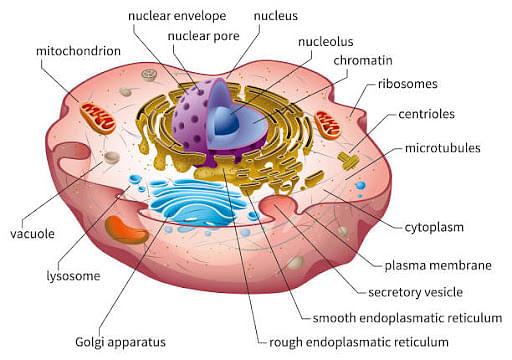
Parts of Cell:
The different parts of a cell and their functions are as follows:
- Cell Membrane
- Cell Wall
- Nucleus
- Cytoplasm