Question:
The difference in the capacitance (in F) between the metal plates at \(t=0\) and that at \(t=500\,\text{s}\) is \((8-n)\epsilon_0\), where \(\epsilon_0\) is the permittivity of free space. The value of \(n\) is:
The difference in the capacitance (in F) between the metal plates at \(t=0\) and that at \(t=500\,\text{s}\) is \((8-n)\epsilon_0\), where \(\epsilon_0\) is the permittivity of free space. The value of \(n\) is:
Show Hint
Treat each chamber as a stack: liquid layer of height h (er = 15) in series with an air layer of height 2 - h. Add the two chambers in parallel.
Updated On: Nov 19, 2026
Show Solution

Verified By Collegedunia
Correct Answer: 1.9 - 2.1
Solution and Explanation
Step 1: Capacitance of one chamber:
The plates \(M_1, M_2\) are the floor and the roof, 2 m apart. In each chamber (cross-section area \(1\,\text{m}^2\)) a liquid layer of height \(h\) is in series with an air layer of height \(2-h\).
\[ C = \frac{\epsilon_0 A}{\dfrac{h}{\epsilon_r} + (2 - h)} = \frac{\epsilon_0}{\dfrac{h}{15} + 2 - h} \]
Step 2: At t = 0:
Left chamber \(h = 2\): \(C = \dfrac{\epsilon_0}{2/15} = 7.5\,\epsilon_0\).
Right chamber \(h = 0\): \(C = \dfrac{\epsilon_0}{2} = 0.5\,\epsilon_0\).
The chambers are in parallel, so \(C_0 = 8\,\epsilon_0\).
Step 3: At t = 500 s:
From the container problem, the left height is \(1.25\) m and the right height is \(0.75\) m.
Left: \(\dfrac{1.25}{15} + 0.75 = 0.8333 \Rightarrow C = 1.2\,\epsilon_0\).
Right: \(\dfrac{0.75}{15} + 1.25 = 1.3 \Rightarrow C = 0.769\,\epsilon_0\).
Total \(C = 1.969\,\epsilon_0\).
Step 4: Difference:
\[ C_0 - C = (8 - 1.969)\,\epsilon_0 = (8 - n)\,\epsilon_0 \ \Rightarrow\ n = 1.969 \approx 1.97 \]
Final Answer:
The value of n is about 1.97. \[ \boxed{n \approx 1.97} \]
Was this answer helpful?
0
0
Top JEE Advanced Physics Questions
- Yellow light is used in a single slit diffraction experiment with slit width of 0.6 mm. If yellow light is replaced by X-rays, then the observed pattern will reveal
- The size of the image of an object, which is at infinity, as formed by a convex lens of focal length 30 cm is 2 cm. If a concave lens of focal length 20 cm is placed between the convex lens and the image at a distance of 26 cm from the convex lens, calculate the new size of the image.
- A concave lens of glass, refractive index 1.5 has both surfaces of same radius of curvature R. On immersion in a medium of refractive index 1.75, it will behave as a
- The position vector $\vec{r}$ of a particle of mass $m$ is given by the following equation $\vec{r}(t)=\alpha t^{3} \hat{i}+\beta t^{2} \hat{j}$ where $\alpha=\frac{10}{3} \,ms ^{-3}, \beta=5\, ms ^{-2}$ and $m =0.1 \,kg$. At $t =1\, s$, which of the following statement (s) is (are) true about the particle?
- In an n-p-n transistor circuit, the collector current is 10 mA. If 90% of the electrons emitted reach the collector
View More Questions
Top JEE Advanced Capacitors and Capacitance Questions
- In the circuit shown below, the switch $S$ is connected to position $P$ for a long time so that the charge on the capacitor becomes $q _{1}\, \mu C$ Then $S$ is switched to position $Q$ After a long time, the charge on the capacitor is $q _{2}\, \mu C$ The magnitude of $q_1$is ____
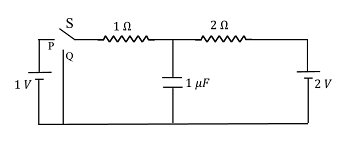
- In the circuit shown below, the switch $S$ is connected to position $P$ for a long time so that the charge on the capacitor becomes $q _{1}\, \mu C$. Then $S$ is switched to position $Q$. After a long time, the charge on the capacitor is $q _{2}\, \mu C$
- Two capacitors with capacitance values $C_{1}=2000 \pm 10\, pF$ and $C_{2}=3000 \pm 15\, pF$ are connected in series. The voltage applied across this combination is $V =5.00 \pm 002 \,V$. The percentage error in the calculation of the energy stored in this combination of capacitors is _____
- The difference in the capacitance (in F) between the metal plates at \(t=0\) and that at \(t=500\,\text{s}\) is \((8-n)\epsilon_0\), where \(\epsilon_0\) is the permittivity of free space. The value of \(n\) is:
Top JEE Advanced Questions
- Yellow light is used in a single slit diffraction experiment with slit width of 0.6 mm. If yellow light is replaced by X-rays, then the observed pattern will reveal
- The size of the image of an object, which is at infinity, as formed by a convex lens of focal length 30 cm is 2 cm. If a concave lens of focal length 20 cm is placed between the convex lens and the image at a distance of 26 cm from the convex lens, calculate the new size of the image.
- A concave lens of glass, refractive index 1.5 has both surfaces of same radius of curvature R. On immersion in a medium of refractive index 1.75, it will behave as a
- The position vector $\vec{r}$ of a particle of mass $m$ is given by the following equation $\vec{r}(t)=\alpha t^{3} \hat{i}+\beta t^{2} \hat{j}$ where $\alpha=\frac{10}{3} \,ms ^{-3}, \beta=5\, ms ^{-2}$ and $m =0.1 \,kg$. At $t =1\, s$, which of the following statement (s) is (are) true about the particle?
- In an n-p-n transistor circuit, the collector current is 10 mA. If 90% of the electrons emitted reach the collector
View More Questions