Comprehension
In the circuit shown below, the switch $S$ is connected to position $P$ for a long time so that the charge on the capacitor becomes $q _{1}\, \mu C$. Then $S$ is switched to position $Q$. After a long time, the charge on the capacitor is $q _{2}\, \mu C$
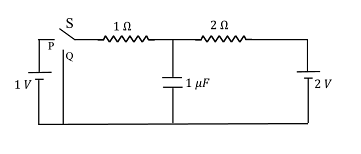
Question: 1
The magnitude of q1 is _____.
The magnitude of q1 is _____.
Updated On: May 9, 2025
Show Solution

Verified By Collegedunia
Correct Answer: 1.33
Solution and Explanation
Step 1: Understanding the given data
We are given the following information:
- Switch \( S \) is at position \( P \), and after a long time, the potential difference across the capacitor branch is:
\[ \frac{4 \times 1}{3} = \frac{4}{3} \, \text{V} \] - The charge on the capacitor is denoted as \( q_1 \) in microcoulombs (\( \mu C \)).
Step 2: Applying the formula for charge on the capacitor
The charge \( q_1 \) on a capacitor is related to the potential difference across the capacitor and its capacitance \( C \) by the equation:
\[ q = C \times V \] where \( V \) is the potential difference and \( C \) is the capacitance.
In this case, the potential difference is given as \( \frac{4}{3} \) V, and from the information provided, we can deduce that the charge on the capacitor \( q_1 \) is also \( \frac{4}{3} \) microcoulombs, as it is related to the potential difference.
Step 3: Conclusion
Therefore, the charge on the capacitor is:
\[ q_1 = \frac{4}{3} \, \mu C = 1.33 \, \mu C \]
We are given the following information:
- Switch \( S \) is at position \( P \), and after a long time, the potential difference across the capacitor branch is:
\[ \frac{4 \times 1}{3} = \frac{4}{3} \, \text{V} \] - The charge on the capacitor is denoted as \( q_1 \) in microcoulombs (\( \mu C \)).
Step 2: Applying the formula for charge on the capacitor
The charge \( q_1 \) on a capacitor is related to the potential difference across the capacitor and its capacitance \( C \) by the equation:
\[ q = C \times V \] where \( V \) is the potential difference and \( C \) is the capacitance.
In this case, the potential difference is given as \( \frac{4}{3} \) V, and from the information provided, we can deduce that the charge on the capacitor \( q_1 \) is also \( \frac{4}{3} \) microcoulombs, as it is related to the potential difference.
Step 3: Conclusion
Therefore, the charge on the capacitor is:
\[ q_1 = \frac{4}{3} \, \mu C = 1.33 \, \mu C \]
Was this answer helpful?
0
0
Question: 2
The magnitude of q2 is_____.
The magnitude of q2 is_____.
Updated On: May 9, 2025
Show Solution
Verified By Collegedunia
Correct Answer: 0.67
Solution and Explanation
Step 1: Understanding the given data
We are given the following information:
- Switch \( S \) is at position \( Q \), and after a long time, the potential difference across the capacitor is equal to the potential difference across a resistance of \( 1 \, \Omega \).
- The charge on the capacitor is denoted as \( q_2 \) in microcoulombs (\( \mu C \)), and it is given as \( \frac{2}{3} \, \mu C \).
Step 2: Relation between potential difference and charge on capacitor
The charge on the capacitor \( q_2 \) is related to the potential difference \( V \) across the capacitor and its capacitance \( C \) by the equation:
\[ q_2 = C \times V \] where \( C \) is the capacitance and \( V \) is the potential difference.
Since the potential difference across the capacitor is equal to the potential difference across the resistance of \( 1 \, \Omega \), we can use the given charge formula to find the charge.
Step 3: Conclusion
The given charge on the capacitor is \( q_2 = \frac{2}{3} \, \mu C \), which simplifies to:
\[ q_2 = 0.67 \, \mu C \]
We are given the following information:
- Switch \( S \) is at position \( Q \), and after a long time, the potential difference across the capacitor is equal to the potential difference across a resistance of \( 1 \, \Omega \).
- The charge on the capacitor is denoted as \( q_2 \) in microcoulombs (\( \mu C \)), and it is given as \( \frac{2}{3} \, \mu C \).
Step 2: Relation between potential difference and charge on capacitor
The charge on the capacitor \( q_2 \) is related to the potential difference \( V \) across the capacitor and its capacitance \( C \) by the equation:
\[ q_2 = C \times V \] where \( C \) is the capacitance and \( V \) is the potential difference.
Since the potential difference across the capacitor is equal to the potential difference across the resistance of \( 1 \, \Omega \), we can use the given charge formula to find the charge.
Step 3: Conclusion
The given charge on the capacitor is \( q_2 = \frac{2}{3} \, \mu C \), which simplifies to:
\[ q_2 = 0.67 \, \mu C \]
Was this answer helpful?
0
0
Top JEE Advanced Questions
- Yellow light is used in a single slit diffraction experiment with slit width of 0.6 mm. If yellow light is replaced by X-rays, then the observed pattern will reveal
- The size of the image of an object, which is at infinity, as formed by a convex lens of focal length 30 cm is 2 cm. If a concave lens of focal length 20 cm is placed between the convex lens and the image at a distance of 26 cm from the convex lens, calculate the new size of the image.
- A concave lens of glass, refractive index 1.5 has both surfaces of same radius of curvature R. On immersion in a medium of refractive index 1.75, it will behave as a
- The position vector $\vec{r}$ of a particle of mass $m$ is given by the following equation $\vec{r}(t)=\alpha t^{3} \hat{i}+\beta t^{2} \hat{j}$ where $\alpha=\frac{10}{3} \,ms ^{-3}, \beta=5\, ms ^{-2}$ and $m =0.1 \,kg$. At $t =1\, s$, which of the following statement (s) is (are) true about the particle?
- In an n-p-n transistor circuit, the collector current is 10 mA. If 90% of the electrons emitted reach the collector
View More Questions