Question:
The difference in the capacitance (in F) between the metal plates at \(t=0\) and that at \(t=500\,\text{s}\) is \((8-n)\epsilon_0\), where \(\epsilon_0\) is the permittivity of free space. The value of \(n\) is:
The difference in the capacitance (in F) between the metal plates at \(t=0\) and that at \(t=500\,\text{s}\) is \((8-n)\epsilon_0\), where \(\epsilon_0\) is the permittivity of free space. The value of \(n\) is:
Show Hint
Chambers side-by-side act as parallel capacitors ($C_{total} = C_1 + C_2$).
Layers of different dielectrics within a chamber act as capacitors in series ($1/C = 1/C_1 + 1/C_2$).
The formula $C = \frac{\epsilon_0 A}{d_1/\epsilon_{r1} + d_2/\epsilon_{r2}}$ is a very useful shortcut for layered capacitors.
Layers of different dielectrics within a chamber act as capacitors in series ($1/C = 1/C_1 + 1/C_2$).
The formula $C = \frac{\epsilon_0 A}{d_1/\epsilon_{r1} + d_2/\epsilon_{r2}}$ is a very useful shortcut for layered capacitors.
Updated On: Jun 4, 2026
Show Solution

Verified By Collegedunia
Solution and Explanation
Step 1: Understanding the Question:
The container is partitioned into two chambers, which act as two capacitors connected in parallel.
In each chamber, the liquid (dielectric $\epsilon_r$) and the air above it (dielectric $1$) form a series combination because the electric field passes through both layers.
The area of each chamber is $1\text{ m}^2$. Total height is $2\text{ m}$.
Step 2: Key Formula or Approach:
Capacitance of a chamber with liquid height $h$:
$C_{liq} = \frac{\epsilon_0 \epsilon_r A}{h}, C_{air} = \frac{\epsilon_0 (1) A}{2-h}$.
$C_{chamber} = \frac{C_{liq} C_{air}}{C_{liq} + C_{air}} = \frac{\epsilon_0 A}{(2-h) + \frac{h}{\epsilon_r}} = \frac{\epsilon_0}{2 - h + \frac{h}{15}} = \frac{\epsilon_0}{2 - \frac{14h}{15}}$.
Total Capacitance $C = C_{left} + C_{right}$.
Step 3: Detailed Explanation:
• At $t = 0$:
$h_1 = 2\text{ m}, h_2 = 0\text{ m}$.
$C_{left} = \frac{\epsilon_0}{2 - \frac{14 \times 2}{15}} = \frac{\epsilon_0}{2 - 28/15} = \frac{\epsilon_0}{2/15} = 7.5 \epsilon_0$.
$C_{right} = \frac{\epsilon_0}{2 - 0} = 0.5 \epsilon_0$.
$C_{total}(0) = 7.5 \epsilon_0 + 0.5 \epsilon_0 = 8 \epsilon_0$.
• At $t = 500\text{ s$:}
$h_1 = 1.25\text{ m}$ (from Q.15), so $h_2 = 2 - 1.25 = 0.75\text{ m}$.
$C_{left} = \frac{\epsilon_0}{2 - \frac{14 \times 1.25}{15}} = \frac{\epsilon_0}{2 - \frac{14 \times 5/4}{15}} = \frac{\epsilon_0}{2 - 7/6} = \frac{\epsilon_0}{5/6} = 1.2 \epsilon_0$.
$C_{right} = \frac{\epsilon_0}{2 - \frac{14 \times 0.75}{15}} = \frac{\epsilon_0}{2 - \frac{14 \times 3/4}{15}} = \frac{\epsilon_0}{2 - 42/60} = \frac{\epsilon_0}{2 - 0.7} = \frac{\epsilon_0}{1.3} \approx 0.7692 \epsilon_0$.
$C_{total}(500) = 1.2 \epsilon_0 + 0.7692 \epsilon_0 = 1.9692 \epsilon_0$.
• Finding $n$:
Difference $= C(0) - C(500) = 8 \epsilon_0 - 1.9692 \epsilon_0 = (8 - 1.9692) \epsilon_0$.
Comparing with $(8-n)\epsilon_0$, we get $n = 1.9692$.
Rounding off to two decimal places: $n = 1.97$.
Step 4: Final Answer:
The total capacitance of the system decreases as the liquid levels equalize because the chamber with higher level provides much more capacitance than the increase in the other.
The value of $n$ is $1.97$.
The container is partitioned into two chambers, which act as two capacitors connected in parallel.
In each chamber, the liquid (dielectric $\epsilon_r$) and the air above it (dielectric $1$) form a series combination because the electric field passes through both layers.
The area of each chamber is $1\text{ m}^2$. Total height is $2\text{ m}$.
Step 2: Key Formula or Approach:
Capacitance of a chamber with liquid height $h$:
$C_{liq} = \frac{\epsilon_0 \epsilon_r A}{h}, C_{air} = \frac{\epsilon_0 (1) A}{2-h}$.
$C_{chamber} = \frac{C_{liq} C_{air}}{C_{liq} + C_{air}} = \frac{\epsilon_0 A}{(2-h) + \frac{h}{\epsilon_r}} = \frac{\epsilon_0}{2 - h + \frac{h}{15}} = \frac{\epsilon_0}{2 - \frac{14h}{15}}$.
Total Capacitance $C = C_{left} + C_{right}$.
Step 3: Detailed Explanation:
• At $t = 0$:
$h_1 = 2\text{ m}, h_2 = 0\text{ m}$.
$C_{left} = \frac{\epsilon_0}{2 - \frac{14 \times 2}{15}} = \frac{\epsilon_0}{2 - 28/15} = \frac{\epsilon_0}{2/15} = 7.5 \epsilon_0$.
$C_{right} = \frac{\epsilon_0}{2 - 0} = 0.5 \epsilon_0$.
$C_{total}(0) = 7.5 \epsilon_0 + 0.5 \epsilon_0 = 8 \epsilon_0$.
• At $t = 500\text{ s$:}
$h_1 = 1.25\text{ m}$ (from Q.15), so $h_2 = 2 - 1.25 = 0.75\text{ m}$.
$C_{left} = \frac{\epsilon_0}{2 - \frac{14 \times 1.25}{15}} = \frac{\epsilon_0}{2 - \frac{14 \times 5/4}{15}} = \frac{\epsilon_0}{2 - 7/6} = \frac{\epsilon_0}{5/6} = 1.2 \epsilon_0$.
$C_{right} = \frac{\epsilon_0}{2 - \frac{14 \times 0.75}{15}} = \frac{\epsilon_0}{2 - \frac{14 \times 3/4}{15}} = \frac{\epsilon_0}{2 - 42/60} = \frac{\epsilon_0}{2 - 0.7} = \frac{\epsilon_0}{1.3} \approx 0.7692 \epsilon_0$.
$C_{total}(500) = 1.2 \epsilon_0 + 0.7692 \epsilon_0 = 1.9692 \epsilon_0$.
• Finding $n$:
Difference $= C(0) - C(500) = 8 \epsilon_0 - 1.9692 \epsilon_0 = (8 - 1.9692) \epsilon_0$.
Comparing with $(8-n)\epsilon_0$, we get $n = 1.9692$.
Rounding off to two decimal places: $n = 1.97$.
Step 4: Final Answer:
The total capacitance of the system decreases as the liquid levels equalize because the chamber with higher level provides much more capacitance than the increase in the other.
The value of $n$ is $1.97$.
Was this answer helpful?
0
0
Top JEE Advanced Physics Questions
- Yellow light is used in a single slit diffraction experiment with slit width of 0.6 mm. If yellow light is replaced by X-rays, then the observed pattern will reveal
- The size of the image of an object, which is at infinity, as formed by a convex lens of focal length 30 cm is 2 cm. If a concave lens of focal length 20 cm is placed between the convex lens and the image at a distance of 26 cm from the convex lens, calculate the new size of the image.
- A concave lens of glass, refractive index 1.5 has both surfaces of same radius of curvature R. On immersion in a medium of refractive index 1.75, it will behave as a
- The position vector $\vec{r}$ of a particle of mass $m$ is given by the following equation $\vec{r}(t)=\alpha t^{3} \hat{i}+\beta t^{2} \hat{j}$ where $\alpha=\frac{10}{3} \,ms ^{-3}, \beta=5\, ms ^{-2}$ and $m =0.1 \,kg$. At $t =1\, s$, which of the following statement (s) is (are) true about the particle?
- In an n-p-n transistor circuit, the collector current is 10 mA. If 90% of the electrons emitted reach the collector
View More Questions
Top JEE Advanced Capacitors and Capacitance Questions
- In the circuit shown below, the switch $S$ is connected to position $P$ for a long time so that the charge on the capacitor becomes $q _{1}\, \mu C$ Then $S$ is switched to position $Q$ After a long time, the charge on the capacitor is $q _{2}\, \mu C$ The magnitude of $q_1$is ____
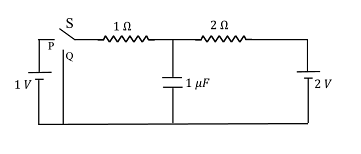
- In the circuit shown below, the switch $S$ is connected to position $P$ for a long time so that the charge on the capacitor becomes $q _{1}\, \mu C$. Then $S$ is switched to position $Q$. After a long time, the charge on the capacitor is $q _{2}\, \mu C$
- Two capacitors with capacitance values $C_{1}=2000 \pm 10\, pF$ and $C_{2}=3000 \pm 15\, pF$ are connected in series. The voltage applied across this combination is $V =5.00 \pm 002 \,V$. The percentage error in the calculation of the energy stored in this combination of capacitors is _____
Top JEE Advanced Questions
- Yellow light is used in a single slit diffraction experiment with slit width of 0.6 mm. If yellow light is replaced by X-rays, then the observed pattern will reveal
- The size of the image of an object, which is at infinity, as formed by a convex lens of focal length 30 cm is 2 cm. If a concave lens of focal length 20 cm is placed between the convex lens and the image at a distance of 26 cm from the convex lens, calculate the new size of the image.
- A concave lens of glass, refractive index 1.5 has both surfaces of same radius of curvature R. On immersion in a medium of refractive index 1.75, it will behave as a
- The position vector $\vec{r}$ of a particle of mass $m$ is given by the following equation $\vec{r}(t)=\alpha t^{3} \hat{i}+\beta t^{2} \hat{j}$ where $\alpha=\frac{10}{3} \,ms ^{-3}, \beta=5\, ms ^{-2}$ and $m =0.1 \,kg$. At $t =1\, s$, which of the following statement (s) is (are) true about the particle?
- In an n-p-n transistor circuit, the collector current is 10 mA. If 90% of the electrons emitted reach the collector
View More Questions