Question:
The correct statement(s) regarding plastocyanin is(are)
The correct statement(s) regarding plastocyanin is(are)
Show Hint
Plastocyanin is a mononuclear type 1 "blue copper" electron-transfer protein with a distorted tetrahedral $Cu(His)_2(Cys)(Met)$ site; sulfide-bridged clusters belong to iron-sulfur proteins, not blue copper proteins.
Updated On: Aug 10, 2026
- It is an electron transfer protein
- It is intensely colored in its oxidised form
- Its central metal ion has a distorted tetrahedral geometry
- It contains \(S^{2-}\) bridged metal cluster
Show Solution

Verified By Collegedunia
The Correct Option is A, B, C
Solution and Explanation
Step 1: Understanding the Concept.
Plastocyanin is a small, single-copper, "blue copper" (type 1 copper) metalloprotein found in the chloroplasts of plants and algae. It works in the photosynthetic electron transport chain, carrying a single electron from the cytochrome \(b_6f\) complex to photosystem I.
Step 2: Evaluate statement (A).
Since its entire biological job is to pick up one electron at cytochrome \(b_6f\) and hand it off to photosystem I, plastocyanin is, by definition, an electron transfer protein, not an enzyme that catalyzes a chemical transformation. Correct.
Step 3: Evaluate statement (B).
The copper center cycles between \(Cu(II)\) (oxidised) and \(Cu(I)\) (reduced) as it shuttles the electron. In the oxidised \(Cu(II)\) state, a cysteine thiolate sulfur bound to the copper undergoes an unusually intense ligand to metal charge transfer (\(S(Cys) \rightarrow Cu(II)\)) transition around 600 nm, which is what gives blue copper proteins like plastocyanin their strong blue color; this band disappears (colorless) once the copper is reduced to \(Cu(I)\), a \(d^{10}\) ion with no available charge transfer of that kind. So plastocyanin is indeed intensely colored specifically in its oxidised form. Correct.
Step 4: Evaluate statement (C).
The type 1 copper site in plastocyanin is coordinated by two histidine nitrogens, one cysteine thiolate sulfur, and one weakly bound methionine thioether sulfur. This four-coordinate arrangement is not a regular tetrahedron; it is best described as a distorted (flattened) tetrahedral geometry, intermediate between the tetrahedral geometry preferred by \(Cu(I)\) (\(d^{10}\)) and the square planar geometry preferred by \(Cu(II)\) (\(d^9\)). This "entatic state" geometry is what lets the copper switch oxidation states with very little structural reorganization, making electron transfer fast. Correct.
Step 5: Evaluate statement (D).
An \(S^{2-}\) (sulfide) bridged metal cluster describes iron-sulfur proteins, such as ferredoxins with \([2Fe-2S]\) or \([4Fe-4S]\) clusters, not plastocyanin. Plastocyanin has only one metal ion (mononuclear copper) and no bridging sulfide at all; its only sulfur donors are the neutral thioether of methionine and the thiolate of a single cysteine, neither of which bridges two metals. Wrong.
Final Answer:
Statements (A), (B), and (C) correctly describe plastocyanin; statement (D) describes an iron-sulfur cluster protein instead. \[ \boxed{\text{(A), (B), and (C)}} \]
Plastocyanin is a small, single-copper, "blue copper" (type 1 copper) metalloprotein found in the chloroplasts of plants and algae. It works in the photosynthetic electron transport chain, carrying a single electron from the cytochrome \(b_6f\) complex to photosystem I.
Step 2: Evaluate statement (A).
Since its entire biological job is to pick up one electron at cytochrome \(b_6f\) and hand it off to photosystem I, plastocyanin is, by definition, an electron transfer protein, not an enzyme that catalyzes a chemical transformation. Correct.
Step 3: Evaluate statement (B).
The copper center cycles between \(Cu(II)\) (oxidised) and \(Cu(I)\) (reduced) as it shuttles the electron. In the oxidised \(Cu(II)\) state, a cysteine thiolate sulfur bound to the copper undergoes an unusually intense ligand to metal charge transfer (\(S(Cys) \rightarrow Cu(II)\)) transition around 600 nm, which is what gives blue copper proteins like plastocyanin their strong blue color; this band disappears (colorless) once the copper is reduced to \(Cu(I)\), a \(d^{10}\) ion with no available charge transfer of that kind. So plastocyanin is indeed intensely colored specifically in its oxidised form. Correct.
Step 4: Evaluate statement (C).
The type 1 copper site in plastocyanin is coordinated by two histidine nitrogens, one cysteine thiolate sulfur, and one weakly bound methionine thioether sulfur. This four-coordinate arrangement is not a regular tetrahedron; it is best described as a distorted (flattened) tetrahedral geometry, intermediate between the tetrahedral geometry preferred by \(Cu(I)\) (\(d^{10}\)) and the square planar geometry preferred by \(Cu(II)\) (\(d^9\)). This "entatic state" geometry is what lets the copper switch oxidation states with very little structural reorganization, making electron transfer fast. Correct.
Step 5: Evaluate statement (D).
An \(S^{2-}\) (sulfide) bridged metal cluster describes iron-sulfur proteins, such as ferredoxins with \([2Fe-2S]\) or \([4Fe-4S]\) clusters, not plastocyanin. Plastocyanin has only one metal ion (mononuclear copper) and no bridging sulfide at all; its only sulfur donors are the neutral thioether of methionine and the thiolate of a single cysteine, neither of which bridges two metals. Wrong.
Final Answer:
Statements (A), (B), and (C) correctly describe plastocyanin; statement (D) describes an iron-sulfur cluster protein instead. \[ \boxed{\text{(A), (B), and (C)}} \]
Was this answer helpful?
0
0
Top GATE CY Inorganic Chemistry Questions
- Which are optically active?
- Among the following, the compound with the lowest CO stretching frequency is
- The ground state of [Cr(H2O)6]2+ is
- The reaction of XeF2 with HN(SO2F)2 at 273 K in CF2Cl2 solvent yields
- The major product in the given reaction sequence is Q. The mass spectrum of Q shows
([M] = molecular ion peak)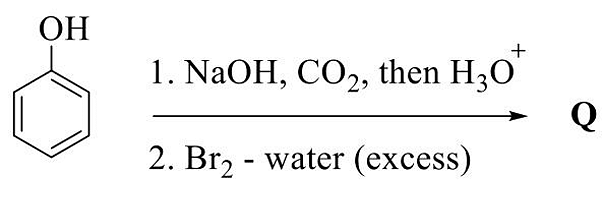
View More Questions
Top GATE CY Bioinorganic Chemistry Questions

Top GATE CY Questions
- Ψ(x) = \(\sqrt{\frac{32}{L^3}}\)[sin(\(\frac{\pi x}{L}\)).cos(\(\frac{\pi x}{L}\)).sin(\(\frac{2\pi y}{L}\)).sin(\(\frac{\pi z}{L}\))]Find the value of E221: E111.
 what is the final product
- Which are optically active?
 intensity ratio of final product
- Which among the following is true?
View More Questions