Question:
The correct statement(s) about enterobactin (ent) is(are)
The correct statement(s) about enterobactin (ent) is(are)
Show Hint
Enterobactin is a catecholate siderophore built from three 2,3-dihydroxybenzoyl-serine units joined into a macrolactone; it binds \(\mathrm{Fe^{3+}}\) through its six phenolate oxygens, not through hydroxamate groups.
Updated On: Aug 10, 2026
- It has three catechol moieties
- It has a serine-trilactone backbone
- It binds with \(\mathrm{Fe^{3+}}\) ion to form \(\mathrm{[Fe(ent)]^{3-}}\) ion
- It has three hydroxamic acid groups
Show Solution

Verified By Collegedunia
The Correct Option is A, B, C
Solution and Explanation
Step 1: Recall what enterobactin is.
Enterobactin is a siderophore, a small molecule bacteria such as \(\mathrm{E.\ coli}\) secrete to scavenge iron(III) from the surroundings, since \(\mathrm{Fe^{3+}}\) is barely soluble in water at neutral pH.
Step 2: Check the catechol claim.
Enterobactin is built from three molecules of 2,3-dihydroxybenzoic acid, each amide-linked to a serine residue, so it carries exactly three catechol (ortho-dihydroxybenzene) units.
Statement (A) is correct.
Step 3: Check the backbone claim.
The three serine residues are joined head to tail through their carboxyl and hydroxyl groups into a 9-membered cyclic triester, a macrolactone ring built from three serines, exactly what the term serine-trilactone backbone describes.
Statement (B) is correct.
Step 4: Check the iron-binding claim.
Each catechol unit offers two phenolate oxygens, giving six donor atoms in total, enough for a hexadentate, octahedral wrap around one \(\mathrm{Fe^{3+}}\) centre.
Each catecholate binds as a \(2-\) ligand once both phenolic protons are lost, so three catecholates carry \(3\times(-2)=-6\); combined with \(\mathrm{Fe^{3+}}\) the overall complex charge is \(-6+3=-3\), giving \(\mathrm{[Fe(ent)]^{3-}}\).
Statement (C) is correct, and this complex is one of the strongest natural iron chelates known.
Step 5: Check the hydroxamic acid claim.
Hydroxamic acid groups (\(\mathrm{-C(=O)NHOH}\)) are the binding groups of a different siderophore class, such as desferrioxamine, not of enterobactin, which binds through catechol oxygens instead.
Statement (D) is wrong.
Final Answer:
Enterobactin has three catechol groups, a cyclic serine-trilactone backbone, and forms \(\mathrm{[Fe(ent)]^{3-}}\); it has no hydroxamic acid groups.
\[ \boxed{\text{(A), (B), (C)}} \]
Enterobactin is a siderophore, a small molecule bacteria such as \(\mathrm{E.\ coli}\) secrete to scavenge iron(III) from the surroundings, since \(\mathrm{Fe^{3+}}\) is barely soluble in water at neutral pH.
Step 2: Check the catechol claim.
Enterobactin is built from three molecules of 2,3-dihydroxybenzoic acid, each amide-linked to a serine residue, so it carries exactly three catechol (ortho-dihydroxybenzene) units.
Statement (A) is correct.
Step 3: Check the backbone claim.
The three serine residues are joined head to tail through their carboxyl and hydroxyl groups into a 9-membered cyclic triester, a macrolactone ring built from three serines, exactly what the term serine-trilactone backbone describes.
Statement (B) is correct.
Step 4: Check the iron-binding claim.
Each catechol unit offers two phenolate oxygens, giving six donor atoms in total, enough for a hexadentate, octahedral wrap around one \(\mathrm{Fe^{3+}}\) centre.
Each catecholate binds as a \(2-\) ligand once both phenolic protons are lost, so three catecholates carry \(3\times(-2)=-6\); combined with \(\mathrm{Fe^{3+}}\) the overall complex charge is \(-6+3=-3\), giving \(\mathrm{[Fe(ent)]^{3-}}\).
Statement (C) is correct, and this complex is one of the strongest natural iron chelates known.
Step 5: Check the hydroxamic acid claim.
Hydroxamic acid groups (\(\mathrm{-C(=O)NHOH}\)) are the binding groups of a different siderophore class, such as desferrioxamine, not of enterobactin, which binds through catechol oxygens instead.
Statement (D) is wrong.
Final Answer:
Enterobactin has three catechol groups, a cyclic serine-trilactone backbone, and forms \(\mathrm{[Fe(ent)]^{3-}}\); it has no hydroxamic acid groups.
\[ \boxed{\text{(A), (B), (C)}} \]
Was this answer helpful?
0
0
Top GATE CY Inorganic Chemistry Questions
- Which are optically active?
- Among the following, the compound with the lowest CO stretching frequency is
- The ground state of [Cr(H2O)6]2+ is
- The reaction of XeF2 with HN(SO2F)2 at 273 K in CF2Cl2 solvent yields
- The major product in the given reaction sequence is Q. The mass spectrum of Q shows
([M] = molecular ion peak)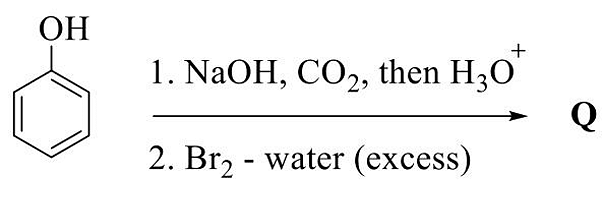
View More Questions
Top GATE CY Bioinorganic Chemistry Questions

Top GATE CY Questions
- Ψ(x) = \(\sqrt{\frac{32}{L^3}}\)[sin(\(\frac{\pi x}{L}\)).cos(\(\frac{\pi x}{L}\)).sin(\(\frac{2\pi y}{L}\)).sin(\(\frac{\pi z}{L}\))]Find the value of E221: E111.
 what is the final product
- Which are optically active?
 intensity ratio of final product
- Which among the following is true?
View More Questions