Question:
The block diagram of a two-tap high-pass FIR filter is shown below. The filter transfer function is given by \( H(z) = \frac{Y(z)}{X(z)} \).
If ratio of the maximum to minimum value of \( H(z) \) is 2 and \( |H(z)|_{\max} = 1 \), the coefficients \( \beta_0 \) and \( \beta_1 \) are _________ and _________, respectively.

The block diagram of a two-tap high-pass FIR filter is shown below. The filter transfer function is given by \( H(z) = \frac{Y(z)}{X(z)} \).
If ratio of the maximum to minimum value of \( H(z) \) is 2 and \( |H(z)|_{\max} = 1 \), the coefficients \( \beta_0 \) and \( \beta_1 \) are _________ and _________, respectively.
If ratio of the maximum to minimum value of \( H(z) \) is 2 and \( |H(z)|_{\max} = 1 \), the coefficients \( \beta_0 \) and \( \beta_1 \) are _________ and _________, respectively.
Show Hint
For two-tap FIR filters, maximum magnitude occurs at \( \omega = 0 \) or \( \omega = \pi \). Use simple algebra from max and min conditions to determine coefficients.
Updated On: Dec 4, 2025
- 0.75, –0.25
- 0.67, 0.33
- 0.60, –0.40
- –0.64, 0.36
Show Solution

Verified By Collegedunia
The Correct Option is A
Solution and Explanation
Step 1: Write the filter transfer function.
For a two-tap FIR filter shown, the transfer function is:
\[ H(z) = \beta_0 + \beta_1 z^{-1} \]
In the frequency domain, substitute \( z^{-1} = e^{-j\omega} \):
\[ H(e^{j\omega}) = \beta_0 + \beta_1 e^{-j\omega} \]
Step 2: Magnitude of the frequency response.
The magnitude becomes:
\[ |H(\omega)| = |\beta_0 + \beta_1 e^{-j\omega}| \]
The maximum magnitude occurs when cosine term adds constructively:
\[ |H|_{\max} = |\beta_0 + \beta_1| = 1 \]
The minimum magnitude occurs when cosine term subtracts:
\[ |H|_{\min} = |\beta_0 - \beta_1| \]
Step 3: Use the ratio of maximum to minimum.
We are given:
\[ \frac{|H|_{\max}}{|H|_{\min}} = 2 \]
\[ \frac{1}{|\beta_0 - \beta_1|} = 2 \]
\[ |\beta_0 - \beta_1| = \frac{1}{2} \]
Step 4: Solve the equations.
We have two equations:
1. \( \beta_0 + \beta_1 = 1 \)
2. \( \beta_0 - \beta_1 = 0.5 \)
Add them:
\[ 2\beta_0 = 1.5 \quad \Rightarrow \quad \beta_0 = 0.75 \]
Substitute back:
\[ 0.75 + \beta_1 = 1 \quad \Rightarrow \quad \beta_1 = -0.25 \]
Step 5: Conclusion.
Thus, the correct coefficients are:
\[ \beta_0 = 0.75,\quad \beta_1 = -0.25 \]
Hence, the correct answer is (A).
For a two-tap FIR filter shown, the transfer function is:
\[ H(z) = \beta_0 + \beta_1 z^{-1} \]
In the frequency domain, substitute \( z^{-1} = e^{-j\omega} \):
\[ H(e^{j\omega}) = \beta_0 + \beta_1 e^{-j\omega} \]
Step 2: Magnitude of the frequency response.
The magnitude becomes:
\[ |H(\omega)| = |\beta_0 + \beta_1 e^{-j\omega}| \]
The maximum magnitude occurs when cosine term adds constructively:
\[ |H|_{\max} = |\beta_0 + \beta_1| = 1 \]
The minimum magnitude occurs when cosine term subtracts:
\[ |H|_{\min} = |\beta_0 - \beta_1| \]
Step 3: Use the ratio of maximum to minimum.
We are given:
\[ \frac{|H|_{\max}}{|H|_{\min}} = 2 \]
\[ \frac{1}{|\beta_0 - \beta_1|} = 2 \]
\[ |\beta_0 - \beta_1| = \frac{1}{2} \]
Step 4: Solve the equations.
We have two equations:
1. \( \beta_0 + \beta_1 = 1 \)
2. \( \beta_0 - \beta_1 = 0.5 \)
Add them:
\[ 2\beta_0 = 1.5 \quad \Rightarrow \quad \beta_0 = 0.75 \]
Substitute back:
\[ 0.75 + \beta_1 = 1 \quad \Rightarrow \quad \beta_1 = -0.25 \]
Step 5: Conclusion.
Thus, the correct coefficients are:
\[ \beta_0 = 0.75,\quad \beta_1 = -0.25 \]
Hence, the correct answer is (A).
Was this answer helpful?
0
0
Top GATE BM Signals and Systems Questions
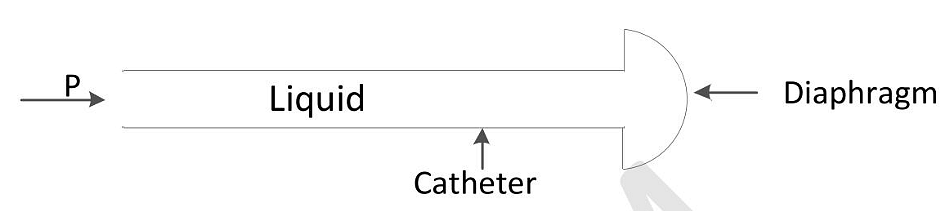
- In a catheter-sensor system to measure blood pressure (P) as shown in the below figure, the liquid resistance (RL) of the catheter is due to friction between shearing molecules flowing through the catheter. Which of the following is TRUE for RL if only the radius of the catheter is doubled. Assume that the pressure difference across the catheter segment is fixed.
- Which of the following statement(s) about pulse oximetry is/are TRUE?
- $x(t)$ is a real continuous-time signal whose magnitude frequency response ($|X(j\omega)|$) is shown below. After sampling $x(t)$ at $100\ \text{rad s}^{-1}$, the spectral point P is down-converted to _________ rad·s$^{-1}$ in the spectrum of the sampled signal.

- Discrete signals \( x[n] \) and \( y[n] \) are shown below. The cross-correlation \( r_{xy}[0] \) is _________

The time delay between the peaks of the voltage signals \( v_1(t) = 2\cos(6t + 60^\circ) \) and \( v_2(t) = -3\sin(6t) \) is ____ s.
View More Questions
Top GATE BM Digital Signal Processing Questions
- Discrete signals \( x[n] \) and \( y[n] \) are shown below. The cross-correlation \( r_{xy}[0] \) is _________
The time delay between the peaks of the voltage signals \( v_1(t) = 2\cos(6t + 60^\circ) \) and \( v_2(t) = -3\sin(6t) \) is ____ s.
- An input $x(t)$ is applied to a system with a frequency transfer function given by $H(j\omega)$ as shown. The magnitude and phase response are shown. If $y(t_d)=0$ for $x(t)=u(t)$, the time $t_d (>0)$ is _________ µs.

Top GATE BM Questions
- What is the value of the following complex line integral counter-clockwise ?
\(\oint_{|z|=3}\frac{8}{z(z-2)(z-4)}dz\) - To solve the equation x = 2 cos x using Newton-Raphson's method, which one of the following iterations should be used ?
- During the repolarization phase of a neuron, the cell is brought back to the resting potential by the action of a Sodium-Potassium pump. Which one of the following statements is TRUE for the active transport of Na+ and K+ ions through the cell membrane ?
- The cardiac rhythm in a healthy human heart originates from ______.
- Which one of the following events is NOT typically encountered in diagnostic X-ray projection radiography ?
View More Questions