Question:
Select the incorrect match :
Select the incorrect match :
Updated On: May 6, 2026
- Polytene chromosomes - Oocytes of amphibians
- Lampbrush chromosomes - Diplotene bivalents
- Submetacentric chromosomes - L-shaped chromososmes
- Allosomes - Sex chromosomes
Show Solution

Verified By Collegedunia
The Correct Option is A
Solution and Explanation
To determine the incorrect match from the given options, let's analyze each option with the relevant biological concepts.
- Polytene chromosomes - Oocytes of amphibians: Polytene chromosomes are oversized chromosomes found in the salivary glands of Drosophila (fruit flies) and some other dipteran insects. They are not typically associated with the oocytes of amphibians. Instead, amphibian oocytes are more likely to contain lampbrush chromosomes. Therefore, this is the incorrect match.
- Lampbrush chromosomes - Diplotene bivalents: Lampbrush chromosomes are a special type of chromosome found in the oocyte nuclei of most vertebrates, including amphibians, during the diplotene stage of meiosis. They are indeed characterized as being in the diplotene bivalents stage. Thus, this match is correct.
- Submetacentric chromosomes - L-shaped chromosomes: Submetacentric chromosomes have their centromere located slightly off-center, resulting in one arm being longer than the other. They are often described as being L-shaped due to this asymmetry. Hence, this match is correct.
- Allosomes - Sex chromosomes: Allosomes are indeed sex chromosomes. They differ from autosomes, which are non-sex chromosomes. Therefore, this match is correct.
In conclusion, the incorrect match is Polytene chromosomes - Oocytes of amphibians since polytene chromosomes are not associated with amphibian oocytes but with certain insect species' salivary glands.
Was this answer helpful?
0
0
Top NEET Biology Questions
- The chronological order of human evolution from early to the recent is
- Upper part of sea/aquatic ecosystem contains
- Where is respiratory electron transport system (ETS) located in plants ?
- Which among the following are the smallest living cells, known without a definite cell wall, pathogenic to plants as well as animals and can survive without oxygen ?
- Three of the following pairs of the human skeletal parts are correctly matched with their respective inclusive skeletal category and one pair is not matched. Identify the non-matching pair. .
Pair of skeletal parts Category (a)$\,\,$ Sternum and ribs$\,\,$ Axial skeleton (b)$\,\,$ Clavicle and glenoid cavity$\,\,$ Pelvic girdle (c)$\,\,$ Flumerus and ulna$\,\,$ Appendicular skeleton (d)$\,\,$ Malleus and stapes$\,\,$ Ear ossicles
View More Questions
Top NEET Cell: the unit of life Questions
- Match the columns and identity the correct option
Column I Column II A. Thylakoids (i) Disc-shaped sacs in Golgi apparatus B Cristate (ii) Condensed structure of DNA C Cisternae (iii) Flat membranous sacs in stroma D Chomatin (iv) Infolding in mitochondria - Identify the components labelled A, B, C and D in the diagram below from the list (i) to (viii) given along with Components: (i) Cristae of mitochondria (ii) Inner membrane of mitochondria (iii) Cytoplasm (iv) Smooth endoplasmic reticulum (v) Rough endoplasmic reticulum (vi) Mitochondrial matrix (vii) Cell vacuole (viii) Nucleus The correct components are:
A B C D (1) (v) (iv) (viii) (iii) (2) (i) (iv) (viii) (vi) (3) (vi) (v) (iv) (vii) (4) (v) (i) (iii) (ii) - Difference in gram ⊕ and gram bacteria is due to
- In plants inulin and pectin are
- Element necessary for the middle lamella
View More Questions
Top NEET Questions
- A $100.0\, mL$ dilute solution of $Ag ^{+}$is electrolysed for $15.0$ minutes with a current of $1.25 \,mA$ and the silver is removed completely. What was the initial $\left[ Ag ^{+}\right]$?
- The time constant of C-R circuit is
- The chronological order of human evolution from early to the recent is
- The correct Boolean operation represented by the circuit diagram drawn is :
- The driver of a car travelling with speed $30\, m/sec$ towards a hill sounds a horn of frequency $600\, Hz.$ If the velocity of sound in air is $330\, m/s,$ the frequency of reflected sound as heard by driver is
View More Questions
Concepts Used:
Cell: The Unit of Life
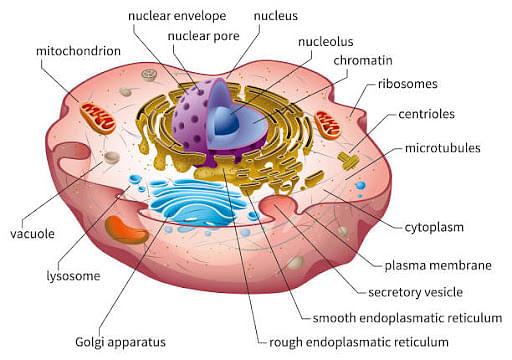
- A cell is derived as the functional and structural unit of life. Every cell is surrounded by a cell membrane that dissects the external and internal environments of the cell. The interior environment of a cell is called the cytoplasm.
- It carries cellular machinery and structural elements. The nucleus is present in the center of the cell, which includes all the hereditary information of an organism. Some of the molecules present in the cell are protein, carbohydrates, starch, and sugar.
Read More: Fundamental Unit of Life: Cell
Parts of Cell:
The different parts of a cell and their functions are as follows:
- Cell Membrane
- Cell Wall
- Nucleus
- Cytoplasm