N>40000, where N is divisible by 5. How many such 5 digit numbers can be formed using 0,1,3,5,7,9 without repetition.

Approach Solution - 1
The correct answer is 120.
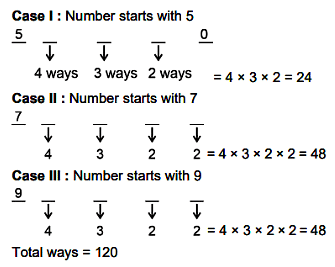
Approach Solution -2
We are to form 5-digit numbers using the digits {0, 1, 3, 5, 7, 9} without repetition, under two conditions:
- The number must be greater than 40,000.
- The number is divisible by 5 (i.e. its last digit must be 0 or 5)
Case 1: Last Digit is 0
With the last digit fixed as 0, the first digit cannot be 0 and must make the number > 40,000. The available digits for the first position (excluding 0) are {1, 3, 5, 7, 9}. Since the number must be > 40,000, the first digit must be at least 4. Among our choices, only 5, 7, and 9 qualify.
Number of choices for the first digit: 3.
After fixing the first and last digits, there remain 4 digits for the three middle positions. The number of ways to fill these positions is:
P(4, 3) = 4 × 3 × 2 = 24
Total numbers for Case 1: 3 × 24 = 72.
Case 2: Last Digit is 5
With the last digit fixed as 5, the first digit must be chosen from the remaining digits {0, 1, 3, 7, 9} (0 is not allowed in the first position) and must be at least 4 to ensure the number is > 40,000. This leaves only 7 and 9.
Number of choices for the first digit: 2.
The remaining three positions (the 2nd, 3rd, and 4th digits) can be filled from the 4 remaining digits (from a total of 6, after fixing the first and last digits) in:
P(4, 3) = 4 × 3 × 2 = 24
Total numbers for Case 2: 2 × 24 = 48.
Total Count
Total 5-digit numbers = 72 + 48 = 120.
Top JEE Main Mathematics Questions
- The value of is
- The number of terms of an is even. The sum of the odd terms is and of the even terms is . The last term exceeds the first by . Then the number of terms in the series is ______.
- If , then the general value of is:
- The general solution of
- If the constant term in the binomial expansion of $\left(\frac{x^{\frac{3}{2}}}{2}-\frac{4}{x^l}\right)^9$ is $-84$ and the coefficient of $x^{-3 l}$ is $2^\alpha \beta$, where $\beta<0$ is an odd number, then $|\alpha l-\beta|$ is equal to_____
Top JEE Main permutations and combinations Questions
- The number of ways of giving 20 distinct oranges to 3 children such that each child gets at least one orange is______
- Five people are distributed in four identical rooms. A room can also contain zero people. Find the number of ways to distribute them.
- The number of ways to distribute the 21 identical apples to three children’s so that each child gets at least 2 apples.
- Let \( \alpha = \frac{(4!)!}{(4!)^{3!}} \) and \( \beta = \frac{(5!)!}{(5!)^{4!}} \). Then:
- Number of ways of arranging 8 identical books into 4 identical shelves where any number of shelves may remain empty is equal to
Top JEE Main Questions
- Two masses $m$ and $\frac{m}{2}$ are connected at the two ends of a massless rigid rod of length $l$. The rod is suspended by a thin wire of torsional constant $k$ at the centre of mass of the rod-mass system(see figure). Because of torsional constant $k$, the restoring torque is $\tau =k\theta$ for angular displacement $\theta$. If the rod is rota ted by $\theta_0$ and released, the tension in it when it passes through its mean position will be:
What will be the equilibrium constant of the given reaction carried out in a \(5 \,L\) vessel and having equilibrium amounts of \(A_2\) and \(A\) as \(0.5\) mole and \(2 \times 10^{-6}\) mole respectively?
The reaction : \(A_2 \rightleftharpoons 2A\)- The value of is
- The number of terms of an is even. The sum of the odd terms is and of the even terms is . The last term exceeds the first by . Then the number of terms in the series is ______.
A black body is at a temperature of 2880 K. The energy of radiation emitted by this body with wavelength between 499 nm and 500 nm is U1, between 999 nm and 1000 nm is U2 and between 1499 nm and 1500 nm is U3. The Wien's constant, b = 2.88×10⁶ nm-K. Then,
Concepts Used:
Permutations
A permutation is an arrangement of multiple objects in a particular order taken a few or all at a time. The formula for permutation is as follows:
\(^nP_r = \frac{n!}{(n-r)!}\)
nPr = permutation
n = total number of objects
r = number of objects selected
Types of Permutation
- Permutation of n different things where repeating is not allowed
- Permutation of n different things where repeating is allowed
- Permutation of similar kinds or duplicate objects