Match the following food products in Column I with their corresponding processes in Column II.

Match the following food products in Column I with their corresponding processes in Column II.
Show Hint
- P-2; Q-3; R-4; S-1
- P-3; Q-2; R-4; S-1
- P-2; Q-4; R-1; S-3
- P-2; Q-3; R-1; S-4

The Correct Option is A
Solution and Explanation
The matching of food products with their respective processes is as follows:
- Idli (P): The correct process for making idli is fermentation (option 2), as idlis are made by fermenting a batter of rice and urad dal.
- Parboiled rice (Q): Parboiling involves gelatinization (option 3) of starch in rice, a process where the rice is soaked, steamed, and then dried.
- Soda beverage (R): The production of soda beverages involves carbonation (option 4), which is the process of dissolving carbon dioxide gas in the liquid to give it its fizz.
- Cookies (S): Baking (option 1) is the appropriate process for cookies, as they are baked in an oven.
Thus, the correct answer is (A) P-2; Q-3; R-4; S-1.
Top GATE XL Food Technology Questions
- Match the plant products in Group 1 with the plant species in Group 2 that produce them and the respective plant parts in Group 3 where they accumulate the most.
Group 1 Group 2 Group 3 (P) Liquorice (i) Cinchona calisaya (a) Leaf (Q) Quinine (ii) Lawsonia inermis (b) Root (R) Henna (iii) Glycyrriza glabra (c) Flower (S) Saffron (iv) Papaver somniferum (d) Bark (v) Crocus sativus (e) Seed - Match the plant products in Group 1 with the plant species in Group 2 that produce them and the respective plant parts in Group 3 where they accumulate the most.
Group 1 Group 2 (P) Net primary productivity (i) Total amount of produced by autotrophs energy (Q) Gross primary productivity (ii) A type of mutualism where one species is benefitted more than the other (R) Net productivity (iii) Amount of energy stored by autotrophs after respiration (S) Secondary productivity (iv) Unused amount of energy after consumption by heterotrophs - Identify the CORRECT combination(s) of plant natural products and the categories they belong to.
- Identify the CORRECT combination(s) between the enzymes in Group 1 and the reactions in Group 2 they catalyze.
Group 1 Group 2 (P) Cinnamate-4-hydroxylase (i) L-phenylalanine → Cinnamic acid (Q) Glycerate kinase (ii) Glyceraldehyde 3-phosphate → dihydroxyacetone phosphate (R) PEP carboxylase (iii) Glycolate + O\(_2\) → Glyoxylate + H\(_2\)O\(_2\) (S) Nitrate reductase (iv) NO\(_3^-\) + NAD(P)H + H\(^+\) → NO\(_2^-\) + NAD(P)\(^+\) + H\(_2\)O - Which of the following cocci is/are examples of division in one plane
Top GATE XL Food Production Questions
- Which mold is responsible for the characteristic blue marbling in blue-veined cheese?
- Identify the analysis that must be performed FIRST to judge 'cleanliness' of spice/herb powders.
- In canning and retorting of foods, which of the following is the correct expression of Ball process time (B)?
- Which of the following is the most suitable flexible packaging laminate for dry fruits?
- Which of the following statement(s) is/are TRUE for a package of gamma-irradiated (7.5 kGy) whole chicken?
Top GATE XL Questions
- The CORRECT order of electronegativity is
- Which one of the following is the CORRECT representation of the variation of the Gibbs free energy (G) of a substance with temperature (T) at constant pressure?
- Among the following, the structure representing histidine is
- The CORRECT order of acidity of the following compounds is
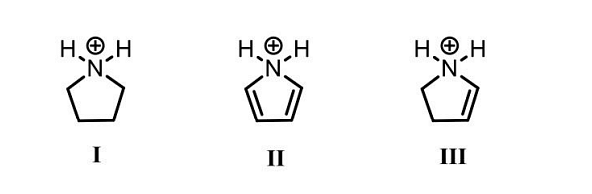
- The molecules A and B are a pair of___