Match List-I with List-II
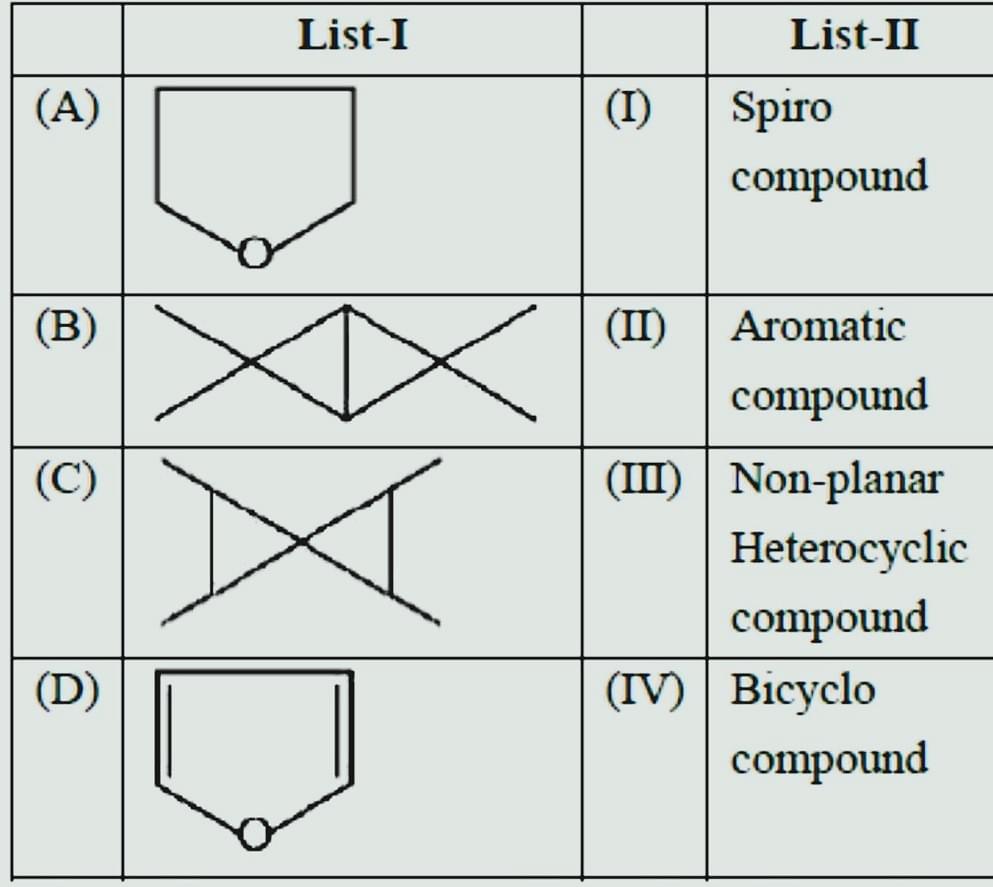
- (A) - (I), (B) - (I), (C) - (IV), (D) - (III)
- (A) - (II), (B) - (I), (C) - (IV), (D) - (III)
- (A) - (III), (B) - (IV), (C) - (I), (D) - (II)
- (A) - (IV), (B) - (III), (C) - (II), (D) - (I)

The Correct Option is C
Solution and Explanation
The correct option is (C): (A) - (III), (B) - (IV), (C) - (I), (D) - (II)
Top JEE Main Chemistry Questions
What will be the equilibrium constant of the given reaction carried out in a \(5 \,L\) vessel and having equilibrium amounts of \(A_2\) and \(A\) as \(0.5\) mole and \(2 \times 10^{-6}\) mole respectively?
The reaction : \(A_2 \rightleftharpoons 2A\)- At equilibrium the concentrations of and in a sealed vessel at . What will be for the reaction
- Find out the major products from the following reactions

Cobalt chloride when dissolved in water forms pink colored complex $X$ which has octahedral geometry. This solution on treating with cone $HCl$ forms deep blue complex, $\underline{Y}$ which has a $\underline{Z}$ geometry $X, Y$ and $Z$, respectively, are
- The correct order of atomic radii is:
Top JEE Main Aromatic Hydrocarbon Questions
Consider the following sequence of reactions:

The major product $P$ is:
- Given below are two statements: one is labelled as Assertion A and, the other is labelled as Reason R.
Assertion A: [6] Annulene, [8] Annulene and cis-[10] Annulene, are respectively aromatic, not-aromatic and aromatic.
Reason R: Planarity is one, of the requirements of aromatic systems.
In the light of the above statements, choose the most appropriate answer from the options given below.
Top JEE Main Questions
- Two masses $m$ and $\frac{m}{2}$ are connected at the two ends of a massless rigid rod of length $l$. The rod is suspended by a thin wire of torsional constant $k$ at the centre of mass of the rod-mass system(see figure). Because of torsional constant $k$, the restoring torque is $\tau =k\theta$ for angular displacement $\theta$. If the rod is rota ted by $\theta_0$ and released, the tension in it when it passes through its mean position will be:
What will be the equilibrium constant of the given reaction carried out in a \(5 \,L\) vessel and having equilibrium amounts of \(A_2\) and \(A\) as \(0.5\) mole and \(2 \times 10^{-6}\) mole respectively?
The reaction : \(A_2 \rightleftharpoons 2A\)- The value of is
- The number of terms of an is even. The sum of the odd terms is and of the even terms is . The last term exceeds the first by . Then the number of terms in the series is ______.
A black body is at a temperature of 2880 K. The energy of radiation emitted by this body with wavelength between 499 nm and 500 nm is U1, between 999 nm and 1000 nm is U2 and between 1499 nm and 1500 nm is U3. The Wien's constant, b = 2.88×10⁶ nm-K. Then,
Concepts Used:
Aromatic hydrocarbon
Aromatic hydrocarbons, sometimes known as arenes, are aromatic organic molecules made up entirely of carbon and hydrogen. In aromatic compounds a benzene ring which is named after the simple aromatic chemical benzene, or a phenyl group when part of a larger structure, is the configuration of six carbon atoms.
Read More: Aromaticity
Reactions of Aromatic Hydrocarbons:
1. Aromatic Substitution Reactions
This reaction involves the replacement of one substituent on the ring of an aromatic hydrocarbon, commonly a hydrogen atom, by a different substituent group.
The common types of aromatic substitution reactions are:
- Nucleophilic aromatic substitution reactions
- Electrophilic aromatic substitution reactions
- Radical nucleophilic aromatic substitution reactions
2. Coupling Reactions
In these types of reactions, the coupling of two fragments that have a radical nature is achieved with the help of a metal catalyst