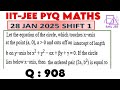
Let the equation of the circle, which touches x-axis at the point \( (a, 0) \) and cuts off an intercept of length \( b \) on y-axis be \( x^2 + y^2 - cx + dy + e = 0 \). If the circle lies below x-axis, then the ordered pair \( (2a, b^2) \) is equal to:
Show Hint
- \( (y, \beta^2 - 4\alpha) \)
- \( (\alpha, \beta^2 - 4\gamma) \)
- \( (y, \beta^2 + 4\alpha) \)
- \( (\alpha, \beta^2 + 4\gamma) \)

The Correct Option is D
Solution and Explanation
The equation of the circle can be rewritten as (x - a)2 + (y - r)2 = r2, where the circle touches the x-axis at the point (\(a, 0\)), meaning its radius \(r\) is such that the center of the circle is \( (a, -r) \). Thus, the circle has the form:
x2 + y2 - 2ax + 2ry + e = 0.
Since it touches the x-axis at \( (a, 0) \), the distance from \((a, -r)\) to the x-axis is \(r\), confirming \(b = 2r\), as it cuts an intercept \(b\) on the y-axis. Solving for the center's y-coordinate from the intercept, we have \( (0, b/2)\) implies:
\((0^2+(b/2)^2+r^2=b^2)\).
Simplifying:
- \(b^2/4 + r^2 = b^2\).
- \(r^2 = 3b^2/4\).
Additionally, the center's equation gives \(d = 2r = b\). Comparing the circle's form with:
- \(c = 2a\).
- \(d = -2r = -b\).
The conditions given in the options align \( (2a, b^2) \) with \((\alpha,\beta^2+4\gamma)\). Therefore, the matching conditions confirm:
- \(\alpha=2a\).
- \(\beta^2=b^2\).
- \(4\gamma=4r^2=3b^2\).
Thus, the correct option is \( (\alpha, \beta^2+4\gamma) \).
Learn with videos:
Top JEE Main Mathematics Questions
- The value of is
- The number of terms of an is even. The sum of the odd terms is and of the even terms is . The last term exceeds the first by . Then the number of terms in the series is ______.
- If , then the general value of is:
- The general solution of
- If the constant term in the binomial expansion of $\left(\frac{x^{\frac{3}{2}}}{2}-\frac{4}{x^l}\right)^9$ is $-84$ and the coefficient of $x^{-3 l}$ is $2^\alpha \beta$, where $\beta<0$ is an odd number, then $|\alpha l-\beta|$ is equal to_____
Top JEE Main Coordinate Geometry Questions
- The area (in square units) of the region bounded by the parabola \(y^2 = 4(x - 2)\) and the line \(y = 2x - 8\) is:
In a △ABC, suppose y = x is the equation of the bisector of the angle B and the equation of the side AC is 2x−y = 2. If 2AB = BC and the points A and B are respectively (4, 6) and (α, β), then α + 2β is equal to:
- Let\((5,\frac{a}{4})\),be the circumcenter of a triangle with vertices A (a, -2),B (a, 6)and C \((\frac{a}{4},-2)\).Let \(\alpha\) denote the circumradius, \(\beta\) denote the area and \(\gamma\) denote the perimeter of the triangle. Then \(\alpha+\beta+\gamma\) is
- The area (in square units) of the part of the circle \(x^2 + y^2 = 169\) which is below the line \( 5x - y = 13 \) is\[\frac{\pi \alpha}{2 \beta} - \frac{65}{2} + \frac{\alpha}{\beta} \sin^{-1} \left( \frac{12}{13} \right)\]where \( \alpha \) and \( \beta \) are coprime numbers. Then \( \alpha + \beta \) is equal to
- The length of the chord of the ellipse \(\frac{x^2}{25} + \frac{y^2}{16} = 1\), whose mid-point is \(\left(1, \frac{2}{5}\right)\), is equal to:
Top JEE Main Questions
- Two masses $m$ and $\frac{m}{2}$ are connected at the two ends of a massless rigid rod of length $l$. The rod is suspended by a thin wire of torsional constant $k$ at the centre of mass of the rod-mass system(see figure). Because of torsional constant $k$, the restoring torque is $\tau =k\theta$ for angular displacement $\theta$. If the rod is rota ted by $\theta_0$ and released, the tension in it when it passes through its mean position will be:
What will be the equilibrium constant of the given reaction carried out in a \(5 \,L\) vessel and having equilibrium amounts of \(A_2\) and \(A\) as \(0.5\) mole and \(2 \times 10^{-6}\) mole respectively?
The reaction : \(A_2 \rightleftharpoons 2A\)- The value of is
- The number of terms of an is even. The sum of the odd terms is and of the even terms is . The last term exceeds the first by . Then the number of terms in the series is ______.
A black body is at a temperature of 2880 K. The energy of radiation emitted by this body with wavelength between 499 nm and 500 nm is U1, between 999 nm and 1000 nm is U2 and between 1499 nm and 1500 nm is U3. The Wien's constant, b = 2.88×10⁶ nm-K. Then,