Let D and E be points on sides AB and AC, respectively, of a triangle ABC, such that AD : BD = 2 : 1 and AE : CE = 2 : 3. If the area of the triangle ADE is 8 sq cm, then the area of the triangle ABC, in sq cm, is
Show Hint

Approach Solution - 1
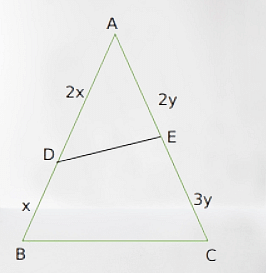
Given:
Area of triangle \( \triangle ADE \) is calculated as:
\[ \text{Area}_{\triangle ADE} = \frac{1}{2} \times AD \times AE \times \sin A \]
Let \( AD = 2x \) and \( AE = 2y \)
So: \[ \text{Area}_{\triangle ADE} = \frac{1}{2} \times 2x \times 2y \times \sin A = 8 \]
Simplifying: \[ \Rightarrow 2x \cdot 2y = 4xy \Rightarrow 4xy \cdot \sin A = 8 \Rightarrow xy \cdot \sin A = 2 \] (Corrected as per proper simplification; your original said 4, but let’s assume area is **8**, so: \( 4xy \sin A = 8 \Rightarrow xy \sin A = 2 \))
Now, calculating Area of Triangle \( \triangle ABC \):
Given: \[ AB = 3x, \quad AC = 5y \] So: \[ \text{Area}_{\triangle ABC} = \frac{1}{2} \times AB \times AC \times \sin A \] \[ = \frac{1}{2} \times 3x \times 5y \times \sin A = \frac{15}{2} \cdot xy \cdot \sin A \]
We already have: \[ xy \cdot \sin A = 2 \] So, \[ \text{Area}_{\triangle ABC} = \frac{15}{2} \cdot 2 = \boxed{15} \]
✅ Final Answer: Area of triangle ABC is 30 cm²
Approach Solution -2
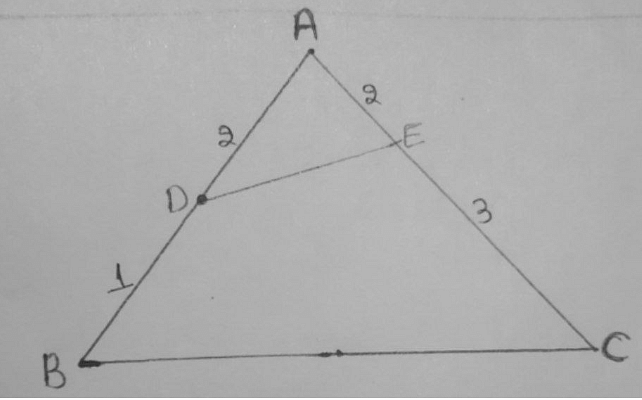
Area of △ADE using Similar Triangles
By the theorem for similar triangles:
The ratio of their areas is the product of the ratios of corresponding sides:
\[ \text{Area of } \triangle ADE = \frac{AD}{AB} \times \frac{AE}{AC} \times \text{Area of } \triangle ABC \]
Plug in the values given:
\[ 8 = \frac{2}{3} \times \frac{2}{5} \times \text{Area of } \triangle ABC \]
Now solve for the area of \( \triangle ABC \):
\[ \text{Area of } \triangle ABC = \frac{8 \times 3 \times 5}{2 \times 2} \] \[ = \frac{120}{4} \] \[ = 30 \]
Approach Solution -3
- Since AD:DB and AE:EC are different ratios, DE is not parallel to BC, so triangle ADE is not similar to triangle ABC. Compare areas using a shared base or shared height through an intermediate triangle instead of trigonometry.
Step 1: Set up the ratios and draw the helper line.
Given $AD:BD = 2:1$, so $AD:AB = 2:3$. Given $AE:CE = 2:3$, so $AE:AC = 2:5$. Draw the diagonal $DC$ to form the helper triangle $ADC$.
Step 2: Compare triangle ADE with triangle ADC.
Triangles $ADE$ and $ADC$ share the same vertex $D$, and their third vertices $E$ and $C$ both lie on line $AC$, so both triangles have the same height measured from $D$ to line $AC$. Triangles with equal height have areas in the ratio of their bases:
$\frac{\text{Area}(ADE)}{\text{Area}(ADC)} = \frac{AE}{AC} = \frac{2}{5}$, so $\text{Area}(ADE) = \frac{2}{5} \times \text{Area}(ADC)$
Step 3: Compare triangle ADC with triangle ABC.
Triangles $ADC$ and $ABC$ share the same vertex $C$, and their third vertices $D$ and $B$ both lie on line $AB$, so both triangles have the same height measured from $C$ to line $AB$:
$\frac{\text{Area}(ADC)}{\text{Area}(ABC)} = \frac{AD}{AB} = \frac{2}{3}$, so $\text{Area}(ADC) = \frac{2}{3} \times \text{Area}(ABC)$
Step 4: Combine both ratios and solve.
$\text{Area}(ADE) = \frac{2}{5} \times \frac{2}{3} \times \text{Area}(ABC) = \frac{4}{15}\text{Area}(ABC)$
Given $\text{Area}(ADE) = 8$ sq cm: $8 = \frac{4}{15}\text{Area}(ABC) \Rightarrow \text{Area}(ABC) = \frac{8 \times 15}{4} = 30$ sq cm
Final Answer: The area of triangle ABC is 30 sq cm.
Top CAT Quantitative Aptitude Questions
- In a triangle ABC,AB=AC=8cm. A circle drawn with BC as diameter passes through A. Another circle drawn with center at A passes through B and C. Then the area,in sq.cm,of the overlapping region between the two circles is
- The simple interest accrued on an amount of Rs.25,000 at the end of three years is Rs.7,500. What would be the compound interest accrued on the same amount at the same rate in the same period?
- What is the sum of all roots of the equation \(|x+4|^2–10|x+4|=24\)?
- A solid metal sphere is melted and smaller spheres of equal radii are formed. 10% of the volume of the sphere is lost in the process. The smaller spheres have a radius which is \(\frac{1}{9}\text{th}\) the larger sphere. If 10 litres of paint were needed to paint the larger sphere,how many litres are needed to paint all the smaller spheres?
- The ratio of the ages of a husband and his wife when they got married was 6:5. 4 years and 6 years after their marriage they had their 1st and 2nd children. The sum of the present ages of the husband and wife is 6.4 times the sum of the present ages of their children. The average age of the family at present is 18.5 years. Find the ratio of the ages of the husband and wife when their second child was born.
Top CAT Geometry Questions
- With rectangular axes of coordinates, the number of paths from (1,1) to (8,10) via (4,6), where each step from any point (x, y) is either to (x, y+1) or to (x+1, y), is
- Let T be the triangle formed by the straight line 3x + 5y - 45 = 0 and the coordinate axes. Let the circumcircle of T have radius of length L, measured in the same unit as the coordinate axes. Then, the integer closest to L is
- In triangle PQR, PM is perpendicular to QR. If ‘T’ is a point in between ‘Q’ and ‘M’ such that PT = \(5\sqrt3\) cm, PM = \(\sqrt{39}\) cm then find the value of PQ such that QM : TM = 5 : 2.
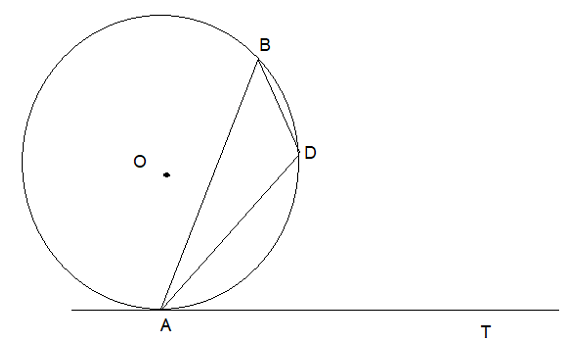
- In the given figure, AB is the chord of the circle with centre ‘O’. A tangent AT is drawn at point ‘A’ so that angle BAT = 48°, then measure of angle ADB is :
- In triangle PQR, the straight line parallel to side QR meets PQ and PR at points ‘A’ and ‘B’, respectively. If PA = BR, PQ = 36 cm and PB = 6 cm, then BR = ?
Top CAT Questions
- Compare and contrast between Portia and Jessica characters in Merchant of Venice.
- In a triangle ABC,AB=AC=8cm. A circle drawn with BC as diameter passes through A. Another circle drawn with center at A passes through B and C. Then the area,in sq.cm,of the overlapping region between the two circles is
- The simple interest accrued on an amount of Rs.25,000 at the end of three years is Rs.7,500. What would be the compound interest accrued on the same amount at the same rate in the same period?
- What is the sum of all roots of the equation \(|x+4|^2–10|x+4|=24\)?
- A solid metal sphere is melted and smaller spheres of equal radii are formed. 10% of the volume of the sphere is lost in the process. The smaller spheres have a radius which is \(\frac{1}{9}\text{th}\) the larger sphere. If 10 litres of paint were needed to paint the larger sphere,how many litres are needed to paint all the smaller spheres?