Question:
Let A = ACE inhibitor, B = beta blocker, C = calcium channel blocker, and D = diuretic. For an elderly patient with hypertension, the antihypertensive drug of choice is?
Let A = ACE inhibitor, B = beta blocker, C = calcium channel blocker, and D = diuretic. For an elderly patient with hypertension, the antihypertensive drug of choice is?
Show Hint
Elderly patients are low-renin, so favour the renin-independent arm of the AB/CD rule.
Updated On: Jun 24, 2026
- A or D
- A or B
- A or C
- C or D
Show Solution

Verified By Collegedunia
The Correct Option is D
Solution and Explanation
Step 1: Antihypertensive therapy is structured by the AB/CD rule. A and B (ACE inhibitor and beta blocker) act mainly by suppressing the renin-angiotensin system and tend to work better in younger patients who have high renin. C and D (calcium channel blocker and diuretic) work independently of renin and are preferred in older patients and in those of African origin, who typically have a low-renin, volume-dependent pattern.
Step 2: In the elderly, renin activity is low, so renin-targeting drugs are less effective as first-line agents. Calcium channel blockers and diuretics give better blood pressure control in this group, which is why C or D is the answer (option d).
Step 3: The other combinations all pair in a renin-dependent agent (A or B), which is the preferred starting choice for the younger high-renin patient, not the elderly. Hence A or D, A or B and A or C are not the best fit here.
Step 2: In the elderly, renin activity is low, so renin-targeting drugs are less effective as first-line agents. Calcium channel blockers and diuretics give better blood pressure control in this group, which is why C or D is the answer (option d).
Step 3: The other combinations all pair in a renin-dependent agent (A or B), which is the preferred starting choice for the younger high-renin patient, not the elderly. Hence A or D, A or B and A or C are not the best fit here.
Was this answer helpful?
0
0
Top NEET PG Pharmacology Questions
- A bronchial asthma patient on inhalational steroids presented with white patchy lesions on the tongue and buccal mucosa. What is the drug that can be used to treat this condition?
- A pregnant woman with a history of bronchial asthma is in the third stage of labor. Which drugs should be avoided in managing postpartum hemorrhage in this mother?
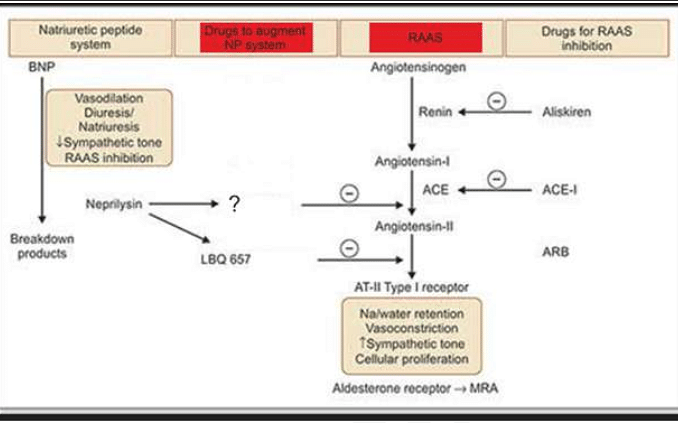
- Name the drug that acts on both the marked areas.
- A patient with a previous history of myocardial infarction and ventricular arrhythmia is ontreatment for a few months. He developed fatigue, dyspnea, and weight gain. He had also developed pulmonary fibrosis. Which of the following drugs is responsible for the side effects mentioned above?
- A young female comes to the emergency department after consuming 100 aspirin tablets.What should be the next step in management?
View More Questions
Top NEET PG Antihypertensives in CKD Questions
Top NEET PG Questions
- A patient hailing from Delhi presents with fever, arthralgia, and extensive petechial rash for 3 days. Lab investigations revealed a hemoglobin of 9 g/ dL, a white blood cell count of 9000 cells/mm3, a platelet count of 20000 cells/mm3, and a prolonged bleeding time. The clotting time was normal. What is the most likely diagnosis?
- Which of the following statements is true about Trichomonas vaginalis?
- A lady from West Rajasthan presented with an ulcer surrounded by erythema on the right leg. Microscopy of the biopsy from the edge of the ulcer showed organisms with dark staining nuclei and kinetoplast. What is the most likely causative agent?
- A child presents with a fever and a rash. Urine examination showed cells with owl's eye appearance. What is the most likely diagnosis?
- Infection with Clonorchis sinensis is associated with an increased risk of__?
View More Questions