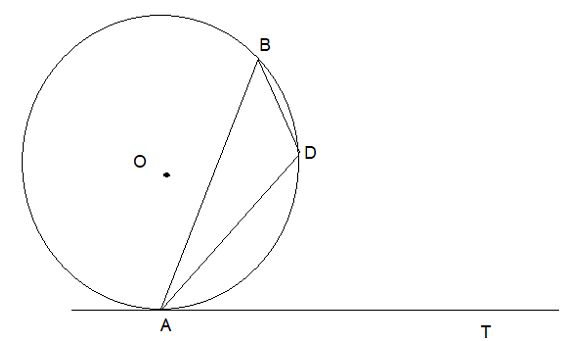
In the figure below, AB is the chord of a circle with center O. AB is extended to C such that BC = OB. The straight line CO is produced to meet the circle at D. If \( \angle ACD \) = y degrees and \( \angle AOD \) = x degrees such that x = ky, then the value of k is
Show Hint
Mark equal radii first. Use the isosceles triangle with BC = OB, then the exterior angle theorem, and watch how the angle at A builds up.
Step 1: Understanding the Concept:
OA, OB and OD are all radii of the same circle, so they are equal. We are also told BC = OB, so BC equals the radius too. Equal sides give isosceles triangles, and equal sides in a triangle have equal angles opposite them. We will use this twice and then use the exterior angle theorem.
Step 2: Key Formula or Approach:
1. Angles opposite equal sides of a triangle are equal.
2. An exterior angle of a triangle equals the sum of the two opposite interior angles.
Step 3: Use triangle OBC.
Since BC = OB, triangle OBC is isosceles with the equal sides BC and OB. The angles opposite them are \( \angle BOC \) (opposite BC) and \( \angle BCO \) (opposite OB). \( \angle BCO \) is the same as \( \angle ACD = y \), so \( \angle BOC = y \) as well.
Step 4: Find the exterior angle at B.
\( \angle OBA \) is an exterior angle of triangle OBC at vertex B, because AB is extended to C. So \( \angle OBA = \angle BOC + \angle BCO = y + y = 2y \).
Step 5: Use triangle OAB.
OA = OB (radii), so triangle OAB is isosceles and \( \angle OAB = \angle OBA = 2y \).
Step 6: Use triangle OAC.
Look at triangle AOC. Its exterior angle at O is \( \angle AOD \), because CO is extended to D. So \[ x = \angle AOD = \angle OAC + \angle ACO = 2y + y = 3y \] Here \( \angle OAC \) is the same as \( \angle OAB = 2y \), since B lies on AC.
Step 7: Read off k and check the options.
We have x = 3y, and the question says x = ky, so \( k = 3 \). Option 2 (value 2) and option 3 (value 1) would make x much smaller than 3y, which does not match the angle chase above. Option 4 is wrong because k is fully determined and equals 3.
Final Answer:
Comparing x = 3y with x = ky gives k = 3, which is option 1.
\[ \boxed{3} \]