Question:
In the circuit shown below, $V_5 = 100 V$, $R_1 = 30 \Omega$, $R_2 = 60 \Omega$, $R_3 = 90 \Omega$, $R_4 = 45 \Omega$, and $R_5 = 30 \Omega$. The current flowing through resistor $R_3$ is \(\underline{\hspace{1cm}}\) A. (rounded off to two decimal places)

In the circuit shown below, $V_5 = 100 V$, $R_1 = 30 \Omega$, $R_2 = 60 \Omega$, $R_3 = 90 \Omega$, $R_4 = 45 \Omega$, and $R_5 = 30 \Omega$. The current flowing through resistor $R_3$ is \(\underline{\hspace{1cm}}\) A. (rounded off to two decimal places)
Show Hint
Use the current divider rule when dealing with resistors in parallel and series to calculate the current through specific resistors.
Updated On: Dec 24, 2025
- +0.30
- +0.21
- -0.21
- -0.30
Show Solution

Verified By Collegedunia
The Correct Option is B
Solution and Explanation
First, we will calculate the total resistance in the circuit. The resistors are connected in a combination of series and parallel. Let's break down the calculation step by step:
1. Combine $R_1$ and $R_2$ in parallel:
The formula for two resistors in parallel is:
\[
\frac{1}{R_{\text{parallel}}} = \frac{1}{R_1} + \frac{1}{R_2}
\]
Substituting values:
\[
\frac{1}{R_{\text{parallel}}} = \frac{1}{30} + \frac{1}{60} = \frac{2}{60} + \frac{1}{60} = \frac{3}{60} = \frac{1}{20}
\]
Thus,
\[
R_{\text{parallel}} = 20 \, \Omega
\]
2. Add $R_3$ in series with $R_{\text{parallel}$:}
\[
R_{\text{total1}} = R_{\text{parallel}} + R_3 = 20 + 90 = 110 \, \Omega
\]
3. Combine $R_4$ and $R_5$ in parallel:
\[
\frac{1}{R_{\text{parallel2}}} = \frac{1}{R_4} + \frac{1}{R_5} = \frac{1}{45} + \frac{1}{30}
\]
\[
\frac{1}{R_{\text{parallel2}}} = \frac{2}{90} + \frac{3}{90} = \frac{5}{90}
\]
Thus,
\[
R_{\text{parallel2}} = \frac{90}{5} = 18 \, \Omega
\]
4. Add $R_{\text{parallel2}$ in series with $R_{\text{total1}}$:}
\[
R_{\text{total}} = R_{\text{total1}} + R_{\text{parallel2}} = 110 + 18 = 128 \, \Omega
\]
5. Calculate the total current using Ohm's Law:
\[
I_{\text{total}} = \frac{V}{R_{\text{total}}} = \frac{100}{128} = 0.78125 \, \text{A}
\]
6. Finally, calculate the current through $R_3$:
Since $R_3$ is in the path with $R_{\text{parallel}}$, we use the current divider rule. The current through $R_3$ is:
\[
I_{R_3} = I_{\text{total}} \times \frac{R_{\text{parallel}}}{R_{\text{total}}} = 0.78125 \times \frac{20}{128} = 0.21 \, \text{A}
\]
Thus, the current through $R_3$ is +0.21 A, corresponding to option (B).
Was this answer helpful?
0
0
Top GATE BM Electrical Circuits Questions
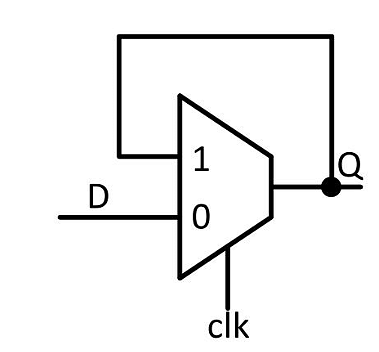
- The circuit shown in the figure functions as which one of the following digital circuit blocks ?
- The measured current through a device is 5 A, the voltage measured across the device is 20 V. The ammeter and the voltmeter used for these measurements have a measurement uncertainty of 1% each. The maximum error in estimation of impedance of the device is ______ mΩ. Give your answer rounded to the nearest integer.
- The Larmor frequency of a Na nucleus when placed in a magnetic field strength of 3 T is _______. (The gyromagnetic ratio of Na is given as γ = 11.26 MHz/T.)
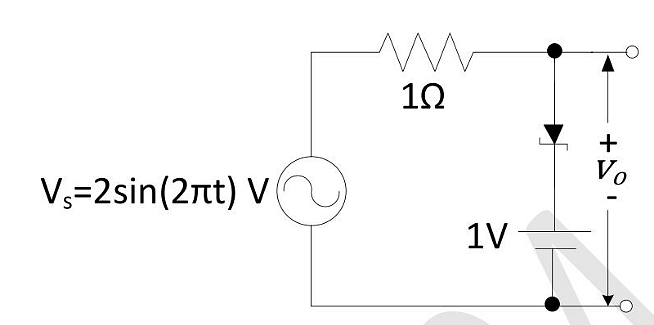
Give your answer in MHz rounded off to the nearest integer. - Which of the following waveforms represents the output V. of the circuit given below? The Zener diode used has a Zener breakdown voltage of 1 V and can be assumed ideal while in forward bias.
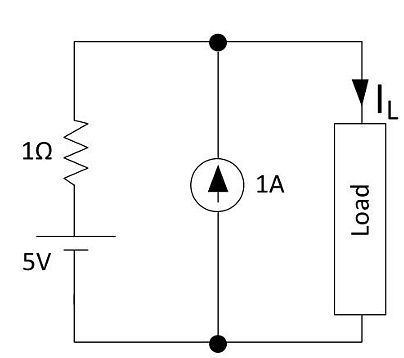
- In the circuit below, what is the value of IL to transfer the maximum power to load ?
View More Questions
Top GATE BM Questions
- What is the value of the following complex line integral counter-clockwise ?
\(\oint_{|z|=3}\frac{8}{z(z-2)(z-4)}dz\) - To solve the equation x = 2 cos x using Newton-Raphson's method, which one of the following iterations should be used ?
- During the repolarization phase of a neuron, the cell is brought back to the resting potential by the action of a Sodium-Potassium pump. Which one of the following statements is TRUE for the active transport of Na+ and K+ ions through the cell membrane ?
- The cardiac rhythm in a healthy human heart originates from ______.
- Which one of the following events is NOT typically encountered in diagnostic X-ray projection radiography ?
View More Questions