Question:
In a circle with center $C$ and radius $6\sqrt{2}$ cm, $PQ$ and $SR$ are two parallel chords separated by one of the diameters. If $\angle PQC = 45^\circ$, and the ratio of the perpendicular distance of $PQ$ and $SR$ from $C$ is $3:2$, then the area, in sq. cm, of the quadrilateral $PQRS$ is:
In a circle with center $C$ and radius $6\sqrt{2}$ cm, $PQ$ and $SR$ are two parallel chords separated by one of the diameters. If $\angle PQC = 45^\circ$, and the ratio of the perpendicular distance of $PQ$ and $SR$ from $C$ is $3:2$, then the area, in sq. cm, of the quadrilateral $PQRS$ is:
Show Hint
For chords in a circle:
\begin{itemize}
\item The perpendicular from the center to a chord bisects the chord.
\item Use right triangles with the radius as hypotenuse to relate distances from the center to chord lengths.
\item When two parallel chords lie on opposite sides of the center, the distance between them is the sum of their perpendicular distances from the center.
\end{itemize}
Updated On: Jul 24, 2026
- \(20(3 + \sqrt{14})\)
- \(20(3\sqrt{2} + \sqrt{7})\)
- \(4(3 + \sqrt{14})\)
- \(4(3\sqrt{2} + \sqrt{7})\)
Show Solution

Verified By Collegedunia
The Correct Option is A
Approach Solution - 1
Approach: A perpendicular from the centre bisects each chord, and the radius to an endpoint forms a right triangle with that perpendicular. The \(45^\circ\) angle pins down the first chord; the \(3:2\) ratio gives the second distance, and since the chords sit on opposite sides of a diameter, the figure is a trapezium whose height is the sum of the two distances.
Step 1: Chord \(PQ\) and its distance \(d_1\). Drop \(CM \perp PQ\); then \(M\) is the midpoint and \(\triangle CMQ\) is right-angled at \(M\) with hypotenuse \(CQ = R = 6\sqrt2\) and \(\angle MQC = 45^\circ\). \[ d_1 = CM = R\sin 45^\circ = 6\sqrt2 \cdot \tfrac{1}{\sqrt2} = 6, \qquad MQ = R\cos 45^\circ = 6. \] So \(PQ = 2 \cdot MQ = 12\).
Step 2: Distance \(d_2\) and chord \(SR\). From \(d_1 : d_2 = 3:2\) with \(d_1 = 6\): \[ d_2 = 6 \cdot \tfrac{2}{3} = 4. \] In right \(\triangle CNR\) (with \(CN = d_2 = 4\), \(CR = R\)): \[ NR^2 = R^2 - d_2^2 = 72 - 16 = 56 \implies NR = 2\sqrt{14}, \] so \(SR = 2 \cdot NR = 4\sqrt{14}\).
Step 3: Area of trapezium \(PQRS\). The chords are parallel and on opposite sides of \(C\), so the height between them is \[ h = d_1 + d_2 = 6 + 4 = 10. \] \[ \text{Area} = \tfrac12(PQ + SR)\,h = \tfrac12\big(12 + 4\sqrt{14}\big)\cdot 10 = 5\big(12 + 4\sqrt{14}\big) = 60 + 20\sqrt{14}. \] \[ = 20\big(3 + \sqrt{14}\big). \]
\[ \boxed{20(3 + \sqrt{14}) \text{ sq. cm}} \] (option 1).
Step 1: Chord \(PQ\) and its distance \(d_1\). Drop \(CM \perp PQ\); then \(M\) is the midpoint and \(\triangle CMQ\) is right-angled at \(M\) with hypotenuse \(CQ = R = 6\sqrt2\) and \(\angle MQC = 45^\circ\). \[ d_1 = CM = R\sin 45^\circ = 6\sqrt2 \cdot \tfrac{1}{\sqrt2} = 6, \qquad MQ = R\cos 45^\circ = 6. \] So \(PQ = 2 \cdot MQ = 12\).
Step 2: Distance \(d_2\) and chord \(SR\). From \(d_1 : d_2 = 3:2\) with \(d_1 = 6\): \[ d_2 = 6 \cdot \tfrac{2}{3} = 4. \] In right \(\triangle CNR\) (with \(CN = d_2 = 4\), \(CR = R\)): \[ NR^2 = R^2 - d_2^2 = 72 - 16 = 56 \implies NR = 2\sqrt{14}, \] so \(SR = 2 \cdot NR = 4\sqrt{14}\).
Step 3: Area of trapezium \(PQRS\). The chords are parallel and on opposite sides of \(C\), so the height between them is \[ h = d_1 + d_2 = 6 + 4 = 10. \] \[ \text{Area} = \tfrac12(PQ + SR)\,h = \tfrac12\big(12 + 4\sqrt{14}\big)\cdot 10 = 5\big(12 + 4\sqrt{14}\big) = 60 + 20\sqrt{14}. \] \[ = 20\big(3 + \sqrt{14}\big). \]
\[ \boxed{20(3 + \sqrt{14}) \text{ sq. cm}} \] (option 1).
Was this answer helpful?
0
0
Show Solution
Verified By Collegedunia
Approach Solution -2
Approach: Use the special \(45^\circ\)-\(45^\circ\)-\(90^\circ\) triangle property directly (equal legs) instead of trigonometric ratios, and the general "chord length from centre distance" relation \(\text{half-chord} = \sqrt{R^2 - d^2}\), to get both chords quickly.
Step 1: Distance to \(PQ\). Drop the perpendicular \(CM\) from centre \(C\) to \(PQ\); \(\triangle CMQ\) is right-angled at \(M\) with \(\angle MQC = 45^\circ\), so it is an isosceles right triangle: \(CM = MQ\). By Pythagoras, \(CM^2 + MQ^2 = R^2 = 72\), and since \(CM=MQ\), \(2\,CM^2 = 72 \Rightarrow CM = 6\). So \(d_1 = 6\) and \(PQ = 2 \times 6 = 12\).
Step 2: Distance to \(SR\) and its length. The ratio \(d_1:d_2 = 3:2\) gives \(d_2 = 4\). Using the general chord relation, half of \(SR\) is \(\sqrt{R^2-d_2^2} = \sqrt{72-16}=\sqrt{56}=2\sqrt{14}\), so \(SR = 4\sqrt{14}\).
Step 3: Area of the trapezium. The chords lie on opposite sides of the diameter, so the height between them is \(d_1+d_2=10\).
\[ \text{Area} = \frac{1}{2}(PQ+SR)\times 10 = \frac{1}{2}(12+4\sqrt{14})\times 10 = 60+20\sqrt{14} = 20(3+\sqrt{14}). \]
\[ \boxed{20(3+\sqrt{14})\text{ sq. cm}} \] option (1).
Step 1: Distance to \(PQ\). Drop the perpendicular \(CM\) from centre \(C\) to \(PQ\); \(\triangle CMQ\) is right-angled at \(M\) with \(\angle MQC = 45^\circ\), so it is an isosceles right triangle: \(CM = MQ\). By Pythagoras, \(CM^2 + MQ^2 = R^2 = 72\), and since \(CM=MQ\), \(2\,CM^2 = 72 \Rightarrow CM = 6\). So \(d_1 = 6\) and \(PQ = 2 \times 6 = 12\).
Step 2: Distance to \(SR\) and its length. The ratio \(d_1:d_2 = 3:2\) gives \(d_2 = 4\). Using the general chord relation, half of \(SR\) is \(\sqrt{R^2-d_2^2} = \sqrt{72-16}=\sqrt{56}=2\sqrt{14}\), so \(SR = 4\sqrt{14}\).
Step 3: Area of the trapezium. The chords lie on opposite sides of the diameter, so the height between them is \(d_1+d_2=10\).
\[ \text{Area} = \frac{1}{2}(PQ+SR)\times 10 = \frac{1}{2}(12+4\sqrt{14})\times 10 = 60+20\sqrt{14} = 20(3+\sqrt{14}). \]
\[ \boxed{20(3+\sqrt{14})\text{ sq. cm}} \] option (1).
Was this answer helpful?
0
0
Top CAT Quantitative Aptitude Questions
- In a triangle ABC,AB=AC=8cm. A circle drawn with BC as diameter passes through A. Another circle drawn with center at A passes through B and C. Then the area,in sq.cm,of the overlapping region between the two circles is
- The simple interest accrued on an amount of Rs.25,000 at the end of three years is Rs.7,500. What would be the compound interest accrued on the same amount at the same rate in the same period?
- What is the sum of all roots of the equation \(|x+4|^2–10|x+4|=24\)?
- A solid metal sphere is melted and smaller spheres of equal radii are formed. 10% of the volume of the sphere is lost in the process. The smaller spheres have a radius which is \(\frac{1}{9}\text{th}\) the larger sphere. If 10 litres of paint were needed to paint the larger sphere,how many litres are needed to paint all the smaller spheres?
- The ratio of the ages of a husband and his wife when they got married was 6:5. 4 years and 6 years after their marriage they had their 1st and 2nd children. The sum of the present ages of the husband and wife is 6.4 times the sum of the present ages of their children. The average age of the family at present is 18.5 years. Find the ratio of the ages of the husband and wife when their second child was born.
View More Questions
Top CAT Geometry Questions
- With rectangular axes of coordinates, the number of paths from (1,1) to (8,10) via (4,6), where each step from any point (x, y) is either to (x, y+1) or to (x+1, y), is
- Let T be the triangle formed by the straight line 3x + 5y - 45 = 0 and the coordinate axes. Let the circumcircle of T have radius of length L, measured in the same unit as the coordinate axes. Then, the integer closest to L is
- In triangle PQR, PM is perpendicular to QR. If ‘T’ is a point in between ‘Q’ and ‘M’ such that PT = \(5\sqrt3\) cm, PM = \(\sqrt{39}\) cm then find the value of PQ such that QM : TM = 5 : 2.
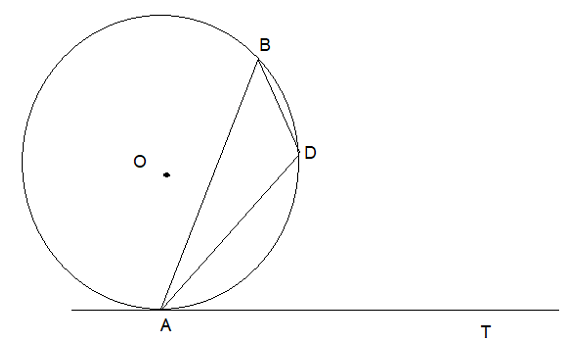
- In the given figure, AB is the chord of the circle with centre ‘O’. A tangent AT is drawn at point ‘A’ so that angle BAT = 48°, then measure of angle ADB is :
- In triangle PQR, the straight line parallel to side QR meets PQ and PR at points ‘A’ and ‘B’, respectively. If PA = BR, PQ = 36 cm and PB = 6 cm, then BR = ?
View More Questions
Top CAT Questions
- Compare and contrast between Portia and Jessica characters in Merchant of Venice.
- In a triangle ABC,AB=AC=8cm. A circle drawn with BC as diameter passes through A. Another circle drawn with center at A passes through B and C. Then the area,in sq.cm,of the overlapping region between the two circles is
- The simple interest accrued on an amount of Rs.25,000 at the end of three years is Rs.7,500. What would be the compound interest accrued on the same amount at the same rate in the same period?
- What is the sum of all roots of the equation \(|x+4|^2–10|x+4|=24\)?
- A solid metal sphere is melted and smaller spheres of equal radii are formed. 10% of the volume of the sphere is lost in the process. The smaller spheres have a radius which is \(\frac{1}{9}\text{th}\) the larger sphere. If 10 litres of paint were needed to paint the larger sphere,how many litres are needed to paint all the smaller spheres?
View More Questions