Question:
Identify the type of flowers based on the position of calyx, corolla and androecium with respect to the ovary from the given figures (a) and (b).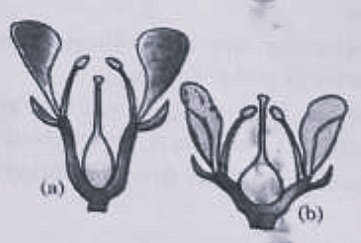
Identify the type of flowers based on the position of calyx, corolla and androecium with respect to the ovary from the given figures (a) and (b).
Updated On: Mar 19, 2026
- (a) Epigynous; (b) Hypogynous
- (a) Hypogynous; (b) Epigynous
- (a) Perigynous; (b) Epigynous
- (a) Perigynous; (b) Perigynous
Show Solution

Verified By Collegedunia
The Correct Option is D
Solution and Explanation
The position of floral organs in relation to the ovary can be categorized as follows:
- Hypogynous – The floral organs are attached below the ovary (e.g., in a buttercup).
- Epigynous – The floral organs are attached above the ovary (e.g., in a daisy).
- Perigynous – The floral organs are attached at the same level as the ovary (e.g., in a peach flower).
Step 1: In Figure (a), the floral organs are attached at the same level as the ovary, so it is Perigynous.
Step 2: In Figure (b), the floral organs are also attached at the same level as the ovary, so it is Perigynous.
Thus, the correct answer is (4) (a) Perigynous; (b) Perigynous.
Was this answer helpful?
8
3
Top NEET Biology Questions
- The chronological order of human evolution from early to the recent is
- Upper part of sea/aquatic ecosystem contains
- Where is respiratory electron transport system (ETS) located in plants ?
- Which among the following are the smallest living cells, known without a definite cell wall, pathogenic to plants as well as animals and can survive without oxygen ?
- Three of the following pairs of the human skeletal parts are correctly matched with their respective inclusive skeletal category and one pair is not matched. Identify the non-matching pair. .
Pair of skeletal parts Category (a)$\,\,$ Sternum and ribs$\,\,$ Axial skeleton (b)$\,\,$ Clavicle and glenoid cavity$\,\,$ Pelvic girdle (c)$\,\,$ Flumerus and ulna$\,\,$ Appendicular skeleton (d)$\,\,$ Malleus and stapes$\,\,$ Ear ossicles
View More Questions
Top NEET The Flower Questions
- Which of the following is an example of actinomorphic flower?
- Identify the set of correct statement:
A. The flowers of Vallisneria are colourful and produce nectar.
B. The flowers of waterlily are not pollinated by water.
C. In most of water-pollinated species, the pollen grains are protected from wetting.
D. Pollen grains of some hydrophytes are long and ribbon like.
E. In some hydrophytes, the pollen grains are carried passively inside water.
Choose the correct answer from the options given below - Identify the correct description about the given figure.

- Match List I with List II
List I (Types of Stamens) List II (Example) A Monoadelphous I Citrus B Diadelphous II Pea C Polyadelphous III Lily D Epiphyllous IV China-rose
Choose the correct answer from the options given below: - The ovary is half inferior in:
Top NEET Questions
- A $100.0\, mL$ dilute solution of $Ag ^{+}$is electrolysed for $15.0$ minutes with a current of $1.25 \,mA$ and the silver is removed completely. What was the initial $\left[ Ag ^{+}\right]$?
- The time constant of C-R circuit is
- The chronological order of human evolution from early to the recent is
- The correct Boolean operation represented by the circuit diagram drawn is :
- The driver of a car travelling with speed $30\, m/sec$ towards a hill sounds a horn of frequency $600\, Hz.$ If the velocity of sound in air is $330\, m/s,$ the frequency of reflected sound as heard by driver is
View More Questions