Given below are two statements: one is labelled as Assertion (A) and the other is labelled as Reason (R).
Assertion (A): Time period of a simple pendulum is longer at the top of a mountain than that at the base of the mountain.
Reason (R): Time period of a simple pendulum decreases with increasing value of acceleration due to gravity and vice-versa. In the light of the above statements.
choose the most appropriate answer from the options given below:
Given below are two statements: one is labelled as Assertion (A) and the other is labelled as Reason (R).
Assertion (A): Time period of a simple pendulum is longer at the top of a mountain than that at the base of the mountain.
Reason (R): Time period of a simple pendulum decreases with increasing value of acceleration due to gravity and vice-versa. In the light of the above statements.
choose the most appropriate answer from the options given below:
Show Hint
- Both (A) and (R) are true but (R) is not the correct explanation of (A)
- (A) is false but (R) is true
- Both (A) and (R) are true and (R) is the correct explanation of (A)
- (A) is true but (R) is false

The Correct Option is A
Approach Solution - 1
To solve the problem, let's analyze the given statements:
- Assertion (A): The time period of a simple pendulum is longer at the top of a mountain than at the base of the mountain.
- Reason (R): The time period of a simple pendulum decreases with increasing value of acceleration due to gravity and vice-versa.
The formula for the time period (T) of a simple pendulum is:
T = 2π√(L/g)
where L is the length of the pendulum and g is the acceleration due to gravity. From this formula, we see that the time period is inversely related to the square root of g. As the altitude increases, like at the top of a mountain, the value of g decreases slightly because of the increase in distance from the center of the Earth. This leads to a longer time period (T) at the mountain top compared to the base. Thus, Assertion (A) is true.
The Reason (R) correctly states that the time period decreases with an increase in g, which is mathematically accurate. However, while this reason is true, it does not specifically explain why the time period is longer at a mountain top. This is due to the decrease in g at higher altitudes, which is only indirectly related to the reason given.
Therefore, the correct answer is: Both (A) and (R) are true but (R) is not the correct explanation of (A).
Approach Solution -2
Assertion (A): The time period of a simple pendulum is longer at the top of a mountain than at the base of the mountain.
Reason (R): The time period of a simple pendulum decreases with increasing value of acceleration due to gravity and vice-versa.
Step 2: Recall the formula for the time period of a simple pendulum.
The time period \( T \) of a simple pendulum is given by:
\[ T = 2\pi \sqrt{\frac{l}{g}} \] where \( l \) is the length of the pendulum and \( g \) is the acceleration due to gravity.
Step 3: Analyze the effect of gravity at the top of a mountain.
The value of acceleration due to gravity \( g \) decreases with height from the Earth's surface. Therefore, at the top of a mountain, \( g \) is smaller compared to its value at the base of the mountain.
From the formula above, when \( g \) decreases, the time period \( T \) increases. Hence, the pendulum takes a longer time to complete one oscillation at the mountain top.
Step 4: Evaluate the truth of Assertion (A) and Reason (R).
- Assertion (A) is true because the time period is indeed longer at the top of the mountain due to the smaller value of \( g \).
- Reason (R) is also true because the time period \( T \) is inversely proportional to the square root of \( g \); an increase in \( g \) decreases \( T \), and vice versa.
Step 5: Determine if (R) correctly explains (A).
Although both statements are true, (R) is a general statement about the relationship between \( T \) and \( g \). It does not directly explain the specific reason why \( g \) is smaller at the mountain top (which is due to increased distance from the Earth's center). Therefore, (R) does not correctly explain (A).
Final Answer:
Both (A) and (R) are true but (R) is not the correct explanation of (A).
Top JEE Main Physics Questions
- Two masses $m$ and $\frac{m}{2}$ are connected at the two ends of a massless rigid rod of length $l$. The rod is suspended by a thin wire of torsional constant $k$ at the centre of mass of the rod-mass system(see figure). Because of torsional constant $k$, the restoring torque is $\tau =k\theta$ for angular displacement $\theta$. If the rod is rota ted by $\theta_0$ and released, the tension in it when it passes through its mean position will be:
A black body is at a temperature of 2880 K. The energy of radiation emitted by this body with wavelength between 499 nm and 500 nm is U1, between 999 nm and 1000 nm is U2 and between 1499 nm and 1500 nm is U3. The Wien's constant, b = 2.88×10⁶ nm-K. Then,
- $I _{ CM }$ is the moment of inertia of a circular disc about an axis (CM) passing through its center and perpendicular to the plane of disc $I_{A B}$ is it's moment of inertia about an axis $AB$ perpendicular to plane and parallel to axis $CM$ at a distance $\frac{2}{3} R$ from center Where $R$ is the radius of the dise The ratio of $I _{ AB }$ and $I _{ CM }$ is $x: 9$ The value of $x$ is______

- A nucleus disintegrates into two smaller parts, which have their velocities in the ratio $3: 2$ The ratio of their nuclear sizes will be $\left(\frac{x}{3}\right)^{\frac{1}{3}}$ The value of ' $x$ ' is:-
- A particle starts with an initial velocity of 10.0 m/s along x-direction and accelerates uniformly at the rate of 2.0 m/s$^2$. The time taken by the particle to reach the velocity of 60.0 m/s is
Top JEE Main Waves and Oscillations Questions
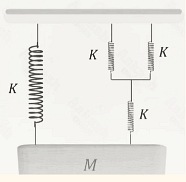
- The period of oscillation of system shown below is \(π\sqrt{\bigg(\frac{\alpha M}{5K}\bigg)}\) then \(\alpha\) is
- A simple harmonic oscillator has an amplitude \( A \) and a time period of \( 6\pi \) seconds. Assuming the oscillation starts from its mean position, the time required by it to travel from \( x = A \) to \( x = \frac{\sqrt{3}}{2} A \) will be \( \frac{\pi}{x} \) seconds, where \( x = \, \underline{\hspace{2cm}} \).
- A particle executes simple harmonic motion with an amplitude of 4 cm. At the mean position, the velocity of the particle is 10 cm/s. The distance of the particle from the mean position when its speed becomes 5 cm/s is \( \sqrt{\alpha} \) cm, where $\alpha$ = ______
- A tuning fork resonates with a sonometer wire of length 1 m stretched with a tension of 6 N. When the tension in the wire is changed to 54 N, the same tuning fork produces 12 beats per second with it. The frequency of the tuning fork is _______ Hz.
- A particle performs simple harmonic motion with amplitude \( A \). Its speed is increased to three times at an instant when its displacement is \( \frac{2A}{3} \). The new amplitude of motion is \( \frac{nA}{3} \). The value of \( n \) is _____.
Top JEE Main Questions
- Two masses $m$ and $\frac{m}{2}$ are connected at the two ends of a massless rigid rod of length $l$. The rod is suspended by a thin wire of torsional constant $k$ at the centre of mass of the rod-mass system(see figure). Because of torsional constant $k$, the restoring torque is $\tau =k\theta$ for angular displacement $\theta$. If the rod is rota ted by $\theta_0$ and released, the tension in it when it passes through its mean position will be:
What will be the equilibrium constant of the given reaction carried out in a \(5 \,L\) vessel and having equilibrium amounts of \(A_2\) and \(A\) as \(0.5\) mole and \(2 \times 10^{-6}\) mole respectively?
The reaction : \(A_2 \rightleftharpoons 2A\)- The value of is
- The number of terms of an is even. The sum of the odd terms is and of the even terms is . The last term exceeds the first by . Then the number of terms in the series is ______.
A black body is at a temperature of 2880 K. The energy of radiation emitted by this body with wavelength between 499 nm and 500 nm is U1, between 999 nm and 1000 nm is U2 and between 1499 nm and 1500 nm is U3. The Wien's constant, b = 2.88×10⁶ nm-K. Then,