Fullerene (C₆₀) crystallizes in an FCC unit cell (edge length = 14.14 Å) with one C₆₀ centered at each lattice point. The smallest distance (in Å) between the centers of two C₆₀ molecules is ..........
(Round off to two decimal places)
(Round off to two decimal places)
Show Hint

Correct Answer: 10.1 - 9.9
Solution and Explanation
The FCC (face-centered cubic) unit cell is a type of crystal structure where each corner and face center of the cube is occupied by atoms or molecules. In an FCC lattice, the simplest way to determine the distance between the centers of molecules, such as fullerenes (C₆₀), adhering to the crystal lattice rules is to use the face diagonal of the cube. Each face diagonal passes through the centers of two opposite face-centered spheres and contains two radii of the spheres.
Given edge length a is 14.14 Å.
In FCC, the face diagonal relates to the edge length as follows:
Face diagonal = √2 * a = √2 * 14.14 Å.
The smallest distance between the centers of two C₆₀ molecules is along the face diagonal and equals half of it because it stretches from the center of one face-centered atom to the other:
Distance = (√2 * 14.14) / 2 = (1.414 * 14.14) / 2 = 9.99358 Å.
Rounding off, we get the smallest distance as 9.99 Å.
The smallest distance between the centers of two C₆₀ molecules in an FCC unit cell is therefore 9.99 Å.
Top IIT JAM CY Physical Chemistry Questions
- The diagram that best describes the variation of viscosity (𝜂) of water with temperature at 1 atm is
The SI unit of the molar conductivity of an electrolyte solution is
- The system with the lowest zero-point energy when it is confined to a one dimensional box of length 𝐿 is
- Adsorption of a gas on a solid surface follows the Langmuir isotherm. If \(\frac{ k_a}{k_d}\)=1.0 bar-1 , the fraction of adsorption sites occupied by the gas at equilibrium under 2.0 bar pressure of the gas at 25 °C is
( ka and kd are the rate constants for adsorption and desorption processes, respectively, at 25 °C) - The vapor pressure of a dilute solution of a non-volatile solute and the vapor pressure of the pure solvent at the same temperature are P and P*, respectively. \(\frac{P^*-P}{P^*}\) is equal to
(Assume that the vapor phase behaves as an ideal gas)
Top IIT JAM CY Solid State Questions
- The separation (in nm) of {134} planes of an orthorhombic unit cell (with cell parameters 𝑎=0.5 nm, 𝑏=0.6 nm, and 𝑐=0.8 nm) is
- Wavelength of X-rays used in a diffraction experiment is 1.54 Å. X-rays are diffracted from a set of planes with an interplanar spacing of 1.54 Å. Then the angle θ (in degrees) corresponding to the first-order Bragg diffraction is
- The unit cell of a two-dimensional square lattice with lattice parameter a is indicated by the dashed lines as shown below:
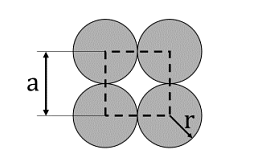
The percentage (%) area occupied by the grey circles (of radius r) inside the unit cell is _______. (rounded off to the nearest integer) - All possible lattice types are observed in the
- The common point defect(s) in a solid is/are
Top IIT JAM CY Questions
- The structure of Q in the following reaction scheme is.

- The major product of the reaction is

- The rate of addition of 1-hexyl radical to the given molecules follows the order

- The major product of the reaction is

- The diagram that best describes the variation of viscosity (𝜂) of water with temperature at 1 atm is