$\frac{x}{x+4}$ is the ratio of energies of photons produced due to transition of an electron of hydrogen atom from its (i) third permitted energy level to the second level and (ii) the highest permitted energy level to the second permitted level The value of $x$ will be

Correct Answer: 5
Solution and Explanation
Top JEE Main Physics Questions
- In a hydrogen like atom, when an electron jumps from the $M$ - shell to the $L$ - shell, the wavelength of emitted radiation is $\lambda$. If an electron jumps from $N$-shell to the $L$-shell, the wavelength of emitted radiation will be :
- Two masses $m$ and $\frac{m}{2}$ are connected at the two ends of a massless rigid rod of length $l$. The rod is suspended by a thin wire of torsional constant $k$ at the centre of mass of the rod-mass system(see figure). Because of torsional constant $k$, the restoring torque is $\tau =k\theta$ for angular displacement $\theta$. If the rod is rota ted by $\theta_0$ and released, the tension in it when it passes through its mean position will be:
A black body is at a temperature of 2880 K. The energy of radiation emitted by this body with wavelength between 499 nm and 500 nm is U1, between 999 nm and 1000 nm is U2 and between 1499 nm and 1500 nm is U3. The Wien's constant, b = 2.88×10⁶ nm-K. Then,
- $I _{ CM }$ is the moment of inertia of a circular disc about an axis (CM) passing through its center and perpendicular to the plane of disc $I_{A B}$ is it's moment of inertia about an axis $AB$ perpendicular to plane and parallel to axis $CM$ at a distance $\frac{2}{3} R$ from center Where $R$ is the radius of the dise The ratio of $I _{ AB }$ and $I _{ CM }$ is $x: 9$ The value of $x$ is______

- A nucleus disintegrates into two smaller parts, which have their velocities in the ratio $3: 2$ The ratio of their nuclear sizes will be $\left(\frac{x}{3}\right)^{\frac{1}{3}}$ The value of ' $x$ ' is:-
Top JEE Main Bohr’s Model for Hydrogen Atom Questions
- According to Bohr's theory, the moment of momentum of an electron revolving in the 4th orbit of a hydrogen atom is:
- In Franck-Hertz experiment, the first dip in the current-voltage graph for hydrogen is observed at 10.2 V. The wavelength of light emitted by hydrogen atom when excited to the first excitation level is _____ nm.
(Given $hc = 1245 \, \text{eV nm}, \, e = 1.6 \times 10^{-19} \, \text{C}$). Given below are two statements:
Statement (I) : The dimensions of Planck’s constant and angular momentum are same.
Statement (II) : In Bohr’s model, electron revolves around the nucleus in those orbits for which angular momentum is an integral multiple of Planck’s constant.
In the light of the above statements, choose the most appropriate answer from the options given below:- The radius of electron's second stationary orbit in Bohr's atom is $R$ The radius of 3rd orbit will be
An electron of a hydrogen like atom, having \(Z=4\), jumps from \(4^{\text {th }}\) energy state to \(2^{\text {nd }}\) energy state. The energy released in this process, will be :
\((\) Given Rch \(=136 eV )\)
Where \(R =\) Rydberg constant
\(c =\) Speed of light in vacuum
\(h =\) Planck's constant
Top JEE Main Questions
- In a hydrogen like atom, when an electron jumps from the $M$ - shell to the $L$ - shell, the wavelength of emitted radiation is $\lambda$. If an electron jumps from $N$-shell to the $L$-shell, the wavelength of emitted radiation will be :
- Two masses $m$ and $\frac{m}{2}$ are connected at the two ends of a massless rigid rod of length $l$. The rod is suspended by a thin wire of torsional constant $k$ at the centre of mass of the rod-mass system(see figure). Because of torsional constant $k$, the restoring torque is $\tau =k\theta$ for angular displacement $\theta$. If the rod is rota ted by $\theta_0$ and released, the tension in it when it passes through its mean position will be:
What will be the equilibrium constant of the given reaction carried out in a \(5 \,L\) vessel and having equilibrium amounts of \(A_2\) and \(A\) as \(0.5\) mole and \(2 \times 10^{-6}\) mole respectively?
The reaction : \(A_2 \rightleftharpoons 2A\)- The value of is
- The number of terms of an is even. The sum of the odd terms is and of the even terms is . The last term exceeds the first by . Then the number of terms in the series is ______.
Concepts Used:
Atoms
- The smallest unit of matter indivisible by chemical means is known as an atom.
- The fundamental building block of a chemical element.
- The smallest possible unit of an element that still has all the chemical properties of that element.
- An atom is consisting of a nucleus surrounded by one or more shells of electrons.
- Word origin: from the Greek word atomos, which means uncuttable, something that cannot be divided further.
All matter we encounter in everyday life consists of smallest units called atoms – the air we breath consists of a wildly careening crowd of little groups of atoms, my computer’s keyboard of a tangle of atom chains, the metal surface it rests on is a crystal lattice of atoms. All the variety of matter consists of less than hundred species of atoms (in other words: less than a hundred different chemical elements).
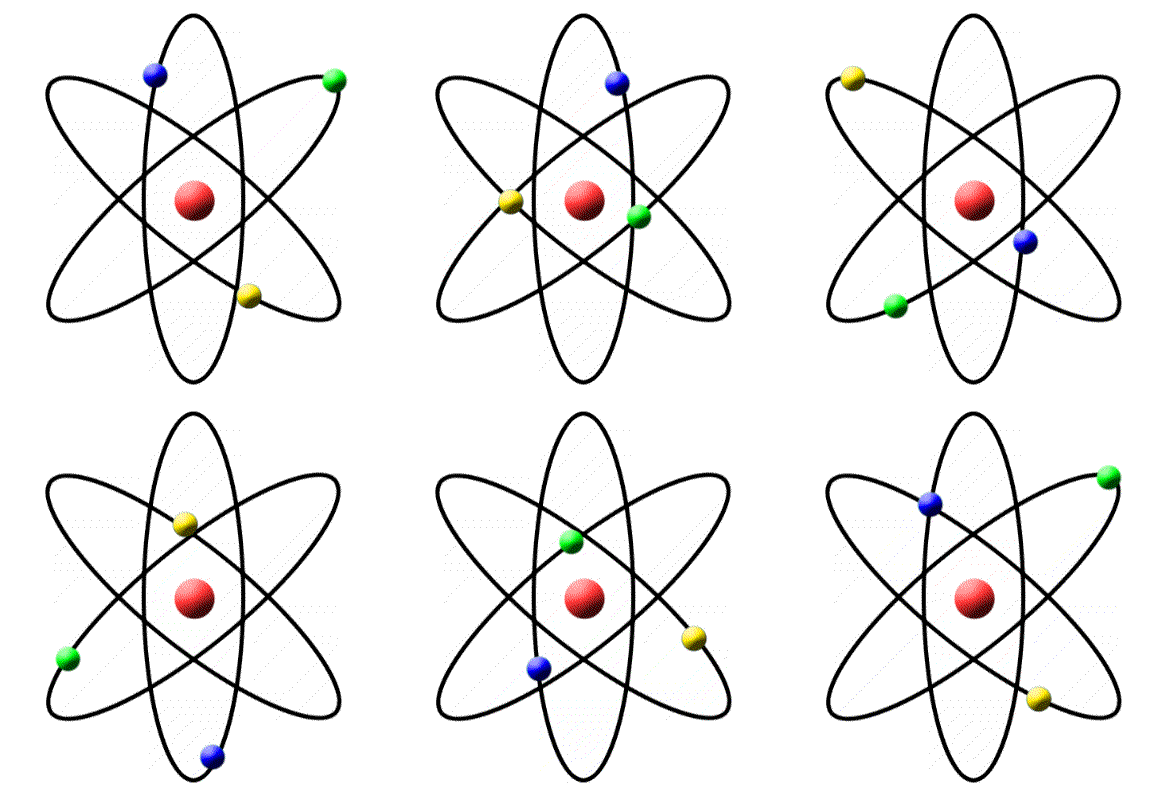
Every atom consists of an nucleus surrounded by a cloud of electrons. Nearly all of the atom’s mass is concentrated in its nucleus, while the structure of the electron cloud determines how the atom can bind to other atoms (in other words: its chemical properties). Every chemical element can be defined via a characteristic number of protons in its nucleus. Atoms that have lost some of their usual number of electrons are called ions. Atoms are extremely small (typical diameters are in the region of tenths of a billionth of a metre = 10-10 metres), and to describe their properties and behaviour, one has to resort to quantum theory.