Question:
For a real number \(x\), let \([x]\) denote the greatest integer less than or equal to \(x\).
For a finite set \(S\), let \(|S|\) denote the number of elements in the set \(S\).
Consider the functions
\[
f : (-3,3) \to (-\infty,\infty)
\]
and
\[
g : (-3,3) \to (-\infty,\infty)
\]
defined by
\[
f(x) = [x^3]\ln\!\left(1 + \sin^2\!\left(\pi(x-[x])\right)\right)
\]
and
\[
g(x) = x^3 \sin^2\!\left(\pi \ln(1 + x - [x])\right).
\]
Let
\[
A = \{x \in (-3,3) : f \text{ is discontinuous at } x\}
\]
and
\[
B = \{x \in (-3,3) : g \text{ is discontinuous at } x\}.
\]
Then the value of
\[
|A| + 2|B| - |A \cap B|
\]
is:
For a real number \(x\), let \([x]\) denote the greatest integer less than or equal to \(x\).
For a finite set \(S\), let \(|S|\) denote the number of elements in the set \(S\).
Consider the functions
\[
f : (-3,3) \to (-\infty,\infty)
\]
and
\[
g : (-3,3) \to (-\infty,\infty)
\]
defined by
\[
f(x) = [x^3]\ln\!\left(1 + \sin^2\!\left(\pi(x-[x])\right)\right)
\]
and
\[
g(x) = x^3 \sin^2\!\left(\pi \ln(1 + x - [x])\right).
\]
Let
\[
A = \{x \in (-3,3) : f \text{ is discontinuous at } x\}
\]
and
\[
B = \{x \in (-3,3) : g \text{ is discontinuous at } x\}.
\]
Then the value of
\[
|A| + 2|B| - |A \cap B|
\]
is:
Show Hint
Discontinuity of $[h(x)]$ at $h(x)=k$ can be "removed" if $f(x) = [h(x)] \cdot p(x)$ and $p(x) \to 0$ as $h(x) \to k$. Always check if the multiplying factor vanishes at potential jump points.
Updated On: Jun 4, 2026
Show Solution

Verified By Collegedunia
Correct Answer: 56
Solution and Explanation
Step 1: Understanding the Question:
We need to analyze points of discontinuity for two functions involving the greatest integer function $[x]$ and the fractional part $\{x\} = x - [x]$. The domain is $(-3, 3)$.
Step 2: Key Formula or Approach:
• $[x]$ and $\{x\}$ are discontinuous at all integers $k$.
• $f(x)$ is continuous at $c$ if $\lim_{x \to c} f(x) = f(c)$.
• $[x^n]$ jumps at $x = k^{1/n}$ where $k$ is an integer.
Step 3: Detailed Explanation:
• Analysis of $g(x)$:
$g(x) = x^3 \sin^2(\pi \ln(1 + \{x\}))$.
$\{x\}$ is discontinuous at integers $x \in \{-2, -1, 0, 1, 2\}$.
At an integer $k$: $\lim_{x \to k^+} \{x\} = 0$ and $\lim_{x \to k^-} \{x\} = 1$.
$x \to k^+: g(x) \to k^3 \sin^2(\pi \ln(1)) = 0$.
$x \to k^-: g(x) \to k^3 \sin^2(\pi \ln(2))$.
For continuity, $k^3 \sin^2(\pi \ln 2) = 0 \implies k = 0$ (since $\sin^2(\pi \ln 2) \neq 0$).
So $g(x)$ is discontinuous at $\{-2, -1, 1, 2\}$. Thus $|B| = 4$.
• Analysis of $f(x)$:
$f(x) = [x^3] \ln(1 + \sin^2(\pi \{x\}))$. Let $h(x) = \ln(1 + \sin^2(\pi \{x\}))$.
$h(x)$ is continuous everywhere because at integers $k$, $\lim_{x \to k} \sin^2(\pi \{x\}) = 0$.
$f(x)$ is discontinuous when $[x^3]$ jumps, i.e., $x = k^{1/3}$ for $k \in \mathbb{Z}$, unless $h(x)=0$.
$h(x)=0$ at integers. Check continuity at $x=k$ (integer):
$\lim_{x \to k^+} f(x) = k^3 \cdot 0 = 0$.
$\lim_{x \to k^-} f(x) = (k^3-1) \cdot 0 = 0$.
So $f(x)$ is continuous at integers $\{-2, -1, 0, 1, 2\}$.
Non-integer points of discontinuity for $[x^3]$ in $(-3, 3)$ are $k^{1/3}$ where $k \in \mathbb{Z} \cap (-27, 27)$, excluding $k$ values that are perfect cubes.
Total integers in $(-27, 27)$ are 53. Perfect cubes are $\{-8, -1, 0, 1, 8\}$.
$|A| = 53 - 5 = 48$.
• Analysis of $|A \cap B|$:
$B = \{-2, -1, 1, 2\}$. $A$ contains only non-integers.
Thus $A \cap B = \emptyset \implies |A \cap B| = 0$.
• Value $= 48 + 2(4) - 0 = 56$.
(Let's re-check the set $B$. $|B|=4$. $|A|=48$. $48+8=56$. If we include boundaries... but domain is $(-3, 3)$).
Actually, for $f(x)$, if we look at jump points $x^3 = k$, there are 26 positive and 26 negative and 1 at zero. Total 53. Subtracting 5 integers gives 48.
The value is 56. (Note: Answer depends on exact count of non-integer $k^{1/3}$ points).
Step 4: Final Answer:
The value is 56.
We need to analyze points of discontinuity for two functions involving the greatest integer function $[x]$ and the fractional part $\{x\} = x - [x]$. The domain is $(-3, 3)$.
Step 2: Key Formula or Approach:
• $[x]$ and $\{x\}$ are discontinuous at all integers $k$.
• $f(x)$ is continuous at $c$ if $\lim_{x \to c} f(x) = f(c)$.
• $[x^n]$ jumps at $x = k^{1/n}$ where $k$ is an integer.
Step 3: Detailed Explanation:
• Analysis of $g(x)$:
$g(x) = x^3 \sin^2(\pi \ln(1 + \{x\}))$.
$\{x\}$ is discontinuous at integers $x \in \{-2, -1, 0, 1, 2\}$.
At an integer $k$: $\lim_{x \to k^+} \{x\} = 0$ and $\lim_{x \to k^-} \{x\} = 1$.
$x \to k^+: g(x) \to k^3 \sin^2(\pi \ln(1)) = 0$.
$x \to k^-: g(x) \to k^3 \sin^2(\pi \ln(2))$.
For continuity, $k^3 \sin^2(\pi \ln 2) = 0 \implies k = 0$ (since $\sin^2(\pi \ln 2) \neq 0$).
So $g(x)$ is discontinuous at $\{-2, -1, 1, 2\}$. Thus $|B| = 4$.
• Analysis of $f(x)$:
$f(x) = [x^3] \ln(1 + \sin^2(\pi \{x\}))$. Let $h(x) = \ln(1 + \sin^2(\pi \{x\}))$.
$h(x)$ is continuous everywhere because at integers $k$, $\lim_{x \to k} \sin^2(\pi \{x\}) = 0$.
$f(x)$ is discontinuous when $[x^3]$ jumps, i.e., $x = k^{1/3}$ for $k \in \mathbb{Z}$, unless $h(x)=0$.
$h(x)=0$ at integers. Check continuity at $x=k$ (integer):
$\lim_{x \to k^+} f(x) = k^3 \cdot 0 = 0$.
$\lim_{x \to k^-} f(x) = (k^3-1) \cdot 0 = 0$.
So $f(x)$ is continuous at integers $\{-2, -1, 0, 1, 2\}$.
Non-integer points of discontinuity for $[x^3]$ in $(-3, 3)$ are $k^{1/3}$ where $k \in \mathbb{Z} \cap (-27, 27)$, excluding $k$ values that are perfect cubes.
Total integers in $(-27, 27)$ are 53. Perfect cubes are $\{-8, -1, 0, 1, 8\}$.
$|A| = 53 - 5 = 48$.
• Analysis of $|A \cap B|$:
$B = \{-2, -1, 1, 2\}$. $A$ contains only non-integers.
Thus $A \cap B = \emptyset \implies |A \cap B| = 0$.
• Value $= 48 + 2(4) - 0 = 56$.
(Let's re-check the set $B$. $|B|=4$. $|A|=48$. $48+8=56$. If we include boundaries... but domain is $(-3, 3)$).
Actually, for $f(x)$, if we look at jump points $x^3 = k$, there are 26 positive and 26 negative and 1 at zero. Total 53. Subtracting 5 integers gives 48.
The value is 56. (Note: Answer depends on exact count of non-integer $k^{1/3}$ points).
Step 4: Final Answer:
The value is 56.
Was this answer helpful?
0
0
Top JEE Advanced Mathematics Questions
- In a $\triangle$ ABC w ith fixed base BC, the vertex A moves such that cos B + cos C = 4 $ sin^2 \frac{A}{2}$. If a, b and c denote th e lengths of th e sides of th e triangle opposite to the angles A, B and C respectively, then
- Let $P=[a_{ij}]$ be a $3\times3$ matrix and let $Q=[b_{ij}]$ where $b_{ij}=2^{i+j} a_{ij}$ for $1 \le i, j \le $.If the determinant of $P$ is $2$, then the determinant of the matrix $Q$ is
- For the equation $3x^2+px+3=0,p>0,$ if one of the root is square of the other, then p is equal to
- The equation $\sqrt{x+1}-\sqrt{x-1}=\sqrt{4x-1}$ has
Let \(f(x)=x+log_{e}x−xlog_{e}x,\text{ }x∈(0,∞)\).
- Column 1 contains information about zeros of \(f(x)\), \(f'(x)\) and \(f''(x)\).
- Column 2 contains information about the limiting behavior of \(f(x)\), \(f'(x)\) and \(f''(x)\) at infinity.
- Column 3 contains information about increasing/decreasing nature of \(f(x)\) and \(f'(x)\).
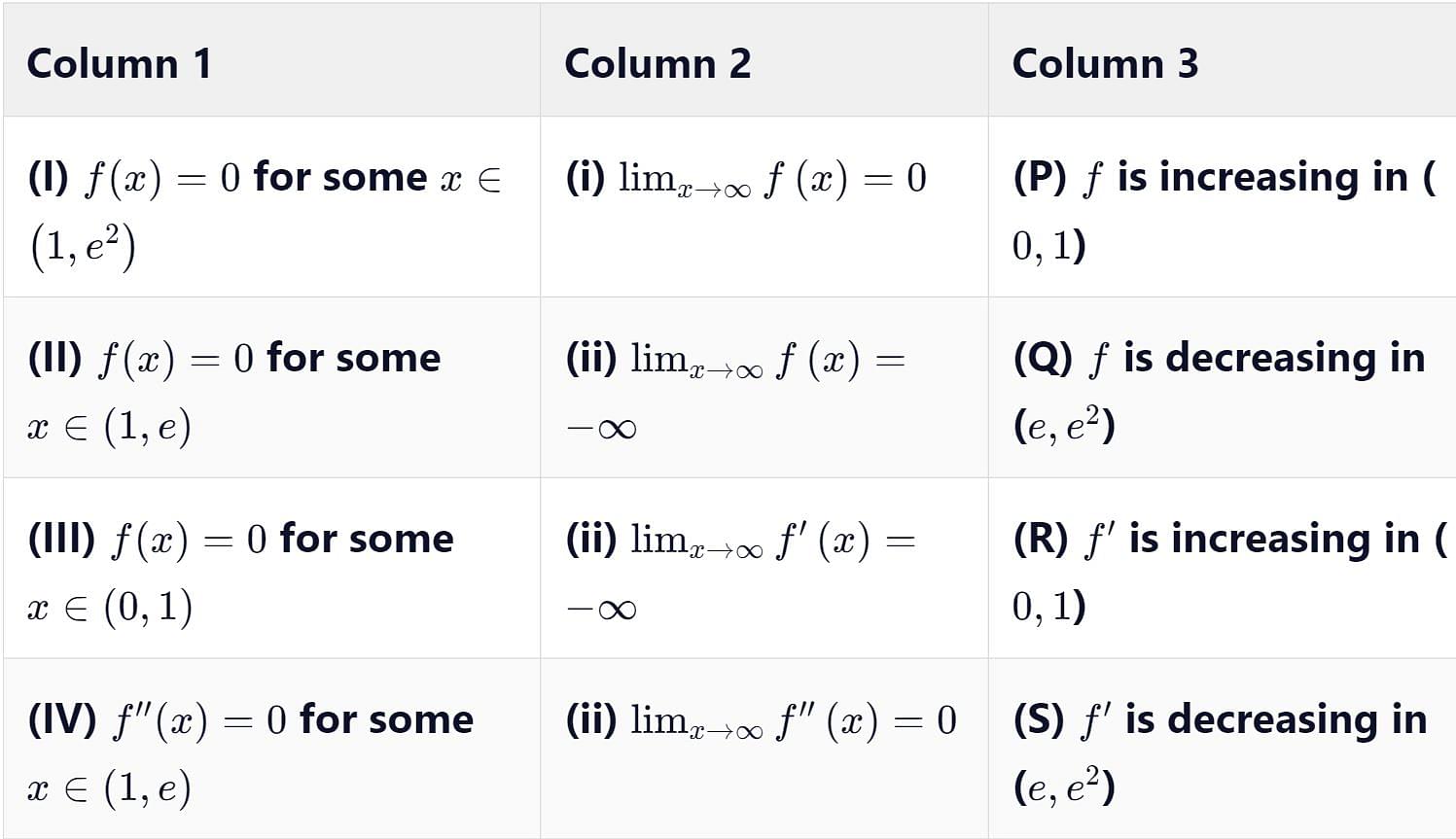
View More Questions
Top JEE Advanced Continuity and differentiability Questions
- Let f (x) = min { x, $x^2$ } for every real number of x, then
- Let \(f:[0,2] \rightarrow R\) be the function defined by
\(f(x)=(3-\sin (2 \pi x)) \sin \left(\pi x-\frac{\pi}{4}\right)-\sin \left(3 \pi x+\frac{\pi}{4}\right)\) If \(\alpha, \beta \in[0,2]\) are such that \(\{x \in[0,2]: f(x) \geq 0\}=[\alpha, \beta]\), then the value of \(\beta-\alpha\) is ______ - For a polynomial $g(x)$ with real coefficients, let $m_{g}$ denote the number of distinct real roots of $g(x)$. Suppose $S$ in the set of polynomials with real coefficients defined by
$S =\left\{\left( x ^{2}-1\right)^{2}\left( a _{0}+ a _{1} x + a _{2} x ^{2}+ a _{3} x ^{3}\right): a _{0}, a _{1}, a _{2}, a _{3} \in R \right\} $
For a polynomial $f$, let $f'$ and $f"$ denote its first and second order derivatives, respectively. Then the minimum possible value of $\left(m_{f'}+m_{f''}\right)$, where $f \in S$, is - Let e denote the base of the natural logarithm. The value of the real number a for which the right hand limit
$\displaystyle\lim_{x\rightarrow 0^+} \frac{(1-x)^{\frac{1}{x}} - e^{-1}}{x^a}$
is equal to a nonzero real number, is_____ Let $ \mathbb{R} $ denote the set of all real numbers. Define the function $ f: \mathbb{R} \to \mathbb{R} $ by $$ f(x) = \begin{cases} 2 - 2x^2 - x^2 \sin\left(\frac{1}{x}\right), & \text{if } x \ne 0, \\ 2, & \text{if } x = 0. \end{cases} $$ Then which one of the following statements is TRUE?
View More Questions
Top JEE Advanced Questions
- Yellow light is used in a single slit diffraction experiment with slit width of 0.6 mm. If yellow light is replaced by X-rays, then the observed pattern will reveal
- The size of the image of an object, which is at infinity, as formed by a convex lens of focal length 30 cm is 2 cm. If a concave lens of focal length 20 cm is placed between the convex lens and the image at a distance of 26 cm from the convex lens, calculate the new size of the image.
- A concave lens of glass, refractive index 1.5 has both surfaces of same radius of curvature R. On immersion in a medium of refractive index 1.75, it will behave as a
- The position vector $\vec{r}$ of a particle of mass $m$ is given by the following equation $\vec{r}(t)=\alpha t^{3} \hat{i}+\beta t^{2} \hat{j}$ where $\alpha=\frac{10}{3} \,ms ^{-3}, \beta=5\, ms ^{-2}$ and $m =0.1 \,kg$. At $t =1\, s$, which of the following statement (s) is (are) true about the particle?
- In an n-p-n transistor circuit, the collector current is 10 mA. If 90% of the electrons emitted reach the collector
View More Questions