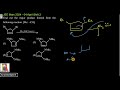
Step 1: Nucleophilic substitution (\( S_N2 \)) with dimethylamine (\( \text{Me}_2\text{NH} \)): The bromine atom at one of the carbons is replaced by the nucleophile (\( \text{Me}_2\text{N} \)) via an \( S_N2 \) mechanism. This forms an intermediate with a quaternary amine at the adjacent carbon. Step 2: Deprotonation: The positively charged intermediate loses a proton (\(-\text{H}^+\)) to stabilize the structure, forming an alkene. Step 3: Second \( S_N2 \) reaction: The second equivalent of dimethylamine attacks the adjacent carbon-bromine bond, substituting the bromine atom with another \( \text{Me}_2\text{N} \) group. The final product contains two \( \text{Me}_2\text{N} \) groups attached to the cyclopentane ring at adjacent positions. The above mechanism is valid for both cis and trans isomers. Hence, the products are the same for both.