Correctly match the photosynthetic pathways (Group I) with their first stable products (Group II) in respective plants (Group III):

Correctly match the photosynthetic pathways (Group I) with their first stable products (Group II) in respective plants (Group III):
Show Hint
- P-1-a; Q-3-b; R-3-c
- P-1-a; Q-2-b; R-3-c
- P-1-b; Q-3-a; R-2-c
- P-1-b; Q-2-c; R-2-a

The Correct Option is A
Solution and Explanation
Let’s go through the photosynthetic pathways and their first stable products in respective plants:
- (P) C3 cycle: In C3 plants such as wheat (Group III, a), the first stable product formed in the Calvin cycle is 3-Phosphoglycerate (Group II, 1). This is characteristic of the C3 cycle, where CO2 is fixed into 3-Phosphoglycerate, making the correct match \( P-1-a \).
- (Q) C4 cycle: In C4 plants like sugarcane (Group III, b), the first stable product formed during the initial fixation of CO2 is Oxaloacetate (Group II, 3). This occurs before the further processing of Oxaloacetate into other intermediates, making the correct match \( Q-3-b \).
- (R) CAM: In CAM plants like pineapple (Group III, c), the first stable product formed is Oxaloacetate (Group II, 3) during the initial fixation of CO2 at night when stomata are open. Therefore, the correct match is \( R-3-c \).
Thus, the correct answer is (A), as the correct matching for the first stable products in the respective plants is \( P-1-a \), \( Q-3-b \), and \( R-3-c \).
Top GATE XL Life Science Questions
- Which one of the following molecules captures \(CO_2\) in the \(CO_4\) cycle?
- Which one of the following methods separates biomolecules based on their hydrodynamic volumes?
- Which one of the following restriction endonucleases is a blunt cutter?
- Which one of the following ion channels opens to repolarize the neuronal membrane when an action potential is generated?
- Which one of the following is the most sensitive immunoassay?
Top GATE XL Botany Questions
Correctly match the carnivorous plants (Group I) with the organs (Group II) they modify to trap the prey:

- Which of the following molecular approaches can be used to generate complete knock-out of a target gene in plants?
- If an egg cell of a diploid plant species has 10 chromosomes, the expected number of chromosomes in a double trisomic somatic cell of this species would be ............. (Answer in integer).
In the history of photosynthetic research, the empirical reaction of photosynthesis was first proposed for green plants (equation 1), followed by another reaction for purple sulfur bacteria (equation 2), leading to a generalized equation for photosynthesis (equation 3), where \( {H}_2{A} \) in equation 3 is a generalized electron donor.
\[ {CO}_2 + {H}_2{O} \xrightarrow{{light}} {(CH}_2{O)} + {O}_2 \quad {(equation 1)} \] \[ {CO}_2 + 2{H}_2{S} \xrightarrow{{light}} {(CH}_2{O)} + {H}_2{O} + 2{S} \quad {(equation 2)} \] \[ {CO}_2 + 2{H}_2{A} \xrightarrow{{light}} {(CH}_2{O)} + {H}_2{O} + 2{A} \quad {(equation 3)} \] Where \( {H}_2{A} \) in equation 3 is a generalized electron donor. Which one of the following statements is DISPROVEN by equation 3?
The following table summarizes the flowering time behavior (days to flower) and the transcript levels in four genotypes of a plant species.

Which one of the following genetic pathways best explains the observations shown in the table?
Top GATE XL Questions
- The CORRECT order of electronegativity is
- Which one of the following is the CORRECT representation of the variation of the Gibbs free energy (G) of a substance with temperature (T) at constant pressure?
- Among the following, the structure representing histidine is
- The CORRECT order of acidity of the following compounds is
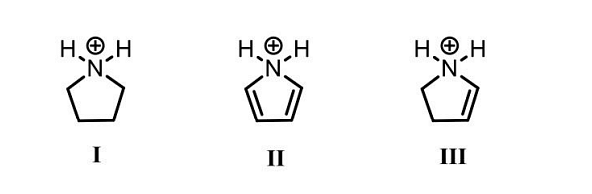
- The molecules A and B are a pair of___