Question:
Consider the ellipses given by $x^2 + 4y^2 = 1$ and $4x^2 + y^2 = 1$.
If $\alpha$ is the area of the common region that lies inside both the given ellipses, then the value of $\tan(\alpha/2)$ is {
Consider the ellipses given by $x^2 + 4y^2 = 1$ and $4x^2 + y^2 = 1$.
If $\alpha$ is the area of the common region that lies inside both the given ellipses, then the value of $\tan(\alpha/2)$ is {
If $\alpha$ is the area of the common region that lies inside both the given ellipses, then the value of $\tan(\alpha/2)$ is {
Show Hint
Using polar coordinates for intersection area problems involving central conics (ellipses/hyperbolas centered at the origin) often transforms a difficult Cartesian integral into a simple trigonometric one.
Updated On: Jun 4, 2026
Show Solution

Verified By Collegedunia
Correct Answer: 2
Solution and Explanation
Step 1: Understanding the Question:
The area $\alpha$ is the intersection area of two ellipses. By symmetry, the area is 8 times the area of a portion in the first quadrant bounded by $y=x$ and one of the ellipses.
Step 2: Key Formula or Approach:
• Area in polar coordinates: $\alpha = \int \frac{1}{2} r^2 d\theta$.
• Region consists of 8 equal sectors from $\theta = 0$ to $\pi/4$.
Step 3: Detailed Explanation:
• In polar form, $x^2 + 4y^2 = 1$ becomes $r^2(\cos^2 \theta + 4\sin^2 \theta) = 1 \implies r^2 = \frac{1}{1 + 3\sin^2 \theta}$.
• Area $\alpha = 8 \times \int_0^{\pi/4} \frac{1}{2} r^2 d\theta = 4 \int_0^{\pi/4} \frac{1}{1 + 3\sin^2 \theta} d\theta$.
• To integrate, divide numerator and denominator by $\cos^2 \theta$:
$\alpha = 4 \int_0^{\pi/4} \frac{\sec^2 \theta}{1 + \tan^2 \theta + 3\tan^2 \theta} d\theta = 4 \int_0^{\pi/4} \frac{\sec^2 \theta}{1 + 4\tan^2 \theta} d\theta$.
• Let $u = \tan \theta, du = \sec^2 \theta d\theta$. Limits: $0 \to 1$.
$\alpha = 4 \int_0^1 \frac{du}{1 + 4u^2} = 4 \left[ \frac{1}{2} \tan^{-1}(2u) \right]_0^1 = 2 \tan^{-1}(2)$.
• Thus $\alpha = 2 \tan^{-1}(2) \implies \alpha/2 = \tan^{-1}(2)$.
• $\tan(\alpha/2) = \tan(\tan^{-1}(2)) = 2$.
Step 4: Final Answer:
The value of $\tan(\alpha/2)$ is 2.
The area $\alpha$ is the intersection area of two ellipses. By symmetry, the area is 8 times the area of a portion in the first quadrant bounded by $y=x$ and one of the ellipses.
Step 2: Key Formula or Approach:
• Area in polar coordinates: $\alpha = \int \frac{1}{2} r^2 d\theta$.
• Region consists of 8 equal sectors from $\theta = 0$ to $\pi/4$.
Step 3: Detailed Explanation:
• In polar form, $x^2 + 4y^2 = 1$ becomes $r^2(\cos^2 \theta + 4\sin^2 \theta) = 1 \implies r^2 = \frac{1}{1 + 3\sin^2 \theta}$.
• Area $\alpha = 8 \times \int_0^{\pi/4} \frac{1}{2} r^2 d\theta = 4 \int_0^{\pi/4} \frac{1}{1 + 3\sin^2 \theta} d\theta$.
• To integrate, divide numerator and denominator by $\cos^2 \theta$:
$\alpha = 4 \int_0^{\pi/4} \frac{\sec^2 \theta}{1 + \tan^2 \theta + 3\tan^2 \theta} d\theta = 4 \int_0^{\pi/4} \frac{\sec^2 \theta}{1 + 4\tan^2 \theta} d\theta$.
• Let $u = \tan \theta, du = \sec^2 \theta d\theta$. Limits: $0 \to 1$.
$\alpha = 4 \int_0^1 \frac{du}{1 + 4u^2} = 4 \left[ \frac{1}{2} \tan^{-1}(2u) \right]_0^1 = 2 \tan^{-1}(2)$.
• Thus $\alpha = 2 \tan^{-1}(2) \implies \alpha/2 = \tan^{-1}(2)$.
• $\tan(\alpha/2) = \tan(\tan^{-1}(2)) = 2$.
Step 4: Final Answer:
The value of $\tan(\alpha/2)$ is 2.
Was this answer helpful?
0
0
Top JEE Advanced Mathematics Questions
- In a $\triangle$ ABC w ith fixed base BC, the vertex A moves such that cos B + cos C = 4 $ sin^2 \frac{A}{2}$. If a, b and c denote th e lengths of th e sides of th e triangle opposite to the angles A, B and C respectively, then
- Let $P=[a_{ij}]$ be a $3\times3$ matrix and let $Q=[b_{ij}]$ where $b_{ij}=2^{i+j} a_{ij}$ for $1 \le i, j \le $.If the determinant of $P$ is $2$, then the determinant of the matrix $Q$ is
- For the equation $3x^2+px+3=0,p>0,$ if one of the root is square of the other, then p is equal to
- The equation $\sqrt{x+1}-\sqrt{x-1}=\sqrt{4x-1}$ has
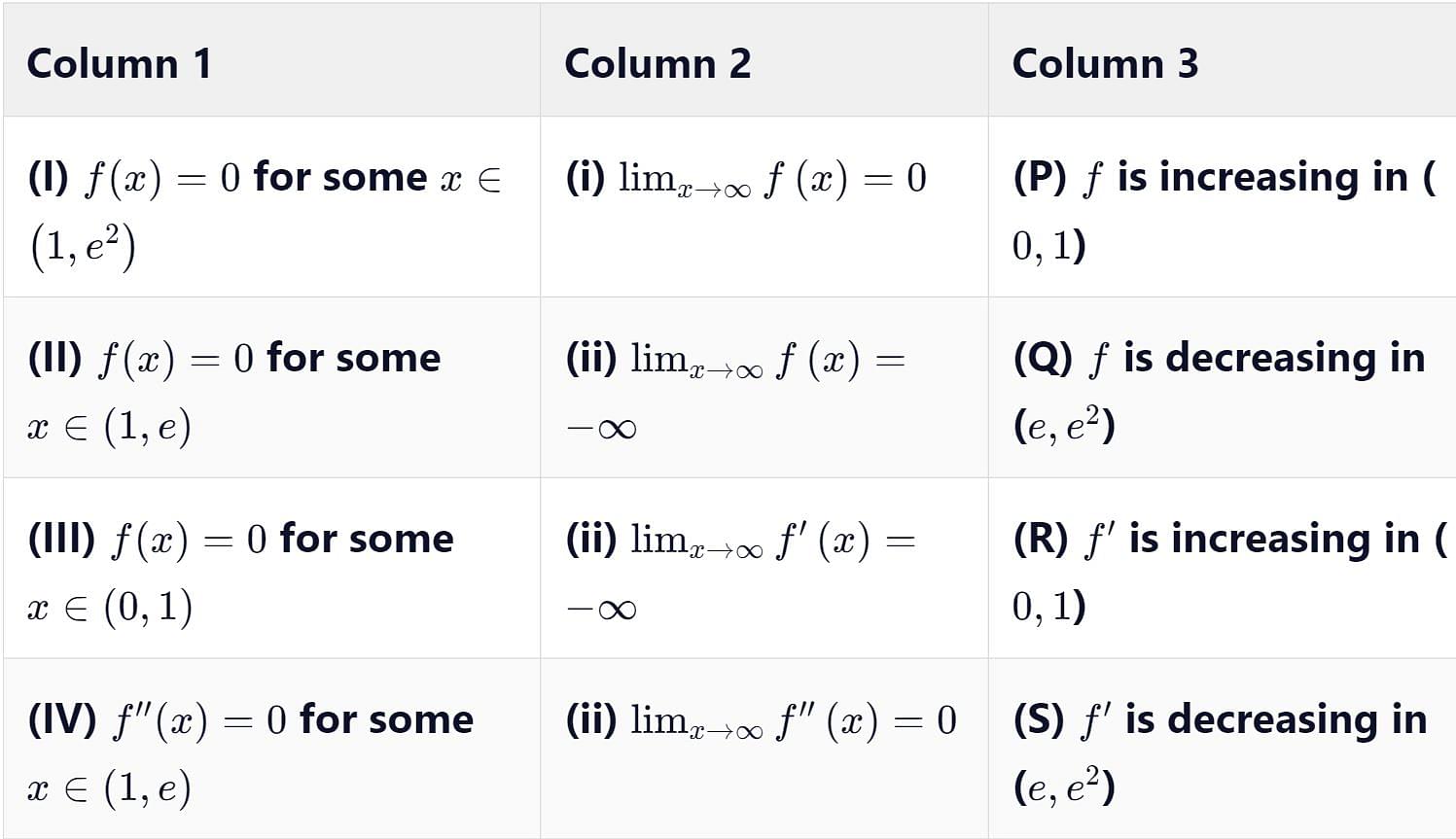
Let \(f(x)=x+log_{e}x−xlog_{e}x,\text{ }x∈(0,∞)\).
- Column 1 contains information about zeros of \(f(x)\), \(f'(x)\) and \(f''(x)\).
- Column 2 contains information about the limiting behavior of \(f(x)\), \(f'(x)\) and \(f''(x)\) at infinity.
- Column 3 contains information about increasing/decreasing nature of \(f(x)\) and \(f'(x)\).
View More Questions
Top JEE Advanced sections of a cone Questions
- Let $T$ be the tangent to the parabola $y^2 = 16x$ at the point $(64, 32)$. Let $L$ be the tangent to the same parabola at another point $(x_1, y_1)$ on the parabola. If $L$ and $T$ are perpendicular to each other, then the distance between the point $(x_1, y_1)$ and the focus of the parabola, is
- Consider the ellipse \(E\) given by \[ \frac{x^2}{18} + \frac{y^2}{12} = 1. \] Let \(H\) be the hyperbola whose eccentricity is the reciprocal of the eccentricity of \(E\) and whose foci are the same as that of \(E\). Let \(P\) and \(Q\) be the points of intersection of \(H\) and the parabola \[ \sqrt{5}\,y = x^2 \] in the first quadrant. Let \(d\) be the distance between \(P\) and \(Q\). If \(a\) and \(b\) are the integers such that \[ d^2 = a + b\sqrt{5}, \] then the value of \[ a - b \] is:
- Consider the ellipses given by $x^2 + 4y^2 = 1$ and $4x^2 + y^2 = 1$.
Let $P$ be the point in the first quadrant where the given ellipses intersect. If $\theta$ is the acute angle between the tangents to the given ellipses at the point $P$, then the value of $4 \tan \theta$ is {
Top JEE Advanced Questions
- Yellow light is used in a single slit diffraction experiment with slit width of 0.6 mm. If yellow light is replaced by X-rays, then the observed pattern will reveal
- The size of the image of an object, which is at infinity, as formed by a convex lens of focal length 30 cm is 2 cm. If a concave lens of focal length 20 cm is placed between the convex lens and the image at a distance of 26 cm from the convex lens, calculate the new size of the image.
- A concave lens of glass, refractive index 1.5 has both surfaces of same radius of curvature R. On immersion in a medium of refractive index 1.75, it will behave as a
- The position vector $\vec{r}$ of a particle of mass $m$ is given by the following equation $\vec{r}(t)=\alpha t^{3} \hat{i}+\beta t^{2} \hat{j}$ where $\alpha=\frac{10}{3} \,ms ^{-3}, \beta=5\, ms ^{-2}$ and $m =0.1 \,kg$. At $t =1\, s$, which of the following statement (s) is (are) true about the particle?
- In an n-p-n transistor circuit, the collector current is 10 mA. If 90% of the electrons emitted reach the collector
View More Questions