Ciliates differ from all other protozoans in
- having two types of nuclei
- using flagella for locomotion
- using pseudopodia for capturing prey
- having a contractile excess water

The Correct Option is A
Solution and Explanation
Ciliates are a unique group of protozoans distinguished mainly by their possession of two types of nuclei: a macronucleus and a micronucleus. This feature is not found in other protozoans, which have only one type of nucleus.
Let's analyze the options:
- Having two types of nuclei: This is a characteristic feature of ciliates. The macronucleus is responsible for the everyday metabolic and developmental functions, while the micronucleus is involved in reproductive processes. Hence, this option is correct.
- Using flagella for locomotion: This is characteristic of another group of protozoans called flagellates, not ciliates.
- Using pseudopodia for capturing prey: Amoebas, another type of protozoan, use pseudopodia for movement and capturing food, not ciliates.
- Having a contractile vacuole for excess water: Although ciliates do possess contractile vacuoles for osmoregulation, this feature is not exclusive to them; it is found in various protozoans and other single-celled organisms.
Therefore, the correct answer is having two types of nuclei.
Top NEET Biology Questions
- The chronological order of human evolution from early to the recent is
- Upper part of sea/aquatic ecosystem contains
- Where is respiratory electron transport system (ETS) located in plants ?
- Which among the following are the smallest living cells, known without a definite cell wall, pathogenic to plants as well as animals and can survive without oxygen ?
- Three of the following pairs of the human skeletal parts are correctly matched with their respective inclusive skeletal category and one pair is not matched. Identify the non-matching pair. .
Pair of skeletal parts Category (a)$\,\,$ Sternum and ribs$\,\,$ Axial skeleton (b)$\,\,$ Clavicle and glenoid cavity$\,\,$ Pelvic girdle (c)$\,\,$ Flumerus and ulna$\,\,$ Appendicular skeleton (d)$\,\,$ Malleus and stapes$\,\,$ Ear ossicles
Top NEET biological classification Questions
- Which among the following are the smallest living cells, known without a definite cell wall, pathogenic to plants as well as animals and can survive without oxygen ?
- The unequivocal proof of DNA as the genetic material came from the studies on a
- Chromosomes in a bacterial cell can be 1–3 in number and:
- Two crosses between the same pair of genotypes or phenotypes in which the sources of the gametes are reversed in one cross, is known as:
Top NEET Questions
- A $100.0\, mL$ dilute solution of $Ag ^{+}$is electrolysed for $15.0$ minutes with a current of $1.25 \,mA$ and the silver is removed completely. What was the initial $\left[ Ag ^{+}\right]$?
- The time constant of C-R circuit is
- The chronological order of human evolution from early to the recent is
- The correct Boolean operation represented by the circuit diagram drawn is :
- The driver of a car travelling with speed $30\, m/sec$ towards a hill sounds a horn of frequency $600\, Hz.$ If the velocity of sound in air is $330\, m/s,$ the frequency of reflected sound as heard by driver is
Concepts Used:
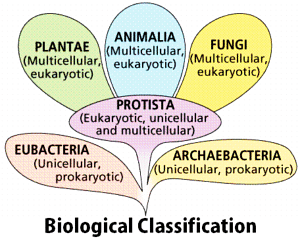
Biological Classification
The process of grouping living organisms into categories is called biological classification. The most modern 5-kingdom classification was put ahead by an eminent scientist R.H.Whittaker. The five-kingdom classification is based on the criteria like cell structure, mode of nutrition, body form, and reproduction. One of the most important characteristics of this system is that it follows the evolutionary sequence of living organisms. The organisms are classified into distinct taxa or levels like Kingdom, Phylum, Division, Class, Order, Family, Genus, and Species. The 5 kingdoms are as follows: