Question:
Choose the CORRECT trend(s) of the first ionization energies among the following. (Given: Atomic numbers C: 6; N: 7; O: 8; F: 9; Si: 14; P: 15; S: 16; Cl: 17)
Choose the CORRECT trend(s) of the first ionization energies among the following. (Given: Atomic numbers C: 6; N: 7; O: 8; F: 9; Si: 14; P: 15; S: 16; Cl: 17)
Show Hint
Across a period IE increases, but remember the classic exceptions from half-filled \(p\) subshells: \( \mathrm{O}<\mathrm{N} \) and \( \mathrm{S}<\mathrm{P} \). When in doubt, check for \(p^3\) stability.
Updated On: Sep 1, 2025
- C < N > O < F
- Si < P > S < Cl
- C < N < O < F
- Si < P < S < Cl
Show Solution

Verified By Collegedunia
The Correct Option is A, B
Solution and Explanation
Step 1: Periodic trend. Across a period, first ionization energy generally increases (effective nuclear charge rises), and down a group it generally decreases (greater size & shielding).
Step 2: Key anomaly (half-filled stability). Elements with half-filled \(p\) subshells are relatively more stable, so removing an electron requires more energy. Hence:
\(\bullet\) In Period~2: \( \mathrm{N}(2p^3) \) has higher IE than \( \mathrm{O}(2p^4) \) because removing an electron from O relieves inter-electronic repulsion in the paired \(p\) orbital \(⇒\) \( \mathrm{O}<\mathrm{N} \).
\(\bullet\) In Period~3: \( \mathrm{P}(3p^3) \) has higher IE than \( \mathrm{S}(3p^4) \) for the same reason \(⇒\) \( \mathrm{S}<\mathrm{P} \).
Step 3: Check each option.
(A) \( \mathrm{C}<\mathrm{N}>\mathrm{O}<\mathrm{F} \): Correct—captures the anomaly \( \mathrm{O}<\mathrm{N} \) and the overall rise towards F. \(\checkmark\)
(B) \( \mathrm{Si}<\mathrm{P}>\mathrm{S}<\mathrm{Cl} \): Correct—captures the anomaly \( \mathrm{S}<\mathrm{P} \) and rise towards Cl. \(\checkmark\)
(C) \( \mathrm{C}<\mathrm{N}<\mathrm{O}<\mathrm{F} \): Incorrect—ignores \( \mathrm{O}<\mathrm{N} \). \(\times\)
(D) \( \mathrm{Si}<\mathrm{P}<\mathrm{S}<\mathrm{Cl} \): Incorrect—ignores \( \mathrm{S}<\mathrm{P} \). \(\times\)
\(\boxed{\text{Correct options: (A) and (B)}}\)
Step 2: Key anomaly (half-filled stability). Elements with half-filled \(p\) subshells are relatively more stable, so removing an electron requires more energy. Hence:
\(\bullet\) In Period~2: \( \mathrm{N}(2p^3) \) has higher IE than \( \mathrm{O}(2p^4) \) because removing an electron from O relieves inter-electronic repulsion in the paired \(p\) orbital \(⇒\) \( \mathrm{O}<\mathrm{N} \).
\(\bullet\) In Period~3: \( \mathrm{P}(3p^3) \) has higher IE than \( \mathrm{S}(3p^4) \) for the same reason \(⇒\) \( \mathrm{S}<\mathrm{P} \).
Step 3: Check each option.
(A) \( \mathrm{C}<\mathrm{N}>\mathrm{O}<\mathrm{F} \): Correct—captures the anomaly \( \mathrm{O}<\mathrm{N} \) and the overall rise towards F. \(\checkmark\)
(B) \( \mathrm{Si}<\mathrm{P}>\mathrm{S}<\mathrm{Cl} \): Correct—captures the anomaly \( \mathrm{S}<\mathrm{P} \) and rise towards Cl. \(\checkmark\)
(C) \( \mathrm{C}<\mathrm{N}<\mathrm{O}<\mathrm{F} \): Incorrect—ignores \( \mathrm{O}<\mathrm{N} \). \(\times\)
(D) \( \mathrm{Si}<\mathrm{P}<\mathrm{S}<\mathrm{Cl} \): Incorrect—ignores \( \mathrm{S}<\mathrm{P} \). \(\times\)
\(\boxed{\text{Correct options: (A) and (B)}}\)
Was this answer helpful?
0
0
Top GATE XL Life Science Questions
- Which one of the following molecules captures \(CO_2\) in the \(CO_4\) cycle?
- Which one of the following methods separates biomolecules based on their hydrodynamic volumes?
- Which one of the following restriction endonucleases is a blunt cutter?
- Which one of the following ion channels opens to repolarize the neuronal membrane when an action potential is generated?
- Which one of the following is the most sensitive immunoassay?
View More Questions
Top GATE XL Life Science Questions
Which one of the given figures P, Q, R, and S represents the graph of the following function? \[ f(x) = |x + 2| - |x - 1| \]

An opaque cylinder (shown below) is suspended in the path of a parallel beam of light, such that its shadow is cast on a screen oriented perpendicular to the direction of the light beam. The cylinder can be reoriented in any direction within the light beam. Under these conditions, which one of the shadows P, Q, R, and S is NOT possible?

- Which one among the following mixtures gives a buffer solution in water?
What is the major product formed in the given reaction?

- The CORRECT order of stability of the given metal oxides is
View More Questions
Top GATE XL Questions
- The CORRECT order of electronegativity is
- Which one of the following is the CORRECT representation of the variation of the Gibbs free energy (G) of a substance with temperature (T) at constant pressure?
- Among the following, the structure representing histidine is
- The CORRECT order of acidity of the following compounds is
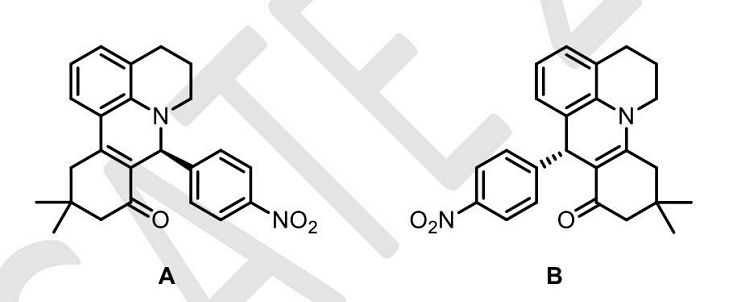
- The molecules A and B are a pair of___
View More Questions