Choose the correct answer:
1. Two balls A and B are placed at the top of 180 m tall tower. Ball A is released from the top at t = 0 s. Ball B is thrown vertically down with an initial velocity u at t = 2 s. After a certain time, both balls meet 100 m above the ground. Find the value of u in ms–1 [use g = 10 ms–2]
Choose the correct answer:
1. Two balls A and B are placed at the top of 180 m tall tower. Ball A is released from the top at t = 0 s. Ball B is thrown vertically down with an initial velocity u at t = 2 s. After a certain time, both balls meet 100 m above the ground. Find the value of u in ms–1 [use g = 10 ms–2]
- 10
- 15
- 20
- 30

The Correct Option is D
Solution and Explanation
The correct option is(D): 30 m/s.
Let us assume that they meet at t = t0
\(A:80=\frac{1}{2}gt^2_0....(i)\)
\(B:80=u(t_0-2)+\frac{1}{2}+\frac{!}{2}g(t_0-2)^2...(ii)\)
⇒ 80 = 2u + 5(2)2
⇒ u= 30 m/s
Top JEE Main Physics Questions
- Two masses $m$ and $\frac{m}{2}$ are connected at the two ends of a massless rigid rod of length $l$. The rod is suspended by a thin wire of torsional constant $k$ at the centre of mass of the rod-mass system(see figure). Because of torsional constant $k$, the restoring torque is $\tau =k\theta$ for angular displacement $\theta$. If the rod is rota ted by $\theta_0$ and released, the tension in it when it passes through its mean position will be:
A black body is at a temperature of 2880 K. The energy of radiation emitted by this body with wavelength between 499 nm and 500 nm is U1, between 999 nm and 1000 nm is U2 and between 1499 nm and 1500 nm is U3. The Wien's constant, b = 2.88×10⁶ nm-K. Then,
- $I _{ CM }$ is the moment of inertia of a circular disc about an axis (CM) passing through its center and perpendicular to the plane of disc $I_{A B}$ is it's moment of inertia about an axis $AB$ perpendicular to plane and parallel to axis $CM$ at a distance $\frac{2}{3} R$ from center Where $R$ is the radius of the dise The ratio of $I _{ AB }$ and $I _{ CM }$ is $x: 9$ The value of $x$ is______

- A nucleus disintegrates into two smaller parts, which have their velocities in the ratio $3: 2$ The ratio of their nuclear sizes will be $\left(\frac{x}{3}\right)^{\frac{1}{3}}$ The value of ' $x$ ' is:-
- A particle starts with an initial velocity of 10.0 m/s along x-direction and accelerates uniformly at the rate of 2.0 m/s$^2$. The time taken by the particle to reach the velocity of 60.0 m/s is
Top JEE Main Speed and velocity Questions
- A uniform disk of mass \(50\) \(kg\) is rolling without slipping with a speed of \(0.4 \;m/s\). Find minimum energy required to bring the disk to rest (in \(J\)).
- Two trains run on North-South parallel tracks. Train A moves with velocity 20 m/s towards North and train B moves with velocity 30 m/s towards South. Then find the velocity of train B with respect to train A
- A ball of mass \(120\) \(g\) moving with initial velocity \(25 \;m/s\) is stopped by an external force \(F\) in \(0.15\) \(sec\). Find value of \(F\) in newton :
A body of mass 1000 kg is moving horizontally with a velocity of 6 m/s. If 200 kg extra mass is added, the final velocity (in m/s) is:
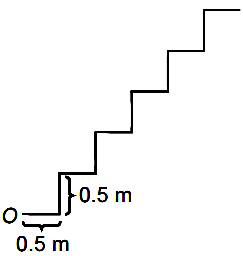
Consider a series of steps as shown. A ball is thrown from 0. Find the minimum speed to directly jump to 5th step
Top JEE Main Questions
- Two masses $m$ and $\frac{m}{2}$ are connected at the two ends of a massless rigid rod of length $l$. The rod is suspended by a thin wire of torsional constant $k$ at the centre of mass of the rod-mass system(see figure). Because of torsional constant $k$, the restoring torque is $\tau =k\theta$ for angular displacement $\theta$. If the rod is rota ted by $\theta_0$ and released, the tension in it when it passes through its mean position will be:
What will be the equilibrium constant of the given reaction carried out in a \(5 \,L\) vessel and having equilibrium amounts of \(A_2\) and \(A\) as \(0.5\) mole and \(2 \times 10^{-6}\) mole respectively?
The reaction : \(A_2 \rightleftharpoons 2A\)- The value of is
- The number of terms of an is even. The sum of the odd terms is and of the even terms is . The last term exceeds the first by . Then the number of terms in the series is ______.
A black body is at a temperature of 2880 K. The energy of radiation emitted by this body with wavelength between 499 nm and 500 nm is U1, between 999 nm and 1000 nm is U2 and between 1499 nm and 1500 nm is U3. The Wien's constant, b = 2.88×10⁶ nm-K. Then,
Concepts Used:
Relative Velocity
The velocity with which one object moves with respect to another object is the relative velocity of an object with respect to another. By relative velocity, we can further understand the time rate of change in the relative position of one object with respect to another.
It is generally used to describe the motion of moving boats through water, airplanes in the wind, etc. According to the person as an observer inside the object, we can compute the velocity very easily.
The velocity of the body A – the velocity of the body B = The relative velocity of A with respect to B
V_{AB} = V_{A} – V_{B}
Where,
The relative velocity of the body A with respect to the body B = V_{AB}
The velocity of the body A = V_{A}
The velocity of body B = V_{B}