Question:
Assertion (A): Supravaginal elongation of cervix occurs in uterovaginal prolapse.
Reason (R): There is gaping genital hiatus but the ligamentous support of uterus is strong.
Assertion (A): Supravaginal elongation of cervix occurs in uterovaginal prolapse.
Reason (R): There is gaping genital hiatus but the ligamentous support of uterus is strong.
Show Hint
Ask whether prolapse happens because pelvic support is strong or because it has weakened.
Updated On: Jul 7, 2026
- Both A and R are true and R is the correct explanation of A.
- Both A and R are true but R is NOT the correct explanation of A.
- A is true but R is false.
- A is false but R is true.
Show Solution

Verified By Collegedunia
The Correct Option is C
Solution and Explanation
Step 1: Understand the assertion.
In long-standing uterovaginal prolapse, especially procidentia, the part of the cervix above its attachment to the vagina, called the supravaginal portion, can become stretched and elongated. This happens as the uterine body descends downward through the pelvis while the upper vaginal attachments and surrounding tissue provide some resistance, drawing out the supravaginal cervix over time. So the assertion, that supravaginal elongation of the cervix occurs in uterovaginal prolapse, is a true and recognized clinical finding.
Step 2: Understand the reason.
The reason has two parts. A gaping genital hiatus, meaning a widened vaginal opening with poor closure of the perineum and levator muscles, is indeed commonly seen in uterovaginal prolapse. However, the second part of the reason claims that the ligamentous support of the uterus is strong. This is the opposite of what actually happens. Prolapse develops precisely because the pelvic supports, the pubocervical fascia, the cardinal and uterosacral ligaments, and the levator ani muscles, become weakened, stretched, or damaged, usually from childbirth trauma, aging, or chronic raised abdominal pressure. So the claim that ligamentous support is strong is false.
Step 3: Decide the correct code.
Since the assertion is true but the reason contains a false claim about strong ligamentous support, this matches the pattern where A is true but R is false.
Step 4: Rule out the other options.
Options (a) and (b) both require R to be true, which fails here because of the incorrect claim about strong support. Option (d) requires A to be false, but the supravaginal elongation described is a genuine feature of uterovaginal prolapse.
Final Answer:
A is true but R is false.
In long-standing uterovaginal prolapse, especially procidentia, the part of the cervix above its attachment to the vagina, called the supravaginal portion, can become stretched and elongated. This happens as the uterine body descends downward through the pelvis while the upper vaginal attachments and surrounding tissue provide some resistance, drawing out the supravaginal cervix over time. So the assertion, that supravaginal elongation of the cervix occurs in uterovaginal prolapse, is a true and recognized clinical finding.
Step 2: Understand the reason.
The reason has two parts. A gaping genital hiatus, meaning a widened vaginal opening with poor closure of the perineum and levator muscles, is indeed commonly seen in uterovaginal prolapse. However, the second part of the reason claims that the ligamentous support of the uterus is strong. This is the opposite of what actually happens. Prolapse develops precisely because the pelvic supports, the pubocervical fascia, the cardinal and uterosacral ligaments, and the levator ani muscles, become weakened, stretched, or damaged, usually from childbirth trauma, aging, or chronic raised abdominal pressure. So the claim that ligamentous support is strong is false.
Step 3: Decide the correct code.
Since the assertion is true but the reason contains a false claim about strong ligamentous support, this matches the pattern where A is true but R is false.
Step 4: Rule out the other options.
Options (a) and (b) both require R to be true, which fails here because of the incorrect claim about strong support. Option (d) requires A to be false, but the supravaginal elongation described is a genuine feature of uterovaginal prolapse.
Final Answer:
A is true but R is false.
Was this answer helpful?
0
0
Top NEET PG Gynaecology and Obstetrics Questions
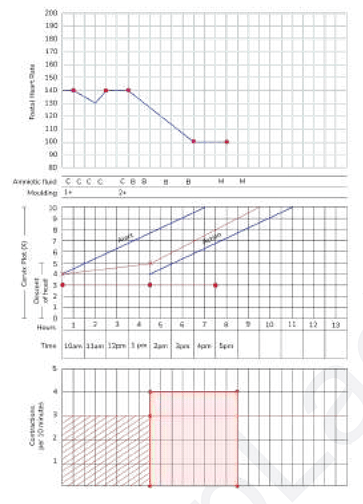
- A partogram of a woman who is in labor is shown below. Oxytocin infusion is already given. How will you manage the condition?
- A woman presents to you at 36 weeks of gestation with complaints of breathlessness and excessive abdominal distension. Fetal movements are normal. On examination, fetal parts are not easily felt and fetal heartbeat is heard but it is muffled. Her symphysis fundal height is 41 cm. Her abdomen is tense but not tender. What is the most likely diagonosis?
- For which of the following procedures in the given OT list, can you preferably do a hysteroscopy ?
- A primigravida presents to you with anemia early in her pregnancy. She is 7 weeks pregnant as seen on ultrasound. Her hemoglobin level is 9 g/dL. When should the iron supplements be started for her?
- A 23-year-old woman accompanied by her mother-in-law comes to the infertility clinic. She has been having regular intercourse for 6 months but is not able to conceive. What is the next best step?
View More Questions
Top NEET PG Pessary in uterine prolapse Questions
Top NEET PG Questions
- A patient hailing from Delhi presents with fever, arthralgia, and extensive petechial rash for 3 days. Lab investigations revealed a hemoglobin of 9 g/ dL, a white blood cell count of 9000 cells/mm3, a platelet count of 20000 cells/mm3, and a prolonged bleeding time. The clotting time was normal. What is the most likely diagnosis?
- Which of the following statements is true about Trichomonas vaginalis?
- A lady from West Rajasthan presented with an ulcer surrounded by erythema on the right leg. Microscopy of the biopsy from the edge of the ulcer showed organisms with dark staining nuclei and kinetoplast. What is the most likely causative agent?
- A child presents with a fever and a rash. Urine examination showed cells with owl's eye appearance. What is the most likely diagnosis?
- Infection with Clonorchis sinensis is associated with an increased risk of__?
View More Questions