Amongst the following, the number of oxide(s) which are paramagnetic in nature is
Na2O, KO2, NO2, N2O, ClO2, NO, SO2, Cl2O
Na2O, KO2, NO2, N2O, ClO2, NO, SO2, Cl2O

Correct Answer: 4
Solution and Explanation
To determine the number of paramagnetic oxides among the listed compounds, we need to understand the concept of paramagnetism, which arises due to the presence of unpaired electrons in a molecule.
Analysis of each oxide:
- Na2O: Sodium oxide is a simple ionic compound with O2− ions having no unpaired electrons. Diamagnetic.
- KO2: Potassium superoxide contains the O2− ion, which has one unpaired electron. Paramagnetic.
- NO2: Nitrogen dioxide has an unpaired electron. Paramagnetic.
- N2O: Nitrous oxide has no unpaired electrons in its bonding structure. Diamagnetic.
- ClO2: Chlorine dioxide has an odd number of valence electrons, resulting in unpaired electrons. Paramagnetic.
- NO: Nitric oxide has one unpaired electron. Paramagnetic.
- SO2: Sulfur dioxide has paired electrons in its structure. Diamagnetic.
- Cl2O: Dichlorine monoxide does not have unpaired electrons. Diamagnetic.
Conclusion: The oxides that are paramagnetic are KO2, NO2, ClO2, and NO. Thus, the number of paramagnetic oxides is 4, which is within the given range (4,4).
Top JEE Main Chemistry Questions
What will be the equilibrium constant of the given reaction carried out in a \(5 \,L\) vessel and having equilibrium amounts of \(A_2\) and \(A\) as \(0.5\) mole and \(2 \times 10^{-6}\) mole respectively?
The reaction : \(A_2 \rightleftharpoons 2A\)- At equilibrium the concentrations of and in a sealed vessel at . What will be for the reaction
- Find out the major products from the following reactions

Cobalt chloride when dissolved in water forms pink colored complex $X$ which has octahedral geometry. This solution on treating with cone $HCl$ forms deep blue complex, $\underline{Y}$ which has a $\underline{Z}$ geometry $X, Y$ and $Z$, respectively, are
- The correct order of atomic radii is:
Top JEE Main Chemical Reactions of Alcohols Phenols and Ethers Questions
- What happens when methane undergoes combustion in systems A and B respectively?

- Given below are two statements, one is labelled as Assertion: A and the other is labelled as Reason R.
Assertion: A Isotopes of hydrogen have almost same chemical properties, but difference in their rates of reaction.
Reason: R Isotopes of hydrogen have different enthalpy of bond dissociation.
In the light of the above statements, choose the most appropriate answer from the options given below - better method for preparation of bef2 among the following is
- The correct group of halide ions which can be oxidised by oxygen in acidic medium is
- Which of the following complexes will exhibit maximum attraction to an applied magnetic field?
Top JEE Main Questions
- Two masses $m$ and $\frac{m}{2}$ are connected at the two ends of a massless rigid rod of length $l$. The rod is suspended by a thin wire of torsional constant $k$ at the centre of mass of the rod-mass system(see figure). Because of torsional constant $k$, the restoring torque is $\tau =k\theta$ for angular displacement $\theta$. If the rod is rota ted by $\theta_0$ and released, the tension in it when it passes through its mean position will be:
What will be the equilibrium constant of the given reaction carried out in a \(5 \,L\) vessel and having equilibrium amounts of \(A_2\) and \(A\) as \(0.5\) mole and \(2 \times 10^{-6}\) mole respectively?
The reaction : \(A_2 \rightleftharpoons 2A\)- The value of is
- The number of terms of an is even. The sum of the odd terms is and of the even terms is . The last term exceeds the first by . Then the number of terms in the series is ______.
A black body is at a temperature of 2880 K. The energy of radiation emitted by this body with wavelength between 499 nm and 500 nm is U1, between 999 nm and 1000 nm is U2 and between 1499 nm and 1500 nm is U3. The Wien's constant, b = 2.88×10⁶ nm-K. Then,
Concepts Used:
Types of Differential Equations
There are various types of Differential Equation, such as:
Ordinary Differential Equations:
Ordinary Differential Equations is an equation that indicates the relation of having one independent variable x, and one dependent variable y, along with some of its other derivatives.
\(F(\frac{dy}{dt},y,t) = 0\)
Partial Differential Equations:
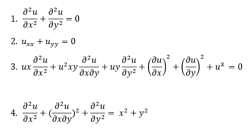
A partial differential equation is a type, in which the equation carries many unknown variables with their partial derivatives.
Linear Differential Equations:
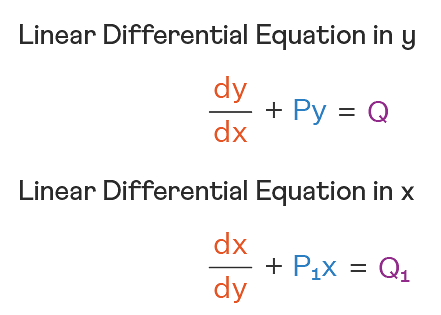
It is the linear polynomial equation in which derivatives of different variables exist. Linear Partial Differential Equation derivatives are partial and function is dependent on the variable.
Homogeneous Differential Equations:
When the degree of f(x,y) and g(x,y) is the same, it is known to be a homogeneous differential equation.
\(\frac{dy}{dx} = \frac{a_1x + b_1y + c_1}{a_2x + b_2y + c_2}\)
Read More: Differential Equations