A tower of 45 cm high costs a shadow of 12 cm, then the angle of elevation of the dun is
A tower of 45 cm high costs a shadow of 12 cm, then the angle of elevation of the dun is
75°
35°
65°
45°

The Correct Option is A
Solution and Explanation
To find the angle of elevation of the sun, we need to understand the relationship between the height of the tower, the length of the shadow, and the angle of elevation. This can be done using trigonometry, specifically the tangent function, which relates the opposite side (height of the tower) to the adjacent side (length of the shadow) in a right-angled triangle.
The formula is:
tan(θ) = Opposite/Adjacent
Here,
- Opposite = 45 cm (height of the tower)
- Adjacent = 12 cm (length of the shadow)
Substituting these values into the formula gives:
tan(θ) = 45/12
Simplifying the fraction:
tan(θ) = 3.75
Now, to find θ, take the arctangent (inverse tangent) of 3.75:
θ = arctan(3.75)
Using a calculator,
θ ≈ 75°
Therefore, the angle of elevation of the sun is 75°.
Top SRMJEEE Mathematics Questions
- What can be said regarding a line if its slope is negative?
In the angle of the shadow of a 30 m long pool is 10√3m, then the angle elevation of the sun is
- In the range of f(x)=6x+3x+6-x+3-x+2 is a subset of
What can be said regarding a line if its slope is negative?
Find the sum and product of the root for the quadratic equation x2+4=0
Top SRMJEEE Trigonometric Functions Questions
Top SRMJEEE Questions
- Three charges -q, Q and -q are placed in a straight line maintaining equal distance from each other. What should be the ratio \(\frac{q}{Q}\) so that net electric potential of the system is zero?
- What can be said regarding a line if its slope is negative?
- An ideal diode presents a(n)______ when reversed-biased and a(n) __________ when forward-biased.
How many enolizable hydrogens are there in the compound 2-methylcyclohex-2- en -1 -one?
Following reaction can produce three products. The order of their amount is
Concepts Used:
Trigonometric Functions
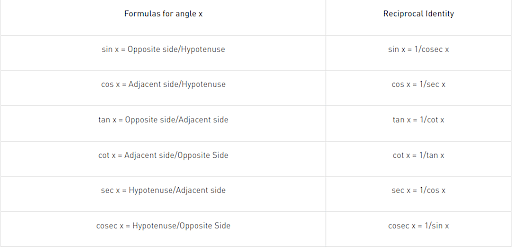
The relationship between the sides and angles of a right-angle triangle is described by trigonometry functions, sometimes known as circular functions. These trigonometric functions derive the relationship between the angles and sides of a triangle. In trigonometry, there are three primary functions of sine (sin), cosine (cos), tangent (tan). The other three main functions can be derived from the primary functions as cotangent (cot), secant (sec), and cosecant (cosec).
Six Basic Trigonometric Functions:
- Sine Function: The ratio between the length of the opposite side of the triangle to the length of the hypotenuse of the triangle.
sin x = a/h
- Cosine Function: The ratio between the length of the adjacent side of the triangle to the length of the hypotenuse of the triangle.
cos x = b/h
- Tangent Function: The ratio between the length of the opposite side of the triangle to the adjacent side length.
tan x = a/b
Tan x can also be represented as sin x/cos x
- Secant Function: The reciprocal of the cosine function.
sec x = 1/cosx = h/b
- Cosecant Function: The reciprocal of the sine function.
cosec x = 1/sinx = h/a
- Cotangent Function: The reciprocal of the tangent function.
cot x = 1/tan x = b/a
Formulas of Trigonometric Functions: