Question:
A thin rod of mass $M$ and length $a$ is free to rotate in horizontal plane about a fixed vertical axis passing through point $O$. A thin circular disc of mass $M$ and of radius $a / 4$ is pivoted on this rod with its center at a distance $a / 4$ from the free end so that it can rotate freely about its vertical axis, as shown in the figure. Assume that both the rod and the disc have uniform density and they remain horizontal during the motion. An outside stationary observer finds the rod rotating with an angular velocity $\Omega$ and the disc rotating about its vertical axis with angular velocity $4\, \Omega$. The total angular momentum of the system about the point $O$ is $\left(\frac{ Ma ^{2} \Omega}{48}\right) n$. The value of $n$ is ______
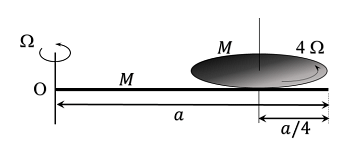
A thin rod of mass $M$ and length $a$ is free to rotate in horizontal plane about a fixed vertical axis passing through point $O$. A thin circular disc of mass $M$ and of radius $a / 4$ is pivoted on this rod with its center at a distance $a / 4$ from the free end so that it can rotate freely about its vertical axis, as shown in the figure. Assume that both the rod and the disc have uniform density and they remain horizontal during the motion. An outside stationary observer finds the rod rotating with an angular velocity $\Omega$ and the disc rotating about its vertical axis with angular velocity $4\, \Omega$. The total angular momentum of the system about the point $O$ is $\left(\frac{ Ma ^{2} \Omega}{48}\right) n$. The value of $n$ is ______
Updated On: May 9, 2025
Show Solution

Verified By Collegedunia
Correct Answer: 49
Solution and Explanation
Given:
- Thin rod of mass M and length a rotating about point O with angular velocity Ω
- A thin disc of mass M and radius a/4 is attached at distance a/4 from the free end of the rod
- The disc is rotating with angular velocity 4Ω about its own vertical axis
- We are to find the total angular momentum of the system about point O in terms of (M a² Ω / 48)·n
Step 1: Angular momentum of the rod about point O
Moment of inertia of thin rod about one end (axis perpendicular to length):
Irod = (1/3) M a²
Angular momentum = I × Ω = (1/3) M a² Ω
Step 2: Angular momentum of the disc
Total angular momentum of the disc has two parts:
- Due to rotation of the disc's center about O:
- Due to spinning of the disc about its own axis:
Total disc angular momentum = (9/16 + 1/8) M a² Ω
Convert to common denominator: (9/16 + 2/16) = 11/16
So, Ldisc = (11/16) M a² Ω
Step 3: Total angular momentum about O
Ltotal = Lrod + Ldisc = (1/3) M a² Ω + (11/16) M a² Ω
Take LCM:
(1/3) = (16/48), (11/16) = (33/48)
⇒ Ltotal = (16 + 33)/48 M a² Ω = (49/48) M a² Ω
Final Answer: n = 49
Was this answer helpful?
0
0
Top JEE Advanced Physics Questions
- Yellow light is used in a single slit diffraction experiment with slit width of 0.6 mm. If yellow light is replaced by X-rays, then the observed pattern will reveal
- The size of the image of an object, which is at infinity, as formed by a convex lens of focal length 30 cm is 2 cm. If a concave lens of focal length 20 cm is placed between the convex lens and the image at a distance of 26 cm from the convex lens, calculate the new size of the image.
- A concave lens of glass, refractive index 1.5 has both surfaces of same radius of curvature R. On immersion in a medium of refractive index 1.75, it will behave as a
- The position vector $\vec{r}$ of a particle of mass $m$ is given by the following equation $\vec{r}(t)=\alpha t^{3} \hat{i}+\beta t^{2} \hat{j}$ where $\alpha=\frac{10}{3} \,ms ^{-3}, \beta=5\, ms ^{-2}$ and $m =0.1 \,kg$. At $t =1\, s$, which of the following statement (s) is (are) true about the particle?
- In an n-p-n transistor circuit, the collector current is 10 mA. If 90% of the electrons emitted reach the collector
View More Questions
Top JEE Advanced Rotational motion Questions
- A ring of mass M and radius R is rotating with angular speed ? about a fixed vertical axis passing through its centre O with two point masses each of mass $\frac{M}{8}$ at rest at O. These masses can moveradially outwards along two massless rods fixed on the ring as shown in the figure. At some instant theangular speed of the system is $\frac{8}{9} ?$ and one of the masses is at a distance of $\frac{3}{5} R$ from O. At this instant the distance of the other mass from O is
- At time $t=0$, a disk of radius $1 \,m$ starts to roll without slipping on a horizontal plane with an angular acceleration of $\alpha=\frac{2}{3}\, rad\, s ^{-2}$ A small stone is stuck to the disk At $t=0$, it is at the contact point of the disk and the plane Later, at time $t=\sqrt{\pi} s$, the stone detaches itself and flies off tangentially from the disk The maximum height (in $m$ ) reached by the stone measured from the plane is $\frac{1}{2}+\frac{x}{10}$ The value of $x$ is ___[ [Take $g=10 \,m s ^{-2}$]
- A bar of m = 1.00 kg and length l = 0.20 m is lying on a horizontal frictionless surface. One end of the bar is pivoted so that the bar is free to rotate in the vertical plane. a small m = 0.10 kg is moving on the same horizontal surface with 5.00 ms-1 speed on its path which is perpendicular to the bar. Its hits the bar at a distance \(\frac{L}{2}\) from the pivoted end and return back on the same path with speed v. After this elastic collision, the bar rotates with an angular velocity ω. Which of the following statement is correct?
- A ball is released on a smooth plane as shown. It strikes with the ground, the coefficient of restitution is \(\frac{1}{\sqrt{3}}\) Choose the correct options

- An annular disc of mass M, inner radius a and outer radius b is placed on a horizontal surface with a coefficient of friction μ, as shown in the figure. At some time, an impulse J0 \(\hat{x}\) is applied at a height of h at the center of the disc. If h=hm, then the disc rolls without slipping along the x-axis, which of the following statement is/are correct?

View More Questions
Top JEE Advanced Questions
- Yellow light is used in a single slit diffraction experiment with slit width of 0.6 mm. If yellow light is replaced by X-rays, then the observed pattern will reveal
- The size of the image of an object, which is at infinity, as formed by a convex lens of focal length 30 cm is 2 cm. If a concave lens of focal length 20 cm is placed between the convex lens and the image at a distance of 26 cm from the convex lens, calculate the new size of the image.
- A concave lens of glass, refractive index 1.5 has both surfaces of same radius of curvature R. On immersion in a medium of refractive index 1.75, it will behave as a
- The position vector $\vec{r}$ of a particle of mass $m$ is given by the following equation $\vec{r}(t)=\alpha t^{3} \hat{i}+\beta t^{2} \hat{j}$ where $\alpha=\frac{10}{3} \,ms ^{-3}, \beta=5\, ms ^{-2}$ and $m =0.1 \,kg$. At $t =1\, s$, which of the following statement (s) is (are) true about the particle?
- In an n-p-n transistor circuit, the collector current is 10 mA. If 90% of the electrons emitted reach the collector
View More Questions
Concepts Used:
Rotational Motion
Rotational motion can be defined as the motion of an object around a circular path, in a fixed orbit.
Rotational Motion Examples:
The wheel or rotor of a motor, which appears in rotation motion problems, is a common example of the rotational motion of a rigid body.
Other examples:
- Moving by Bus
- Sailing of Boat
- Dog walking
- A person shaking the plant.
- A stone falls straight at the surface of the earth.
- Movement of a coin over a carrom board
Types of Motion involving Rotation:
- Rotation about a fixed axis (Pure rotation)
- Rotation about an axis of rotation (Combined translational and rotational motion)
- Rotation about an axis in the rotation (rotating axis)