Question:
A patient presents following a Road Traffic Accident (RTA) with absent air entry on the left side and tenderness in the left lower chest wall. What is the next step in Emergency Management (EMR)?
A patient presents following a Road Traffic Accident (RTA) with absent air entry on the left side and tenderness in the left lower chest wall. What is the next step in Emergency Management (EMR)?
Show Hint
Think of the point-of-care bedside investigation used first in trauma for detecting haemoperitoneum.
Updated On: Jun 23, 2026
- X-ray
- CT
- FAST
- DPL
Show Solution

Verified By Collegedunia
The Correct Option is C
Solution and Explanation
Step 1: Identify the clinical scenario.
The patient has sustained a road traffic accident and presents with absent air entry on the left side along with tenderness in the left lower chest wall. This raises concern for haemothorax, pneumothorax, or intra-abdominal injury with haemoperitoneum.
Step 2: Apply ATLS trauma principles.
In emergency management of a trauma patient, rapid assessment of life-threatening injuries is paramount using the ABC (Airway, Breathing, Circulation) approach.
Step 3: Select the appropriate investigation.
Focused Assessment with Sonography for Trauma (FAST) is the point-of-care ultrasound examination of choice in the initial assessment. It is performed rapidly at the bedside without moving the patient, does not involve radiation, and directly identifies free intraperitoneal fluid (haemoperitoneum) and pericardial effusion. Extended FAST (eFAST) also assesses for pleural fluid and pneumothorax.
Step 4: Why not the other options?
X-ray is useful but slower and less sensitive for haemoperitoneum. CT is highly detailed but time-consuming and requires patient transport to the scanner -- not the first step. DPL (Diagnostic Peritoneal Lavage) is invasive and largely replaced by FAST.
Conclusion: FAST is the immediate next step in emergency management of this trauma patient.
The patient has sustained a road traffic accident and presents with absent air entry on the left side along with tenderness in the left lower chest wall. This raises concern for haemothorax, pneumothorax, or intra-abdominal injury with haemoperitoneum.
Step 2: Apply ATLS trauma principles.
In emergency management of a trauma patient, rapid assessment of life-threatening injuries is paramount using the ABC (Airway, Breathing, Circulation) approach.
Step 3: Select the appropriate investigation.
Focused Assessment with Sonography for Trauma (FAST) is the point-of-care ultrasound examination of choice in the initial assessment. It is performed rapidly at the bedside without moving the patient, does not involve radiation, and directly identifies free intraperitoneal fluid (haemoperitoneum) and pericardial effusion. Extended FAST (eFAST) also assesses for pleural fluid and pneumothorax.
Step 4: Why not the other options?
X-ray is useful but slower and less sensitive for haemoperitoneum. CT is highly detailed but time-consuming and requires patient transport to the scanner -- not the first step. DPL (Diagnostic Peritoneal Lavage) is invasive and largely replaced by FAST.
Conclusion: FAST is the immediate next step in emergency management of this trauma patient.
Was this answer helpful?
0
0
Top NEET PG Surgery Questions
- A 55-year-old male presented with verrucous carcinoma around the glans of the penis. Examination reveals that the inguinal lymph nodes are not enlarged. What is the appropriate management for this patient?
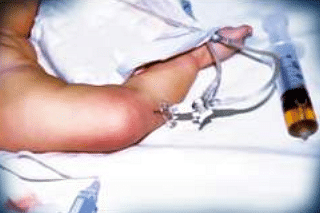
- Identify the procedure being performed in the image given below.
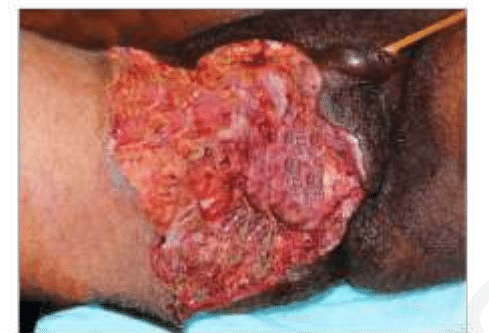
- A diabetic patient presents with sudden-onset perineal pain. On examination, foul-smelling discharge, and necrotic tissue as seen in the image is noted. Which of the following is true about the given condition?
- Which of the following is the most common complication following ligation of the first vessel during abdominoperineal resection for rectal carcinoma?(APR Abdominoperineal resection)
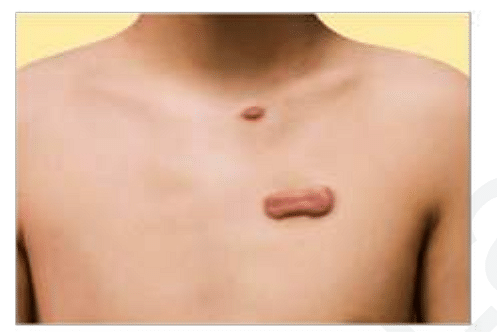
- A patient presents to the clinic with the lesion given in the image. He had a traumatic injury to the chest one year ago. What is the most likely diagnosis?
View More Questions
Top NEET PG Trauma and Emergency Surgery Questions
Top NEET PG Questions
- A patient hailing from Delhi presents with fever, arthralgia, and extensive petechial rash for 3 days. Lab investigations revealed a hemoglobin of 9 g/ dL, a white blood cell count of 9000 cells/mm3, a platelet count of 20000 cells/mm3, and a prolonged bleeding time. The clotting time was normal. What is the most likely diagnosis?
- Which of the following statements is true about Trichomonas vaginalis?
- A lady from West Rajasthan presented with an ulcer surrounded by erythema on the right leg. Microscopy of the biopsy from the edge of the ulcer showed organisms with dark staining nuclei and kinetoplast. What is the most likely causative agent?
- A child presents with a fever and a rash. Urine examination showed cells with owl's eye appearance. What is the most likely diagnosis?
- Infection with Clonorchis sinensis is associated with an increased risk of__?
View More Questions