Question:
A particle is executing simple harmonic motion with time period T. Let x, v an a denote the displacement, velocity and acceleration of the particle, respectively- at time t. Then,
A particle is executing simple harmonic motion with time period T. Let x, v an a denote the displacement, velocity and acceleration of the particle, respectively- at time t. Then,
Updated On: Nov 24, 2025
- \(\frac{aT}{x}\) does not change with time
- (αT + 2πv) does not change with time
- x and v are related by an equation of a straight line
- v and a are related by an equation of an ellipse
Show Solution

Verified By Collegedunia
The Correct Option is A, D
Solution and Explanation
To solve this problem, we need to understand the concepts of simple harmonic motion (SHM) and how displacement (\(x\)), velocity (\(v\)), and acceleration (\(a\)) relate to each other.
- Understanding Simple Harmonic Motion Equations:
- The displacement in SHM is given by: \(x(t) = A\cos(\omega t + \phi)\)
- The velocity is the derivative of the displacement: \(v(t) = -A\omega\sin(\omega t + \phi)\)
- The acceleration is the derivative of the velocity: \(a(t) = -A\omega^2\cos(\omega t + \phi)\)
- Relating Acceleration and Displacement:
- From the equations, acceleration can also be expressed as: \(a = -\omega^2 x\)
- This implies \(\frac{a}{x} = -\omega^2\), a constant.
- Given the period \(T = \frac{2\pi}{\omega}\), we have \(\omega = \frac{2\pi}{T}\).
- Thus, \(\frac{aT}{x} = - (2\pi)^2\), which does not change with time.
- Relating Velocity and Acceleration:
- Using earlier expressions: \(v = -\omega^2 x\) and \(a = -\omega^2 x\).
- Substitute \(x = \frac{v}{-\omega}\sin(\omega t + \phi)\) into the acceleration equation.
- It can be shown that the equation connecting \(v\) and \(a\) forms an ellipse equation upon squaring and adding.
- Conclusion:
- The correct answers are:
- \(\frac{aT}{x}\) does not change with time.
- \(v\) and \(a\) are related by an equation of an ellipse.
- The correct answers are:
Was this answer helpful?
0
0
Top IIT JAM Physics Questions
- The total number of Na and Cl ions per unit cell of the NaCl crystal is:
- The sum of three binary numbers, 10110.10, 11010.01, and 10101.11, in decimal system is:
- Which of the following matrices is Hermitian as well as unitary?
- The divergence of a 3-dimensional vector \(\frac{𝑟̂}{𝑟^3}\) (𝑟̂ is the unit radial vector) is:
- The magnitudes of spin magnetic moments of electron, proton and neutron are μe, μp and μn, respectively. Then
View More Questions
Top IIT JAM Waves and Oscillations Questions
- A particle moving along the x-axis approaches 𝑥=0 from 𝑥 =−∞ with a total energy E. It is subjected to a potential 𝑉(𝑥). For time 𝑡→∞, the probability density P(x) of the particle is schematically shown in the figure.
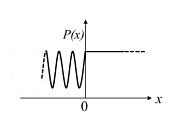
The correct option for the potential 𝑉(𝑥) is: - Which of the following types of motion may be represented by the trajectory,
𝑦(𝑥)=𝑎𝑥 2+𝑏𝑥+𝑐 ?
(Here a, b, and c are constants; x, y are the position coordinates) - If two traveling waves, given by
𝑦1=𝐴0 sin(α𝑘𝑥 -𝜔𝑡) and 𝑦2=𝐴0 sin(α𝑘𝑥 − β𝜔𝑡)
are superposed, which of the following statements is correct? - A whistle S of sound frequency f is oscillating with angular frequency 𝜔 along the x-axis. Its instantaneous position and the velocity are given by 𝑥(𝑡) = 𝑎 sin(𝜔𝑡) and 𝑣(𝑡)=𝑣0 cos (𝜔𝑡), respectively. An observer P is located on the y-axis at a distance L from the origin (see figure). Let 𝑣𝑃𝑆(𝑡) be the component of 𝑣(𝑡) along the line joining the source and the observer. Choose the correct option(s):
(Here 𝑎 and 𝑣0 are constants)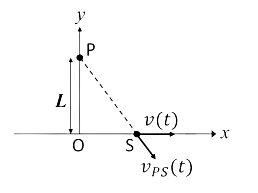
- A uniform stick of length l and mass m pivoted at its top end is oscillating with an angular frequency ωr . Assuming small oscillations, the ratio ωr/ωs , where ωs is the angular frequency of a simple pendulum of the same length, will be
View More Questions
Top IIT JAM Questions
- The total number of Na and Cl ions per unit cell of the NaCl crystal is:
- The sum of three binary numbers, 10110.10, 11010.01, and 10101.11, in decimal system is:
- Which of the following matrices is Hermitian as well as unitary?
- The divergence of a 3-dimensional vector \(\frac{𝑟̂}{𝑟^3}\) (𝑟̂ is the unit radial vector) is:
- The magnitudes of spin magnetic moments of electron, proton and neutron are μe, μp and μn, respectively. Then
View More Questions