Question:
A uniform stick of length l and mass m pivoted at its top end is oscillating with an angular frequency ωr . Assuming small oscillations, the ratio ωr/ωs , where ωs is the angular frequency of a simple pendulum of the same length, will be
A uniform stick of length l and mass m pivoted at its top end is oscillating with an angular frequency ωr . Assuming small oscillations, the ratio ωr/ωs , where ωs is the angular frequency of a simple pendulum of the same length, will be
Updated On: Nov 18, 2025
- \(\sqrt3\)
- \(\sqrt{\frac{3}{2}}\)
- \(\sqrt2\)
- \(\frac{1}{\sqrt3}\)
Show Solution

Verified By Collegedunia
The Correct Option is B
Solution and Explanation
To solve this problem, we need to compare the angular frequency \( \omega_r \) of a physical pendulum (the stick) to \( \omega_s \), the angular frequency of a simple pendulum.
- Angular Frequency of a Physical Pendulum (Stick):
- The stick is pivoted at one end, which makes it a physical pendulum.
- For small oscillations, the angular frequency \( \omega_r \) is given by: \(\omega_r = \sqrt{\frac{mgd}{I}}\) , where \(d\) is the distance from the pivot to the center of mass and \(I\) is the moment of inertia about the pivot.
- For a uniform stick, \(d = \frac{l}{2}\) and the moment of inertia \(I = \frac{1}{3}ml^2\) .
- Substituting these values gives: \(\omega_r = \sqrt{\frac{mg\left(\frac{l}{2}\right)}{\frac{1}{3}ml^2}} = \sqrt{\frac{3g}{2l}}\) .
- Angular Frequency of a Simple Pendulum:
- For a simple pendulum of length \(l\) , the angular frequency \(\omega_s\) is: \(\omega_s = \sqrt{\frac{g}{l}}\) .
- Ratio of Angular Frequencies:
- We are required to find \(\frac{\omega_r}{\omega_s}\) :
- Using the expressions derived: \(\frac{\omega_r}{\omega_s} = \frac{\sqrt{\frac{3g}{2l}}}{\sqrt{\frac{g}{l}}} = \sqrt{\frac{3g}{2l} \times \frac{l}{g}} = \sqrt{\frac{3}{2}}\) .
- The ratio of the angular frequency of a physical pendulum to that of a simple pendulum is \(\sqrt{\frac{3}{2}}\) .
- Therefore, the correct answer is \(\sqrt{\frac{3}{2}}\) .
Was this answer helpful?
0
0
Top IIT JAM Physics Questions
- The total number of Na and Cl ions per unit cell of the NaCl crystal is:
- The sum of three binary numbers, 10110.10, 11010.01, and 10101.11, in decimal system is:
- Which of the following matrices is Hermitian as well as unitary?
- The divergence of a 3-dimensional vector \(\frac{𝑟̂}{𝑟^3}\) (𝑟̂ is the unit radial vector) is:
- The magnitudes of spin magnetic moments of electron, proton and neutron are μe, μp and μn, respectively. Then
View More Questions
Top IIT JAM Waves and Oscillations Questions
- A particle moving along the x-axis approaches 𝑥=0 from 𝑥 =−∞ with a total energy E. It is subjected to a potential 𝑉(𝑥). For time 𝑡→∞, the probability density P(x) of the particle is schematically shown in the figure.
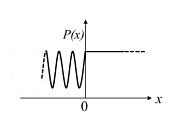
The correct option for the potential 𝑉(𝑥) is: - Which of the following types of motion may be represented by the trajectory,
𝑦(𝑥)=𝑎𝑥 2+𝑏𝑥+𝑐 ?
(Here a, b, and c are constants; x, y are the position coordinates) - If two traveling waves, given by
𝑦1=𝐴0 sin(α𝑘𝑥 -𝜔𝑡) and 𝑦2=𝐴0 sin(α𝑘𝑥 − β𝜔𝑡)
are superposed, which of the following statements is correct? - A whistle S of sound frequency f is oscillating with angular frequency 𝜔 along the x-axis. Its instantaneous position and the velocity are given by 𝑥(𝑡) = 𝑎 sin(𝜔𝑡) and 𝑣(𝑡)=𝑣0 cos (𝜔𝑡), respectively. An observer P is located on the y-axis at a distance L from the origin (see figure). Let 𝑣𝑃𝑆(𝑡) be the component of 𝑣(𝑡) along the line joining the source and the observer. Choose the correct option(s):
(Here 𝑎 and 𝑣0 are constants)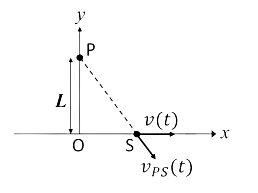
- A periodic function f(x) = x2 for -π < x < π is expanded in a Fourier series. Which of the following statement(s) is/are correct ?
View More Questions
Top IIT JAM Questions
- The total number of Na and Cl ions per unit cell of the NaCl crystal is:
- The sum of three binary numbers, 10110.10, 11010.01, and 10101.11, in decimal system is:
- Which of the following matrices is Hermitian as well as unitary?
- The divergence of a 3-dimensional vector \(\frac{𝑟̂}{𝑟^3}\) (𝑟̂ is the unit radial vector) is:
- The magnitudes of spin magnetic moments of electron, proton and neutron are μe, μp and μn, respectively. Then
View More Questions