A parallel beam of light is allowed to fall on a transparent spherical globe of diameter 30 cm and refractive index 1.5. The distance from the centre of the globe at which the beam of light can converge is________ mm.

Correct Answer: 225
Solution and Explanation
The correct answer is: 225

1st refraction:
\(\frac{1.5}{V_1}-0=\frac{0.5}{15}\)
\(⇒ v_1 = 45 \)cm
2nd refraction:
\(\frac{1}{v_2}-\frac{1.5}{15}=\frac{-0.5}{-15}\)
\(⇒ \frac{1}{v_2}=\frac{1}{30}+\frac{1}{10}\)
\(⇒ v2 = +7.5 \)cm
\(⇒\) Distance from centre = 22.5 cm
Top JEE Main Physics Questions
- Two masses $m$ and $\frac{m}{2}$ are connected at the two ends of a massless rigid rod of length $l$. The rod is suspended by a thin wire of torsional constant $k$ at the centre of mass of the rod-mass system(see figure). Because of torsional constant $k$, the restoring torque is $\tau =k\theta$ for angular displacement $\theta$. If the rod is rota ted by $\theta_0$ and released, the tension in it when it passes through its mean position will be:
A black body is at a temperature of 2880 K. The energy of radiation emitted by this body with wavelength between 499 nm and 500 nm is U1, between 999 nm and 1000 nm is U2 and between 1499 nm and 1500 nm is U3. The Wien's constant, b = 2.88×10⁶ nm-K. Then,
- $I _{ CM }$ is the moment of inertia of a circular disc about an axis (CM) passing through its center and perpendicular to the plane of disc $I_{A B}$ is it's moment of inertia about an axis $AB$ perpendicular to plane and parallel to axis $CM$ at a distance $\frac{2}{3} R$ from center Where $R$ is the radius of the dise The ratio of $I _{ AB }$ and $I _{ CM }$ is $x: 9$ The value of $x$ is______

- A nucleus disintegrates into two smaller parts, which have their velocities in the ratio $3: 2$ The ratio of their nuclear sizes will be $\left(\frac{x}{3}\right)^{\frac{1}{3}}$ The value of ' $x$ ' is:-
- A particle starts with an initial velocity of 10.0 m/s along x-direction and accelerates uniformly at the rate of 2.0 m/s$^2$. The time taken by the particle to reach the velocity of 60.0 m/s is
Top JEE Main Units and measurement Questions
- A huge circular arc of length 4.4 ly subtends an angle '4s' at the centre of the circle. How long it would take for a body to complete 4 revolution if its speed is 8 AU per second ?
Given: 1 ly = \(9.46 \times 10^{15}\) m
1 AU = \(1.5 \times 10^{11}\) m A vernier caliper has \(10\) main scale divisions coinciding with \(11\) vernier scale division equals \(5\) \(mm\). the least count of the device is :
- Match List-I with List-II.
\[ \begin{array}{|c|c|c|} \hline \text{List-I} & & \text{List-II} \\ \hline \text{A. Coefficient of viscosity} & & \text{I.} \; [M L^2 T^{-2}] \\ \text{B. Surface Tension} & & \text{II.} \; [M L^2 T^{-1}] \\ \text{C. Angular momentum} & & \text{III.} \; [M L^1 T^{-1}] \\ \text{D. Rotational kinetic energy} & & \text{IV.} \; [M L^0 T^{-2}] \\ \hline \end{array} \] - Given below are two statements : one is labelled as Assertion(A) and the other is labelled as Reason (R).
Assertion (A) : In Vernier calliper if positive zero error exists, then while taking measurements, the reading taken will be more than the actual reading.
Reason (R) : The zero error in Vernier Calliper might have happened due to manufacturing defect or due to rough handling.
In the light of the above statements, choose the correct answer from the options given below : - 10 divisions on the main scale of a Vernier calliper coincide with 11 divisions on the Vernier scale. If each division on the main scale is of 5 units, the least count of the instrument is :
Top JEE Main Questions
- Two masses $m$ and $\frac{m}{2}$ are connected at the two ends of a massless rigid rod of length $l$. The rod is suspended by a thin wire of torsional constant $k$ at the centre of mass of the rod-mass system(see figure). Because of torsional constant $k$, the restoring torque is $\tau =k\theta$ for angular displacement $\theta$. If the rod is rota ted by $\theta_0$ and released, the tension in it when it passes through its mean position will be:
What will be the equilibrium constant of the given reaction carried out in a \(5 \,L\) vessel and having equilibrium amounts of \(A_2\) and \(A\) as \(0.5\) mole and \(2 \times 10^{-6}\) mole respectively?
The reaction : \(A_2 \rightleftharpoons 2A\)- The value of is
- The number of terms of an is even. The sum of the odd terms is and of the even terms is . The last term exceeds the first by . Then the number of terms in the series is ______.
A black body is at a temperature of 2880 K. The energy of radiation emitted by this body with wavelength between 499 nm and 500 nm is U1, between 999 nm and 1000 nm is U2 and between 1499 nm and 1500 nm is U3. The Wien's constant, b = 2.88×10⁶ nm-K. Then,
Concepts Used:
Types of Differential Equations
There are various types of Differential Equation, such as:
Ordinary Differential Equations:
Ordinary Differential Equations is an equation that indicates the relation of having one independent variable x, and one dependent variable y, along with some of its other derivatives.
\(F(\frac{dy}{dt},y,t) = 0\)
Partial Differential Equations:
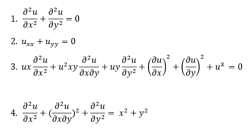
A partial differential equation is a type, in which the equation carries many unknown variables with their partial derivatives.
Linear Differential Equations:
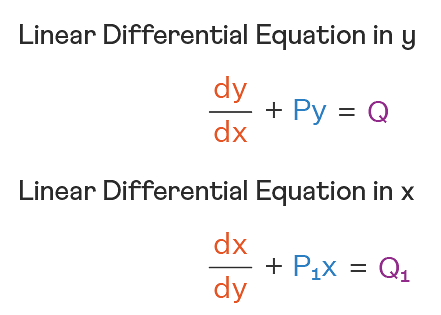
It is the linear polynomial equation in which derivatives of different variables exist. Linear Partial Differential Equation derivatives are partial and function is dependent on the variable.
Homogeneous Differential Equations:
When the degree of f(x,y) and g(x,y) is the same, it is known to be a homogeneous differential equation.
\(\frac{dy}{dx} = \frac{a_1x + b_1y + c_1}{a_2x + b_2y + c_2}\)
Read More: Differential Equations