A lens of large focal length and large aperture is best suited as an objective of an astronomical telescope since:
- a large aperture contributes to the quality and visibility of the images.
- a large area of the objective ensures better light gathering power.
- a large aperture provides a better resolution.
- all of the above.

The Correct Option is D
Solution and Explanation
The question is about selecting the best objective lens for an astronomical telescope. Let's analyze each of the given options to understand why a lens with a large focal length and large aperture is preferable:
- A large aperture contributes to the quality and visibility of the images. A larger aperture allows more light to enter the telescope, improving the brightness of the image and enhancing the visibility of faint astronomical objects.
- A large area of the objective ensures better light gathering power. This is directly related to the lens's ability to gather light. When the aperture is larger, the lens can capture more photons from distant stars or galaxies, which is crucial for astronomical observations, especially under low-light conditions.
- A large aperture provides a better resolution. According to the Rayleigh criterion, the resolution (or ability to distinguish between two close objects) improves with an increase in aperture size. This is because the resolving power of a lens is proportional to its diameter.
Based on the analysis, all the options provided are correct because each explains a beneficial characteristic of a large aperture and focal length in an astronomical telescope. Therefore, the correct answer is all of the above.
Top NEET Physics Questions
- The time constant of C-R circuit is
- The correct Boolean operation represented by the circuit diagram drawn is :
- The driver of a car travelling with speed $30\, m/sec$ towards a hill sounds a horn of frequency $600\, Hz.$ If the velocity of sound in air is $330\, m/s,$ the frequency of reflected sound as heard by driver is
- Two simple harmonic motions of angular frequency 100 and 1000 rad $s^1$ have the same displacement amplitude. The ratio of their maximum acceleration is
- In an ac circuit , an alternating voltage $e = 200 \sqrt2 \,sin \,100\, t$ volts is connected to a capacitor of capacitance $1 \,\mu \,F$. The rms value of the current in the circuit is :
Top NEET Questions
- A $100.0\, mL$ dilute solution of $Ag ^{+}$is electrolysed for $15.0$ minutes with a current of $1.25 \,mA$ and the silver is removed completely. What was the initial $\left[ Ag ^{+}\right]$?
- The time constant of C-R circuit is
- The chronological order of human evolution from early to the recent is
- The correct Boolean operation represented by the circuit diagram drawn is :
- The driver of a car travelling with speed $30\, m/sec$ towards a hill sounds a horn of frequency $600\, Hz.$ If the velocity of sound in air is $330\, m/s,$ the frequency of reflected sound as heard by driver is
Concepts Used:
Spherical Mirrors
A spherical mirror is a mirror which has been cut out of a spherical surface.
There are two kinds of spherical mirrors:
- Convex Mirror
- Concave Mirror
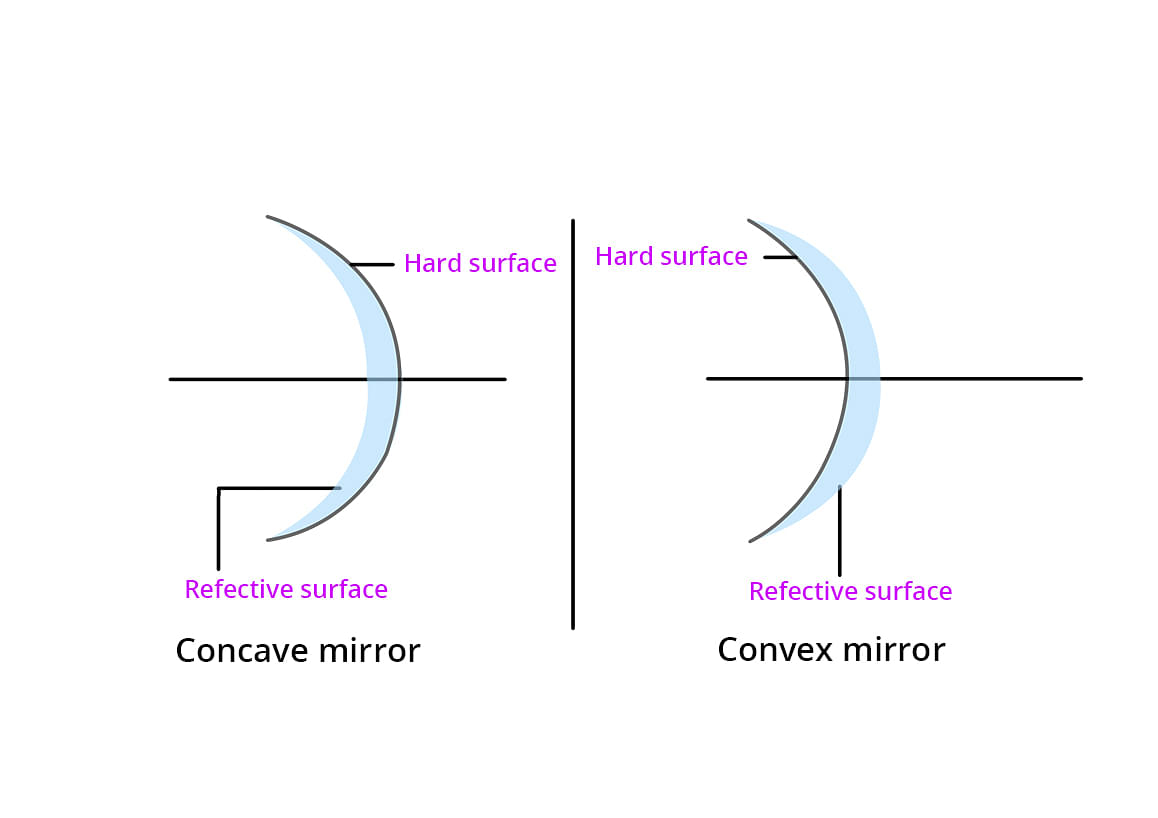
Concave Mirror
Concave mirrors are also called converging mirrors, because in these types of mirrors, light rays converge at a point after impact and reflect back from the reflective surface of the mirror.
Convex Mirror
The convex mirror has a reflective surface that is curved outward. Regardless of the distance between the subject and the mirrors, these mirrors are "always" virtual, upright and reduced.