Question:
A gas of \(N\) classical particles that can occupy energy levels \(\epsilon_1\) and \(\epsilon_2 = \epsilon_1+\Delta\) is in equilibrium with a reservoir at temperature \(T\). From the schematics shown below, choose the correct dependence of the internal energy \(U\) on \(T\).
A gas of \(N\) classical particles that can occupy energy levels \(\epsilon_1\) and \(\epsilon_2 = \epsilon_1+\Delta\) is in equilibrium with a reservoir at temperature \(T\). From the schematics shown below, choose the correct dependence of the internal energy \(U\) on \(T\).
Show Hint
A two-level system's average energy per particle is bounded between \(\epsilon_1\) (all particles in the ground level) and \(\epsilon_1+\Delta/2\) (levels equally populated), and it rises smoothly between the two.
Updated On: Aug 17, 2026
- A curve that starts flat at a low value for small \(T\), rises smoothly through an S-shaped (sigmoid) transition, and saturates to a higher flat value at large \(T\).
- A curve that starts at zero and keeps rising with an ever-increasing slope as \(T\) grows, with no upper flat limit.
- A curve that starts high at small \(T\) and falls off smoothly to a lower flat value as \(T\) increases.
- A curve that starts at a small nonzero value and keeps rising with an ever-increasing slope as \(T\) grows, with no upper flat limit.
Show Solution

Verified By Collegedunia
The Correct Option is A
Solution and Explanation
Step 1: Understanding the Concept:
Each of the \(N\) classical (distinguishable, non-interacting) particles can sit in either of two energy levels, \(\varepsilon_1\) or \(\varepsilon_2 = \varepsilon_1+\Delta\). At temperature \(T\), a single particle's average energy comes from the ordinary canonical (Boltzmann) weighting of these two levels, this is the classic "two-level system."
Step 2: Key Formula or Approach:
The single particle partition function is \(z = e^{-\beta\varepsilon_1}+e^{-\beta\varepsilon_2}\), with \(\beta=1/(k_BT)\). The average energy per particle is \(\langle\varepsilon\rangle = -\dfrac{\partial \ln z}{\partial\beta}\), and the total internal energy is \(U(T) = N\langle\varepsilon\rangle\).
Step 3: Detailed Explanation:
Factor out \(e^{-\beta\varepsilon_1}\): \(z = e^{-\beta\varepsilon_1}(1+e^{-\beta\Delta})\), so \(\ln z = -\beta\varepsilon_1+\ln(1+e^{-\beta\Delta})\).
\[ \langle\varepsilon\rangle = -\frac{\partial\ln z}{\partial\beta} = \varepsilon_1+\frac{\Delta e^{-\beta\Delta}}{1+e^{-\beta\Delta}} = \varepsilon_1+\frac{\Delta}{e^{\beta\Delta}+1} \]
\[ U(T) = N\left[\varepsilon_1+\frac{\Delta}{e^{\Delta/k_BT}+1}\right] \]
Now look at the two extreme temperatures. As \(T\to0\), \(\beta\to\infty\) so \(e^{\beta\Delta}\to\infty\) and the correction term vanishes, giving \(U\to N\varepsilon_1\): every particle sits frozen in the lower level.
As \(T\to\infty\), \(\beta\to0\) so \(e^{\beta\Delta}\to1\) and the correction term saturates at \(\Delta/2\), giving \(U\to N(\varepsilon_1+\Delta/2)\): both levels become equally populated and \(U\) stops changing.
In between, \(U\) rises smoothly from the low plateau to the high plateau as \(k_BT\) becomes comparable to \(\Delta\), tracing out an S-shaped (sigmoid) curve that flattens at both ends.
Step 4: Why the other options are wrong.
Option (B) keeps rising without any upper limit, but \(U\) is physically bounded above by \(N(\varepsilon_1+\Delta/2)\) once the two levels are equally populated, it cannot increase forever.
Option (C) shows \(U\) decreasing with \(T\), but heating a two-level system can only push more particles into the higher level, never fewer, so the internal energy cannot fall as \(T\) rises.
Option (D) also grows without bound and skips the flat low-temperature plateau altogether.
Final Answer:
\(U(T)\) starts flat near \(N\varepsilon_1\), rises through an S-shaped transition, and levels off at \(N(\varepsilon_1+\Delta/2)\), this is exactly the shape in graph (A). \[ \boxed{U(T):\ N\varepsilon_1 \to N\left(\varepsilon_1+\frac{\Delta}{2}\right),\ \text{sigmoid shape, option (A)}} \]
Each of the \(N\) classical (distinguishable, non-interacting) particles can sit in either of two energy levels, \(\varepsilon_1\) or \(\varepsilon_2 = \varepsilon_1+\Delta\). At temperature \(T\), a single particle's average energy comes from the ordinary canonical (Boltzmann) weighting of these two levels, this is the classic "two-level system."
Step 2: Key Formula or Approach:
The single particle partition function is \(z = e^{-\beta\varepsilon_1}+e^{-\beta\varepsilon_2}\), with \(\beta=1/(k_BT)\). The average energy per particle is \(\langle\varepsilon\rangle = -\dfrac{\partial \ln z}{\partial\beta}\), and the total internal energy is \(U(T) = N\langle\varepsilon\rangle\).
Step 3: Detailed Explanation:
Factor out \(e^{-\beta\varepsilon_1}\): \(z = e^{-\beta\varepsilon_1}(1+e^{-\beta\Delta})\), so \(\ln z = -\beta\varepsilon_1+\ln(1+e^{-\beta\Delta})\).
\[ \langle\varepsilon\rangle = -\frac{\partial\ln z}{\partial\beta} = \varepsilon_1+\frac{\Delta e^{-\beta\Delta}}{1+e^{-\beta\Delta}} = \varepsilon_1+\frac{\Delta}{e^{\beta\Delta}+1} \]
\[ U(T) = N\left[\varepsilon_1+\frac{\Delta}{e^{\Delta/k_BT}+1}\right] \]
Now look at the two extreme temperatures. As \(T\to0\), \(\beta\to\infty\) so \(e^{\beta\Delta}\to\infty\) and the correction term vanishes, giving \(U\to N\varepsilon_1\): every particle sits frozen in the lower level.
As \(T\to\infty\), \(\beta\to0\) so \(e^{\beta\Delta}\to1\) and the correction term saturates at \(\Delta/2\), giving \(U\to N(\varepsilon_1+\Delta/2)\): both levels become equally populated and \(U\) stops changing.
In between, \(U\) rises smoothly from the low plateau to the high plateau as \(k_BT\) becomes comparable to \(\Delta\), tracing out an S-shaped (sigmoid) curve that flattens at both ends.
Step 4: Why the other options are wrong.
Option (B) keeps rising without any upper limit, but \(U\) is physically bounded above by \(N(\varepsilon_1+\Delta/2)\) once the two levels are equally populated, it cannot increase forever.
Option (C) shows \(U\) decreasing with \(T\), but heating a two-level system can only push more particles into the higher level, never fewer, so the internal energy cannot fall as \(T\) rises.
Option (D) also grows without bound and skips the flat low-temperature plateau altogether.
Final Answer:
\(U(T)\) starts flat near \(N\varepsilon_1\), rises through an S-shaped transition, and levels off at \(N(\varepsilon_1+\Delta/2)\), this is exactly the shape in graph (A). \[ \boxed{U(T):\ N\varepsilon_1 \to N\left(\varepsilon_1+\frac{\Delta}{2}\right),\ \text{sigmoid shape, option (A)}} \]
Was this answer helpful?
0
0
Top GATE PH Physics Questions
- An infinite one-dimensional lattice extends along the x-axis. At each lattice site, there exists an ion with spin 1/2. The spin can point either in the +z or -z direction only. Let \( S_P \), \( S_F \), and \( S_A \) denote the entropies of paramagnetic, ferromagnetic, and antiferromagnetic configurations, respectively. Which of the following relations is/are true?
- Two point charges of charge \( +q \) each are placed a distance \( 2d \) apart. A grounded solid conducting sphere of radius \( a \) is placed midway between them. Assume \( a^2 \ll d^2 \). Which of the following statements is/are true?
- A particle of mass $m$ is moving in the potential
\[ V(x) = \begin{cases} V_0 + \frac{1}{2} m \omega_{0P}^2 x^2 & \quad \text{if } x > 0 \\ \infty & \quad \text{if } x \leq 0 \end{cases} \]
Figures P, Q, R, and S show different combinations of the values of $ \omega_0 $ and $ V_0 $. - Decays of mesons and baryons can be categorized as weak, strong and electromagnetic decays depending upon the interactions involved in the processes. Which of the following option is/are true?
- The temperature \( T \) dependence of magnetic susceptibility \( \chi \) (Column I) of certain magnetic materials (Column II) are given below. Which of the following options is/are correct?
Column I Column II (1) 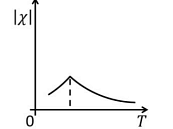
(P) Diamagnetic (2) 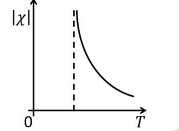
(Q) Paramagnetic (3) 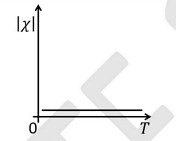
(R) Ferromagnetic (4) 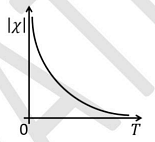
(S) Antiferromagnetic
View More Questions
Top GATE PH Thermodynamic and Statistical Physics Questions
- For a finite system of Fermions where the density of states increases with energy, the chemical potential
- Consider a system of three distinguishable particles, each having spin \( S = \frac{1}{2} \) such that \( S_z = \pm \frac{1}{2} \) with corresponding magnetic moments \( \mu_z = \pm \mu \). When the system is placed in an external magnetic field \( H \) pointing along the z-axis, the total energy of the system is \( \mu H \). Let \( x \) be the state where the first spin has \( S_z = \frac{1}{2} \). The probability of having the state \( x \) and the mean magnetic moment (in the +z direction) of the system in state \( x \) are
Consider a single one-dimensional harmonic oscillator of angular frequency \( \omega \), in equilibrium at temperature \( T = \left( k_B \beta \right)^{-1 }\). The states of the harmonic oscillator are all non-degenerate having energy \( E_n = \left( n + \frac{1}{2} \right) \hbar \omega \) with equal probability, where \( n \) is the quantum number. The Helmholtz free energy of the oscillator is
A system of two atoms can be in three quantum states having energies 0, $\epsilon$ and $2\epsilon$. The system is in equilibrium at temperature \( T = (k_B\beta)^{-1} \). Match the following Statistics with the Partition function.

- Consider the Otto cycle for an ideal gas engine consisting of two quasistatic adiabatic and two quasistatic isochoric processes. The correct temperature-entropy (T-S) phase diagram for the cycle is:
View More Questions
Top GATE PH Questions
- If \( F_1(Q, q) = Qq \) is the generating function of a canonical transformation from \((p, q)\) to \((P, Q)\), then which one of the following relations is correct?
- When an unpolarized plane electromagnetic wave in a dielectric medium with refractive index \( n_1 \) is incident on a plane interface separating it from another dielectric medium with refractive index \( n_2 \) (where \( n_2 > n_1 \)), and the angle of incidence is \(\tan^{-1} \left( \frac{n_2}{n_1} \right) \), the following statement is true:
- The wavefunction of a particle in an infinite one-dimensional potential well at time \( t \) is
\[ \Psi(x, t) = \sqrt{\frac{2}{3}} e^{-iE_1 t/\hbar}\psi_1(x) + \frac{1}{\sqrt{6}} e^{i\pi/6} e^{-iE_2 t/\hbar} \psi_2(x) + \frac{1}{\sqrt{6}} e^{i\pi/4} e^{-iE_3 t/\hbar} \psi_3(x) \]where \(\psi_1\), \(\psi_2\), and \(\psi_3\) are the normalized ground state, the normalized first excited state, and the normalized second excited state, respectively. \(E_1\), \(E_2\), and \(E_3\) are the eigen-energies corresponding to \(\psi_1\), \(\psi_2\), and \(\psi_3\), respectively. The expectation value of energy of the particle in state \(\Psi(x,t)\) is - If a thermodynamical system is adiabatically isolated and experiences a change in volume under an externally applied constant pressure, then the thermodynamical potential minimized at equilibrium is the
- The mean distance between the two atoms of an HD molecule is \( r \), where H and D denote hydrogen and deuterium, respectively. The mass of the hydrogen atom is \( m_H \). The energy difference between the two lowest lying rotational states of HD in multiples of \(\frac{h^2}{m_H r^2}\) is:
View More Questions