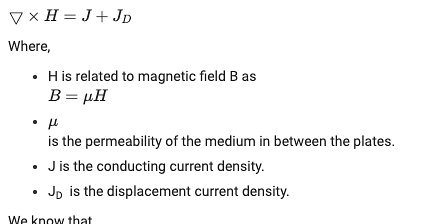
A capacitor of capacitance ‘C’, is connected across an ac source of voltage V, given by V=V0sinωt The displacement current between the plates of the capacitor, would then be given by
\(I_d=V_0\,\omega Csin\omega t\)
\(I_d=V_0\,\omega Ccos\omega t\)
\(I_d=\frac{V_0}{\omega C}cos\omega t\)
\(I_d=\frac{V_0}{\omega C}sin\omega t\)

The Correct Option is B
Solution and Explanation
To determine the displacement current \(I_d\) for a capacitor connected to an AC voltage source, we start by examining the given voltage expression: \(V = V_0 \sin \omega t\), where:
- \(V_0\) is the peak voltage,
- \(\omega\) is the angular frequency,
- \(t\) is the time.
In an AC circuit, the relationship between current and voltage in a capacitor is different from that in a resistor. For a capacitor, the current (or displacement current in this case) leads the voltage by a phase angle of \(\frac{\pi}{2}\) radians.
The displacement current through the capacitor is given by:
- The capacitor equation: \(Q = CV\), where \(Q\) is the charge on the capacitor.
- Differentiate with respect to time to find the current: \(I_d = \frac{dQ}{dt} = C \frac{dV}{dt}\).
Now, differentiate the voltage \(V = V_0\sin\omega t\) with respect to time:
- \(\frac{dV}{dt} = V_0 \omega \cos \omega t\).
Substitute into the expression for current:
- \(I_d = C \left( V_0 \omega \cos \omega t \right)\).
Simplifying, we get:
- \(I_d = V_0 \omega C \cos \omega t\).
Thus, the displacement current is given by the expression: \(I_d = V_0 \omega C \cos \omega t\). This matches the provided correct answer.
The other options can be ruled out since they do not incorporate the correct behavior of current leading the voltage by \(\frac{\pi}{2}\) radians, as seen in the use of \(\cos\) instead of \(\sin\) for current.
Therefore, the correct option is:
- \(I_d = V_0 \omega C \cos \omega t\)
Top NEET Physics Questions
- The time constant of C-R circuit is
- The correct Boolean operation represented by the circuit diagram drawn is :
- The driver of a car travelling with speed $30\, m/sec$ towards a hill sounds a horn of frequency $600\, Hz.$ If the velocity of sound in air is $330\, m/s,$ the frequency of reflected sound as heard by driver is
- Two simple harmonic motions of angular frequency 100 and 1000 rad $s^1$ have the same displacement amplitude. The ratio of their maximum acceleration is
- In an ac circuit , an alternating voltage $e = 200 \sqrt2 \,sin \,100\, t$ volts is connected to a capacitor of capacitance $1 \,\mu \,F$. The rms value of the current in the circuit is :
Top NEET Magnetism and matter Questions
- Among which the magnetic susceptibility does not depend on the temperature
- A bar magnet is oscillating in the Earth's magnetic field with a period T. What happens to this period and motion if this mass is quadrupled:
- The magnetic potential energy, when a magnetic bar of magnetic moment \( \vec{m} \) is placed perpendicular to the magnetic field \( \vec{B} \), is:
- The incorrect relation for a diamagnetic material (all the symbols carry their usual meaning and ε is a small positive number) is:
- The magnetic moment and moment of inertia of a magnetic needle as shown are, respectively, \(1.0 \times 10^{-2} \, \text{A} \, \text{m}^2\) and \(\frac{10^{-6}}{\pi^2} \, \text{kg} \, \text{m}^2\). If it completes 10 oscillations in 10 s, the magnitude of the magnetic field is:

Top NEET Questions
- A $100.0\, mL$ dilute solution of $Ag ^{+}$is electrolysed for $15.0$ minutes with a current of $1.25 \,mA$ and the silver is removed completely. What was the initial $\left[ Ag ^{+}\right]$?
- The time constant of C-R circuit is
- The chronological order of human evolution from early to the recent is
- The correct Boolean operation represented by the circuit diagram drawn is :
- The driver of a car travelling with speed $30\, m/sec$ towards a hill sounds a horn of frequency $600\, Hz.$ If the velocity of sound in air is $330\, m/s,$ the frequency of reflected sound as heard by driver is
Concepts Used:
Displacement Current
Displacement current is a quantity appearing in Maxwell’s equations. Displacement current definition is defined in terms of the rate of change of the electric displacement field (D). It can be explained by the phenomenon observed in a capacitor.