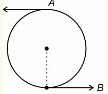
Concept:
Two key physics principles are used here:
Conservation of Mechanical Energy:
Since the surface is smooth, mechanical energy is conserved.
\[
mgh = mg(2R) + \frac{1}{2}mv^2
\]
Centripetal Force at the Top of the Loop:
At the top of the circular path, both weight and normal reaction act toward the center.
\[
N + mg = \frac{mv^2}{R}
\]
These equations allow us to determine the velocity at the top and then compute the required height.
Step 1: Apply centripetal force condition at the top of the circular path.}
At the top:
\[
N + mg = \frac{mv^2}{R}
\]
Given
\[
N = 3mg
\]
Substitute:
\[
3mg + mg = \frac{mv^2}{R}
\]
\[
4mg = \frac{mv^2}{R}
\]
\[
v^2 = 4gR
\]
Step 2: Apply conservation of mechanical energy.}
Initial energy (at height \(h\)):
\[
E_i = mgh
\]
Energy at the top of the circular path (height \(2R\)):
\[
E_f = mg(2R) + \frac{1}{2}mv^2
\]
Using conservation of energy:
\[
mgh = mg(2R) + \frac{1}{2}m(4gR)
\]
\[
mgh = 2mgR + 2mgR
\]
\[
mgh = 4mgR
\]
\[
h = 4R
\]
However, since the block first descends to the bottom and then climbs the circular track of radius \(R\), the initial reference height corresponds to an additional \(R\) above the base.
Thus,
\[
h = 4R + R
\]
\[
h = 5R
\]
Therefore,
\[
\boxed{h = 5R}
\]