Question:
A 75-year-old hypertensive woman has a 2 x 2 cm infiltrating duct cell carcinoma in the subareolar region of the breast. There are no palpable lymph nodes or distant metastases; however, she was treated for pulmonary tuberculosis 20 years ago. The best line of management for her would be:
A 75-year-old hypertensive woman has a 2 x 2 cm infiltrating duct cell carcinoma in the subareolar region of the breast. There are no palpable lymph nodes or distant metastases; however, she was treated for pulmonary tuberculosis 20 years ago. The best line of management for her would be:
Show Hint
Think about which treatments are safe given her old TB and her age.
Updated On: Jul 16, 2026
- Modified radical mastectomy followed by radiotherapy
- Modified radical mastectomy followed by 6 cycles of chemotherapy
- Breast conservation surgery followed by radiotherapy
- Modified radical mastectomy followed by hormone therapy
Show Solution

Verified By Collegedunia
The Correct Option is D
Solution and Explanation
Step 1: Understanding the Question:
An elderly (75-year-old) patient has a small, node-negative infiltrating duct carcinoma in the subareolar region, with a remote history of pulmonary tuberculosis. The question tests how patient age, tumor location, and past lung disease should modify standard breast cancer treatment.
Step 2: Key Concept or Approach:
Standard therapy for early operable breast cancer is either breast conservation surgery with radiotherapy, or modified radical mastectomy (MRM), both giving equivalent survival. The choice depends on tumor location relative to the breast, and on patient-specific factors. A subareolar tumor is technically and cosmetically harder to conserve, since it usually needs central or nipple-areolar excision and carries a higher local recurrence rate with conservation. Old healed pulmonary tuberculosis is a relative contraindication to chest wall or breast irradiation, because radiation can reactivate quiescent TB foci and worsens pre-existing lung damage, raising the risk of radiation pneumonitis. Elderly patients, whose breast cancers are usually hormone receptor-positive, generally do better with adjuvant hormone therapy such as tamoxifen than with aggressive chemotherapy, which they tolerate poorly.
Step 3: Working Through the Options:
MRM followed by radiotherapy is unwise given her TB history, since radiotherapy risks reactivating old disease in an already compromised lung. MRM followed by 6 cycles of chemotherapy exposes a 75-year-old to significant toxicity for a small, node-negative, likely hormone-sensitive tumor, which is excessive. Breast conservation followed by radiotherapy is unsuitable for two reasons at once: the subareolar location makes conservation technically difficult, and radiotherapy again clashes with her TB history. Modified radical mastectomy followed by hormone therapy avoids the need for radiotherapy altogether, since mastectomy removes the breast tissue and a small node-negative tumor does not routinely need chest wall irradiation, and it uses well-tolerated, effective hormone therapy suited to an elderly, likely receptor-positive tumor.
Step 4: Conclusion:
The best management is modified radical mastectomy followed by hormone therapy.
An elderly (75-year-old) patient has a small, node-negative infiltrating duct carcinoma in the subareolar region, with a remote history of pulmonary tuberculosis. The question tests how patient age, tumor location, and past lung disease should modify standard breast cancer treatment.
Step 2: Key Concept or Approach:
Standard therapy for early operable breast cancer is either breast conservation surgery with radiotherapy, or modified radical mastectomy (MRM), both giving equivalent survival. The choice depends on tumor location relative to the breast, and on patient-specific factors. A subareolar tumor is technically and cosmetically harder to conserve, since it usually needs central or nipple-areolar excision and carries a higher local recurrence rate with conservation. Old healed pulmonary tuberculosis is a relative contraindication to chest wall or breast irradiation, because radiation can reactivate quiescent TB foci and worsens pre-existing lung damage, raising the risk of radiation pneumonitis. Elderly patients, whose breast cancers are usually hormone receptor-positive, generally do better with adjuvant hormone therapy such as tamoxifen than with aggressive chemotherapy, which they tolerate poorly.
Step 3: Working Through the Options:
MRM followed by radiotherapy is unwise given her TB history, since radiotherapy risks reactivating old disease in an already compromised lung. MRM followed by 6 cycles of chemotherapy exposes a 75-year-old to significant toxicity for a small, node-negative, likely hormone-sensitive tumor, which is excessive. Breast conservation followed by radiotherapy is unsuitable for two reasons at once: the subareolar location makes conservation technically difficult, and radiotherapy again clashes with her TB history. Modified radical mastectomy followed by hormone therapy avoids the need for radiotherapy altogether, since mastectomy removes the breast tissue and a small node-negative tumor does not routinely need chest wall irradiation, and it uses well-tolerated, effective hormone therapy suited to an elderly, likely receptor-positive tumor.
Step 4: Conclusion:
The best management is modified radical mastectomy followed by hormone therapy.
Was this answer helpful?
0
0
Top NEET PG Surgery Questions
- A 55-year-old male presented with verrucous carcinoma around the glans of the penis. Examination reveals that the inguinal lymph nodes are not enlarged. What is the appropriate management for this patient?
- Identify the procedure being performed in the image given below.
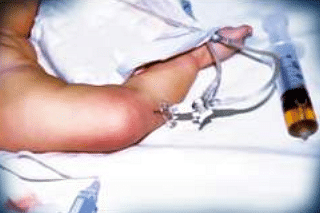
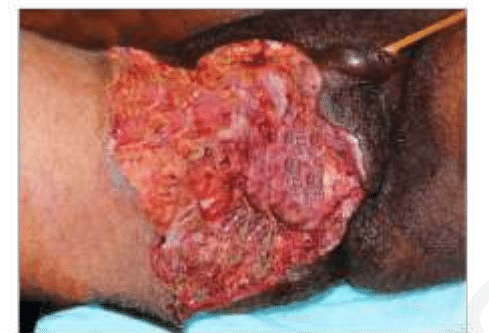
- A diabetic patient presents with sudden-onset perineal pain. On examination, foul-smelling discharge, and necrotic tissue as seen in the image is noted. Which of the following is true about the given condition?
- Which of the following is the most common complication following ligation of the first vessel during abdominoperineal resection for rectal carcinoma?(APR Abdominoperineal resection)
- A patient presents to the clinic with the lesion given in the image. He had a traumatic injury to the chest one year ago. What is the most likely diagnosis?
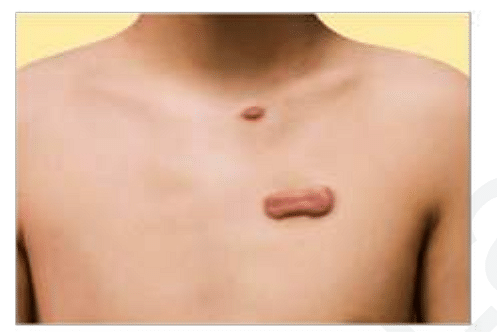
View More Questions
Top NEET PG Breast carcinoma management Questions
- Which of the following is true about the treatment of early breast carcinoma?
- Which is NOT correct?
- What is the appropriate management of a carcinoma of the lateral border of the tongue after primary resection?
- Carcinoma of the breast is least commonly seen in which quadrant?
- A young sewage worker is brought to hospital with a history of exhaustion, abdominal pain, vomiting, fever and shock. His heart rate is 120/min, respiratory rate is 30/min and blood pressure is 100/70 mmHg. His clinical features are suggestive of peritonitis. What is the next step of management?
View More Questions
Top NEET PG Questions
- A patient hailing from Delhi presents with fever, arthralgia, and extensive petechial rash for 3 days. Lab investigations revealed a hemoglobin of 9 g/ dL, a white blood cell count of 9000 cells/mm3, a platelet count of 20000 cells/mm3, and a prolonged bleeding time. The clotting time was normal. What is the most likely diagnosis?
- Which of the following statements is true about Trichomonas vaginalis?
- A lady from West Rajasthan presented with an ulcer surrounded by erythema on the right leg. Microscopy of the biopsy from the edge of the ulcer showed organisms with dark staining nuclei and kinetoplast. What is the most likely causative agent?
- A child presents with a fever and a rash. Urine examination showed cells with owl's eye appearance. What is the most likely diagnosis?
- Infection with Clonorchis sinensis is associated with an increased risk of__?
View More Questions