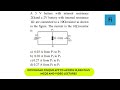
A 5V battery with internal resistance 2Ω and a 2V battery with internal resistance 1Ω are connected to a 10Ω resistor as shown in the figure. The current in the 10Ω resistor is
Explanation: The current flow in the circuit is shown below:Let I will be the current in 10Ω resistor and I1, I2 be the currents in loops ABP2P1A and P2CDP1P2, respectivelyApplying Kirchoff's first law at junction P2,I1 + I2 = IApplying Kirchoff's second law for loop ABP2P1A:10(I1 + I2) + 2I1 - 5 = 0⇒ 12I1 + 10I2 = 5...... (i)Again, applying Kirchoff's second law for loop DCP2P1D:10(I1 + I2) +1I2 - 2 = 0⇒ 10I1 + 11I2 = 2 ...... (ii)Solving equations (i) and (ii), we getI1 = 1.09AI2 = -0.81AThus, the total current in 10Ω resistor isI = I1 + I2 ≃ 0.27A from P2 to P1Hence, the correct option is (A).
Was this answer helpful?
0
0
Show Solution
Verified By Collegedunia
Approach Solution -2
Kirchhoff’s Law
Kirchhoff's law for circuit analysis characterizes how current flows and voltage vary throughout a circuit loop. Kirchhoff's law help in the simplification of circuits containing multiple resistance networks by combining series and parallel resistors. Kirchhoff developed two separate laws for each circuit: Kirchhoff's current law and Kirchhoff's voltage law.
Kirchhoff’s Current Law
It states that the sum of all the currents entering any point in a circuit must be equal to the sum of all the currents leaving that point i.e. the algebraic sum of all the currents meeting at a point in a closed circuit is zero.
I=0
This law is also known as the Junction law.
Kirchhoff’s Voltage Law
It states that the algebraic sum of all voltages i.e. the potential difference across all elements and Emfs of all sources in any closed circuit is zero.