Question:
A 50 year old female is admitted with abdominal pain and anuria. Radiological studies revealed bilateral impacted ureteric stones with hydronephrosis. Urine analysis showed RBCs with pus cells in urine. Serum creatinine level was 16 mg/dl and urea level was 200 mmol/l. Which of the following should be the immediate treatment?
A 50 year old female is admitted with abdominal pain and anuria. Radiological studies revealed bilateral impacted ureteric stones with hydronephrosis. Urine analysis showed RBCs with pus cells in urine. Serum creatinine level was 16 mg/dl and urea level was 200 mmol/l. Which of the following should be the immediate treatment?
Show Hint
In obstructed plus infected kidneys, drain first and remove the stone later.
Updated On: Jun 24, 2026
- Hemodialysis
- 'J' stent drainage
- Lithotripsy
- Ureteroscopic removal of stones
Show Solution

Verified By Collegedunia
The Correct Option is B
Solution and Explanation
Step 1: Frame the emergency. The patient has bilateral impacted ureteric stones causing complete obstruction. Anuria with a serum creatinine of \(16\) mg/dl indicates obstructive (post-renal) acute kidney injury. The pus cells suggest associated infection sitting behind an obstructed system, which is a urological emergency.
Step 2: Decide the priority. In obstructive AKI the kidney cannot recover until the obstruction is relieved and the urine drains. Therefore the immediate goal is urgent decompression of the collecting system, not definitive stone removal.
Step 3: Choose the drainage method. A double 'J' stent (or alternatively percutaneous nephrostomy) bypasses the impacted stone, restores urine flow, drains infected urine, and lets the obstructed kidneys recover. It is quick and can be done even in a sick, septic patient.
Step 4: Reject the distractors. Lithotripsy (ESWL) and ureteroscopic stone removal are definitive treatments that should not be done in the acute setting on an obstructed, infected, uraemic patient, because manipulating an infected obstructed system risks pushing infection into the circulation. Hemodialysis corrects the biochemistry but does nothing for the mechanical obstruction; it is added only if life-threatening uraemia, hyperkalaemia or fluid overload persists, and even then drainage is still needed.
Answer: 'J' stent drainage (Option B).
Step 2: Decide the priority. In obstructive AKI the kidney cannot recover until the obstruction is relieved and the urine drains. Therefore the immediate goal is urgent decompression of the collecting system, not definitive stone removal.
Step 3: Choose the drainage method. A double 'J' stent (or alternatively percutaneous nephrostomy) bypasses the impacted stone, restores urine flow, drains infected urine, and lets the obstructed kidneys recover. It is quick and can be done even in a sick, septic patient.
Step 4: Reject the distractors. Lithotripsy (ESWL) and ureteroscopic stone removal are definitive treatments that should not be done in the acute setting on an obstructed, infected, uraemic patient, because manipulating an infected obstructed system risks pushing infection into the circulation. Hemodialysis corrects the biochemistry but does nothing for the mechanical obstruction; it is added only if life-threatening uraemia, hyperkalaemia or fluid overload persists, and even then drainage is still needed.
Answer: 'J' stent drainage (Option B).
Was this answer helpful?
0
0
Top NEET PG Surgery Questions
- A 55-year-old male presented with verrucous carcinoma around the glans of the penis. Examination reveals that the inguinal lymph nodes are not enlarged. What is the appropriate management for this patient?
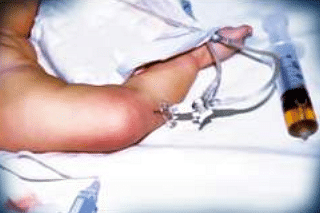
- Identify the procedure being performed in the image given below.
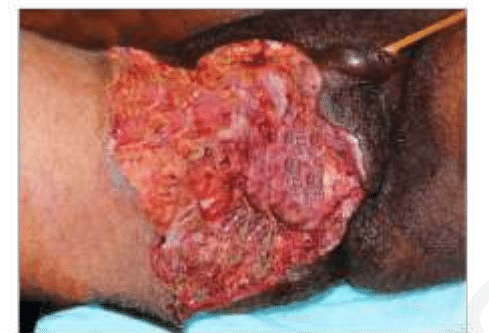
- A diabetic patient presents with sudden-onset perineal pain. On examination, foul-smelling discharge, and necrotic tissue as seen in the image is noted. Which of the following is true about the given condition?
- Which of the following is the most common complication following ligation of the first vessel during abdominoperineal resection for rectal carcinoma?(APR Abdominoperineal resection)
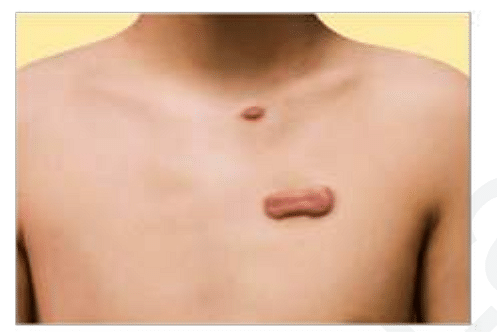
- A patient presents to the clinic with the lesion given in the image. He had a traumatic injury to the chest one year ago. What is the most likely diagnosis?
View More Questions
Top NEET PG Breast carcinoma management Questions
- Which of the following is true about the treatment of early breast carcinoma?
- Which is NOT correct?
- What is the appropriate management of a carcinoma of the lateral border of the tongue after primary resection?
- Carcinoma of the breast is least commonly seen in which quadrant?
- A young sewage worker is brought to hospital with a history of exhaustion, abdominal pain, vomiting, fever and shock. His heart rate is 120/min, respiratory rate is 30/min and blood pressure is 100/70 mmHg. His clinical features are suggestive of peritonitis. What is the next step of management?
View More Questions
Top NEET PG Questions
- A patient hailing from Delhi presents with fever, arthralgia, and extensive petechial rash for 3 days. Lab investigations revealed a hemoglobin of 9 g/ dL, a white blood cell count of 9000 cells/mm3, a platelet count of 20000 cells/mm3, and a prolonged bleeding time. The clotting time was normal. What is the most likely diagnosis?
- Which of the following statements is true about Trichomonas vaginalis?
- A lady from West Rajasthan presented with an ulcer surrounded by erythema on the right leg. Microscopy of the biopsy from the edge of the ulcer showed organisms with dark staining nuclei and kinetoplast. What is the most likely causative agent?
- A child presents with a fever and a rash. Urine examination showed cells with owl's eye appearance. What is the most likely diagnosis?
- Infection with Clonorchis sinensis is associated with an increased risk of__?
View More Questions