2sin(\(\frac{\pi}{22}\))sin(\(\frac{3\pi}{22}\))sin(\(\frac{5\pi}{22}\))sin(\(\frac{7\pi}{22}\))sin(\(\frac{9\pi}{22}\)) is equal to
2sin(\(\frac{\pi}{22}\))sin(\(\frac{3\pi}{22}\))sin(\(\frac{5\pi}{22}\))sin(\(\frac{7\pi}{22}\))sin(\(\frac{9\pi}{22}\)) is equal to
\(\frac{3}{16}\)
\(\frac{1}{16}\)
\(\frac{1}{32}\)
\(\frac{9}{32}\)

The Correct Option is B
Approach Solution - 1
To solve the problem, we need to evaluate the expression:
\(2 \cdot \sin\left(\frac{\pi}{22}\right)\sin\left(\frac{3\pi}{22}\right)\sin\left(\frac{5\pi}{22}\right)\sin\left(\frac{7\pi}{22}\right)\sin\left(\frac{9\pi}{22}\right)\).
This expression is a classic problem involving the product of sine terms that can be solved using trigonometric identities and symmetry properties of the sine function.
We can use a trigonometric identity known as the multiple angle identity for sine, which states:
\(\prod_{k=1}^{n} \sin\left(\frac{k\pi}{2n+1}\right) = \frac{1}{2^n}\), for \(n = 5\).
Applying this identity to our problem, the product of sine terms:
\(\sin\left(\frac{\pi}{22}\right)\sin\left(\frac{3\pi}{22}\right)\sin\left(\frac{5\pi}{22}\right)\sin\left(\frac{7\pi}{22}\right)\sin\left(\frac{9\pi}{22}\right)\)
results in:
\(\frac{1}{2^5}\) which simplifies to \(\frac{1}{32}\).
Since the expression is multiplied by 2, we have:
\(2 \times \frac{1}{32} = \frac{1}{16}\).
Hence, the evaluated expression is \(\frac{1}{16}\).
Therefore, the correct answer is \(\frac{1}{16}\), which matches option B.
Approach Solution -2
\[ 2 \sin \left( \frac{\pi}{22} \right) \sin \left( \frac{3\pi}{22} \right) \sin \left( \frac{5\pi}{22} \right) \sin \left( \frac{7\pi}{22} \right) \sin \left( \frac{9\pi}{22} \right) \]
Using the symmetry of angles: \[ = 2 \sin \left( \frac{11\pi - 10\pi}{22} \right) \sin \left( \frac{11\pi - 8\pi}{22} \right) \sin \left( \frac{11\pi - 6\pi}{22} \right) \sin \left( \frac{11\pi - 4\pi}{22} \right) \sin \left( \frac{11\pi - 2\pi}{22} \right) \]
Simplifying: \[ = 2 \cdot \frac{\cos \pi}{11} \cdot \frac{2\cos \pi}{11} \cdot \frac{\cos 3\pi}{11} \cdot \frac{\cos 4\pi}{11} \cdot \frac{\cos 5\pi}{11} \]
\[ = \frac{2 \sin \left( \frac{32\pi}{11} \right)}{2^5 \sin \left( \frac{\pi}{11} \right)} \]
Finally: \[ = \frac{1}{16} \]
Top JEE Main Mathematics Questions
- The value of is
- The number of terms of an is even. The sum of the odd terms is and of the even terms is . The last term exceeds the first by . Then the number of terms in the series is ______.
- If , then the general value of is:
- The general solution of
- If the constant term in the binomial expansion of $\left(\frac{x^{\frac{3}{2}}}{2}-\frac{4}{x^l}\right)^9$ is $-84$ and the coefficient of $x^{-3 l}$ is $2^\alpha \beta$, where $\beta<0$ is an odd number, then $|\alpha l-\beta|$ is equal to_____
Top JEE Main Integration by Partial Fractions Questions
- The value of \(\frac {120}{\pi^3}|∫_0^\pi\frac {x^2sinx.cosx}{(sinx)^4+(cosx)^4}dx|\) is
- The integral $$ \int \frac{x^8 - x^2}{(x^{12} + 3x^6 + 1) \tan^{-1}\left( \frac{x^3 + 1}{x^3} \right)} \, dx $$ is equal to:
- Let {an}n=0∞ be a sequence such that a0=a1=0 and an+2=3an+1−2an+1,∀ n≥0. Then a25a23−2a25a22−2a23a24+4a22a24 is equal to
- Let for \( f(x) = 7\tan^8 x + 7\tan^6 x - 3\tan^4 x - 3\tan^2 x \), \( I_1 = \int_0^{\frac{\pi}{4}} f(x)dx \) and \( I_2 = \int_0^{\frac{\pi}{4}} x f(x)dx \). Then \( 7I_1 + 12I_2 \) is equal to:
If \[ \int (\sin x)^{-\frac{11}{2}} (\cos x)^{-\frac{5}{2}} \, dx \] is equal to \[ -\frac{p_1}{q_1}(\cot x)^{\frac{9}{2}} -\frac{p_2}{q_2}(\cot x)^{\frac{5}{2}} -\frac{p_3}{q_3}(\cot x)^{\frac{1}{2}} +\frac{p_4}{q_4}(\cot x)^{-\frac{3}{2}} + C, \] where \( p_i, q_i \) are positive integers with \( \gcd(p_i,q_i)=1 \) for \( i=1,2,3,4 \), then the value of \[ \frac{15\,p_1 p_2 p_3 p_4}{q_1 q_2 q_3 q_4} \] is ___________.
Top JEE Main Questions
- Two masses $m$ and $\frac{m}{2}$ are connected at the two ends of a massless rigid rod of length $l$. The rod is suspended by a thin wire of torsional constant $k$ at the centre of mass of the rod-mass system(see figure). Because of torsional constant $k$, the restoring torque is $\tau =k\theta$ for angular displacement $\theta$. If the rod is rota ted by $\theta_0$ and released, the tension in it when it passes through its mean position will be:
What will be the equilibrium constant of the given reaction carried out in a \(5 \,L\) vessel and having equilibrium amounts of \(A_2\) and \(A\) as \(0.5\) mole and \(2 \times 10^{-6}\) mole respectively?
The reaction : \(A_2 \rightleftharpoons 2A\)- The value of is
- The number of terms of an is even. The sum of the odd terms is and of the even terms is . The last term exceeds the first by . Then the number of terms in the series is ______.
A black body is at a temperature of 2880 K. The energy of radiation emitted by this body with wavelength between 499 nm and 500 nm is U1, between 999 nm and 1000 nm is U2 and between 1499 nm and 1500 nm is U3. The Wien's constant, b = 2.88×10⁶ nm-K. Then,
Concepts Used:
Types of Differential Equations
There are various types of Differential Equation, such as:
Ordinary Differential Equations:
Ordinary Differential Equations is an equation that indicates the relation of having one independent variable x, and one dependent variable y, along with some of its other derivatives.
\(F(\frac{dy}{dt},y,t) = 0\)
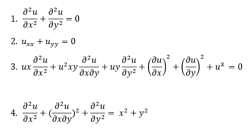
Partial Differential Equations:
A partial differential equation is a type, in which the equation carries many unknown variables with their partial derivatives.
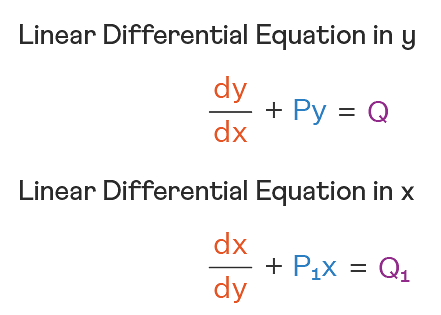
Linear Differential Equations:
It is the linear polynomial equation in which derivatives of different variables exist. Linear Partial Differential Equation derivatives are partial and function is dependent on the variable.
Homogeneous Differential Equations:
When the degree of f(x,y) and g(x,y) is the same, it is known to be a homogeneous differential equation.
\(\frac{dy}{dx} = \frac{a_1x + b_1y + c_1}{a_2x + b_2y + c_2}\)
Read More: Differential Equations